
Boeing Logo History: Meaning, Symbolism & Brand Heritage

The visual identity of Boeing stands as one of the most influential in industrial design history. As a company that helped define modern aviation and space exploration, Boeing’s logo history mirrors a century-long evolution from handcrafted illustration to global corporate symbolism. Few aerospace brands have managed to translate speed, scale, and technological authority into such a restrained and enduring visual language.
Within logo history of aerospace and defense, Boeing occupies a position comparable to Lockheed Martin logo heritage and Airbus logo meaning, where identity must communicate trust, precision, and global reach rather than emotion or trend. As part of the broader industrial logo heritage, Boeing’s emblem demonstrates how abstraction can outperform illustration at planetary scale.
Meaning and History: The Origin of the Boeing Identity
Boeing was founded in 1916 by William Boeing, initially operating as Pacific Aero Products Co. From the outset, the company’s purpose was inseparable from flight itself, and this focus shaped its early logo meaning. In the first decades, Boeing’s visual identity leaned heavily on literal aviation symbolism, reflecting an era when flight was still novel and awe-inspiring.
As Boeing expanded into military aircraft, commercial aviation, and eventually space systems, its branding priorities shifted. The logo needed to represent not a single product, but an entire ecosystem of innovation. Over time, Boeing moved away from decorative imagery toward abstraction, reinforcing its role as a global engineering authority rather than a romantic aviation pioneer.
Logo Symbolism: Speed, Orbit, and Global Reach
The symbolism of the Boeing logo evolved alongside aviation technology. Early designs relied on birds and wings to express flight and freedom. Later iterations replaced these literal forms with geometry and motion cues, aligning with the rise of jet aviation and space exploration.
The modern Boeing emblem combines three symbolic ideas. The circular ring represents the globe, underscoring the company’s worldwide presence. The sweeping arc suggests an orbital path, referencing both aviation trajectories and spaceflight. The angular mark embedded within the symbol is widely interpreted as a stylized aircraft, reinforcing Boeing’s core specialization.
Color symbolism is equally deliberate. Blue dominates the Boeing identity, standing for sky, reliability, safety, and technological confidence. Gray complements it with neutrality and industrial precision.
Boeing Logo History Timeline
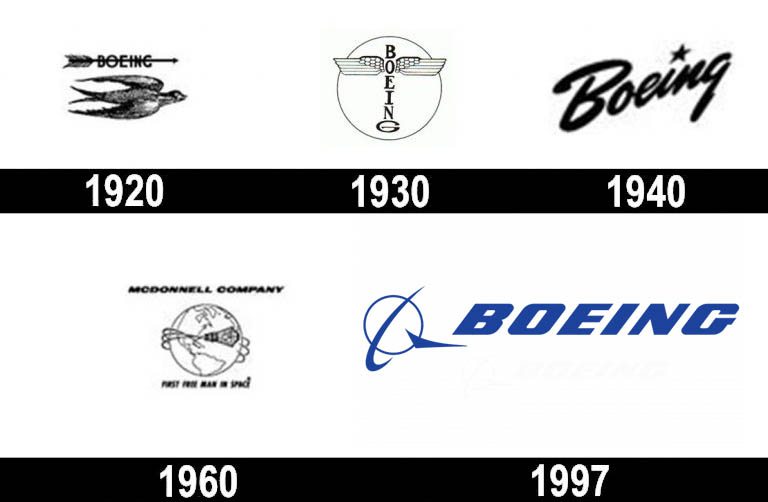
1920–1930: Illustrative Flight and Early Aviation Identity
Boeing’s earliest logos from the 1920s reflected the experimental spirit of early aviation. Multiple badges coexisted, including a detailed bird in flight beneath an arrow bearing the company name, symbolizing speed and freedom. Other variants featured stylized wings arranged symmetrically, echoing luxury automotive emblems of the era and emphasizing craftsmanship and prestige.
These early marks were expressive and decorative, suited to a time when aviation itself was the brand’s strongest message.
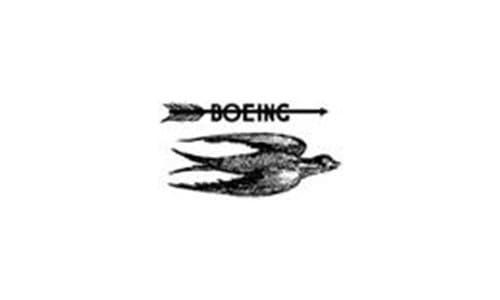
1930–1940: Art Deco Totem and Industrial Confidence
By the late 1930s, Boeing adopted a more structured identity. A vertical totem-like composition featured elongated wings above a stacked wordmark, with an extended letterform acting as a pedestal. This design reflected Art Deco influences, emphasizing symmetry, strength, and upward motion.
The logo conveyed industrial authority and modernity, aligning with Boeing’s growing role in large-scale aircraft manufacturing.
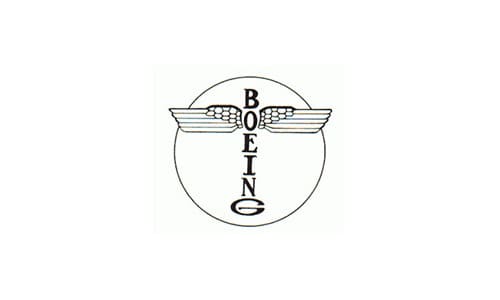
1940–1960: Script Modernism and Wartime Transition
In 1940, Boeing introduced a dramatically different logo. The wordmark was rendered in a flowing script, angled diagonally to suggest motion and progress. A star replaced the dot above the “I,” subtly referencing navigation and aspiration.
This identity accompanied Boeing through wartime production and postwar expansion, balancing elegance with technological confidence during a transformative period in aerospace history.
1960–1997: Bold Sans-Serif and Jet Age Authority
The 1960 redesign marked Boeing’s transition into a modern corporate identity. The company adopted a bold, uppercase sans-serif logotype with a slight italic slant. The typography was strong, masculine, and engineered, reflecting the jet age and Boeing’s leadership in commercial aviation.
This wordmark became synonymous with aircraft design itself, frequently paired with aircraft model numbers such as the Boeing 747. Its longevity underscored the effectiveness of typographic restraint in industrial branding.

1997–Present: Orbital Emblem and Global Aerospace Brand
In 1997, following Boeing’s merger with McDonnell Douglas, the logo was refined to incorporate a new emblem. Designed by Rick Eiber, the symbol combined a circular ring, an orbital arc, and a sharp geometric form into a compact, abstract mark.
The updated identity unified aviation and space exploration under a single visual system. The emblem, paired with the existing italicized wordmark, positioned Boeing as a global aerospace corporation rather than solely an aircraft manufacturer.
Boeing Logo Heritage in the Industrial Context
Boeing’s logo heritage is distinguished by its disciplined evolution. While many industrial brands underwent frequent stylistic overhauls, Boeing refined its identity incrementally, preserving continuity and trust.
Compared with identities discussed in Northrop Grumman logo symbolism or General Electric logo history, Boeing stands out for successfully merging abstraction with narrative meaning. Its logo does not depict products directly, yet it unmistakably communicates flight, orbit, and technological ambition.
Boeing Logo as a Symbol of Aerospace Authority
The Boeing logo history is a study in how visual identity matures alongside technological leadership. From illustrated birds to abstract orbital geometry, Boeing’s branding reflects a shift from fascination with flight to mastery of the skies and beyond. Within logo history and broader logo heritage analysis, Boeing remains a benchmark for how industrial design can convey scale, reliability, and future vision through minimal form.
FAQ: Boeing Logo Meaning and History
What does the Boeing logo represent?
It represents global reach, flight, and space exploration through abstract orbital symbolism.
When was the current Boeing logo introduced?
The current emblem was introduced in 1997.
Who designed the modern Boeing symbol?
The symbol was designed by American graphic designer Rick Eiber.
Why is blue the primary color of the Boeing logo?
Blue symbolizes sky, safety, trust, and technological reliability.