
BMW Logo History: Evolution, Meaning & Symbolism

Few automotive emblems are as instantly recognizable as the BMW logo — a circular badge that has represented precision engineering, speed, and Bavarian heritage for more than a century. While BMW is now synonymous with premium automobiles, its story began far from modern highways. The company emerged in 1916 as an aircraft engine manufacturer, and within a year, the first version of the BMW emblem appeared: a roundel that blended industrial strength with regional identity. For decades, this logo has sparked debate, mythmaking, and fascination among designers and enthusiasts alike.
BMW’s earliest decades shaped how the brand is perceived today. Its transition from aircraft engines to motorcycles and eventually luxury automobiles was accompanied by ongoing refinements to its visual identity. Over time, the emblem evolved from a thickly framed industrial badge to the minimalist, digital-first design used today — all while preserving the signature blue-and-white quarters inspired by Bavaria.
As the brand expanded, BMW embraced innovation both mechanically and visually. From Paul Bracq’s sporty sedan designs in the 1970s, to the birth of BMW M performance, to today’s push toward electrification, each chapter in the company’s evolution has reinforced the logo’s role as a symbol of precision and progress. The 2020 redesign, focused on transparency and digital clarity, marked one of the most modern shifts in BMW’s visual philosophy, signaling a new era while respecting the company’s roots.
Early Influences and the Bavarian Connection
The BMW emblem’s core design — a circle divided into blue and white quadrants — has long been mistaken for a spinning aircraft propeller. The myth gained traction after a 1929 advertising image depicted a propeller overlay behind the roundel. Though visually striking, historians have since clarified that the logo was never meant to represent a propeller. Instead, it draws directly from the Bavarian flag, whose blue-and-white pattern represents the region where BMW was born.
Still, the aviation association remains understandable. BMW’s engineering origins were deeply tied to aircraft engines, which powered the company’s reputation in the early 20th century. The mix of industrial power and regional symbolism made the BMW roundel a timeless brand signature — one that would evolve but never disappear from BMW’s identity.
It was during these early years that BMW introduced the Dixi, the company’s first car. Compact, fast, and innovative for its time, the Dixi hinted at BMW’s automotive future and helped carry the emblem onto road-going vehicles.
BMW Rings Logo History Meaning
The circular design of the BMW logo is often described as “rings,” although it represents a single emblem rather than multiple circles. Its origin dates back to 1917 and was inherited from BMW’s predecessor, Rapp Motorenwerke, which also used a round badge. The blue and white quarters reference Bavaria, BMW’s region of origin, not a spinning airplane propeller as commonly believed. Over time, the BMW rings became a symbol of engineering precision, continuity, and German industrial heritage rather than a literal visual metaphor.
Logo Evolution Through the Years
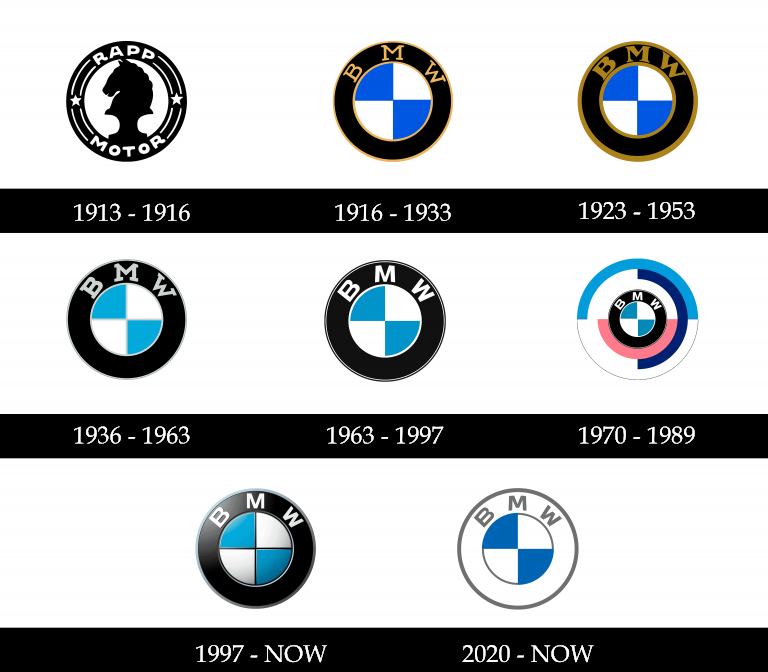
1913–1916: The Rapp Motorenwerke Emblem
Before BMW existed as a manufacturer, Rapp Motorenwerke — one of its predecessors — used a circular black medallion featuring a stylized horse. With a bold outer frame and precise typography, this emblem established the circular format that BMW would soon adopt.
1916–1933: The First Official BMW Roundel
BMW’s first true logo featured the now-iconic blue-and-white quarters and a thick black ring with gold outlines. The lettering was elegant and serifed, reflecting both industrial precision and Bavarian pride.
1923–1953: A Stronger, More Refined Badge
The contours became bolder, the gold accents richer, and the typeface sleeker. This period marked BMW’s shift toward a signature look that balanced engineering strength with upscale aesthetics.
1936–1963: The Silver Era
Gold was replaced with silver, giving the logo a modern, cooler tone. The blue and white quadrants brightened, and the lettering adopted a sharp serif typeface, emphasizing power and technical excellence.
1963–1997: A Clean, Modern Identity
BMW stripped away metallic effects and refined the badge into a crisp, flat design. The white sans-serif letters became iconic during this era, appearing on the grilles of many legendary BMW models.
1970: A Colorful Promotional Variant
For marketing use, BMW temporarily explored a more vibrant badge surrounded by bands of pink, blue, and white. This design never became official but highlighted BMW’s experimentation during an energetic period for the brand.
1997–2020: The 3D Gloss Era
Reflecting trends in digital rendering and automotive styling, BMW introduced a glossy, three-dimensional roundel with metallic shading. This emblem became one of the most recognizable car badges worldwide.
2020–Today: Minimal, Transparent, Digital-Ready
BMW’s latest redesign is a return to minimalism. The solid black ring was removed, replaced by a transparent outline intended for digital interfaces and modern branding. The internal blue-and-white quadrants remain, connecting the present to more than a century of visual heritage.
Symbolism Behind the BMW Logo
The BMW roundel symbolizes more than mechanical precision — it represents evolution, technological ambition, and a deep connection to Bavaria. The emblem’s geometric symmetry communicates clarity and engineering discipline, while the colors connect it to its Munich roots. The persistent “propeller myth” highlights how powerfully the emblem has shaped public imagination, even when the interpretation differs from the original intent.
For BMW fans, the roundel has become a badge of performance and craftsmanship — an instantly recognizable marker of the brand’s engineering legacy.
BMW Emblem Design Characteristics
The emblem’s circular shape and quartered pattern have remained unchanged for over a century. This consistency has allowed BMW to modernize without losing identity. Whether rendered in metallic 3D, a flat digital design, or a monochrome variation for motorsport applications, the roundel continues to represent innovation, confidence, and timeless design language.
Font Used in the BMW Logo
BMW’s typography has evolved significantly across the decades. Early versions used serif fonts with gold or silver finishes, reflecting traditional craftsmanship. Over time, the branding shifted to clean, modern sans-serif lettering that emphasized clarity and engineering purity.
Modern BMW wordmarks use a slightly extended geometric sans-serif typeface, designed for readability across digital interfaces. The font feels intentional: minimalistic, premium, and engineered — much like the vehicles themselves.
BMW Logo Colors
The emblem’s palette — blue, white, and black (later gray/transparent) — carries deep symbolic meaning.
Blue & White:
Directly reference the Bavarian flag, grounding the logo in regional heritage.
Black / Transparent Outer Ring:
Initially added visual weight and contrast, later removed for a more modern, digital-first look.
Silver & Gold (Historical):
Used during different periods to reflect the design aesthetics of the time.
These colors have evolved in saturation and tone, but the core identity remains unmistakable.
FAQ — BMW Logo
Why does the BMW logo have blue and white colors?
Because it reflects the colors of Bavaria, the German region where BMW was founded.
Is the BMW logo really a propeller?
No. The propeller interpretation comes from a 1929 advertisement, but the original design was never meant to represent one.
When did BMW last update its logo?
In 2020, when BMW introduced a minimalist, transparent version optimized for digital platforms.
Why did BMW remove the black ring?
To create a lighter, more modern look better suited for digital displays and branding.
What does the BMW round shape symbolize?
It traces back to the circular emblems commonly used in early German manufacturing and aviation badges.