BBC Logo History: Meaning, Symbolism & Brand Heritage
Few emblems in modern media have achieved the cultural imprint, visual authority, and near-instant recognizability of the BBC logo. For more than a century, the British Broadcasting Corporation has shaped public discourse, pioneered new forms of storytelling, and defined journalism standards across continents. The BBC’s visual identity — restrained, architectural, and unmistakably British — reflects that legacy with unwavering consistency.
Since its establishment in 1922, the BBC has grown from a small radio service into one of the world’s most influential broadcasters. Its imprint extends across television, radio, digital platforms, global news networks, and educational services that reach hundreds of millions of viewers and listeners each week. At the center of that global presence stands a deceptively simple visual signature: three letters, arranged in a grid, distilled into an enduring symbol of trust, editorial independence, and clarity.
The evolution of the BBC logo mirrors the evolution of modern broadcasting itself — from early typographic interpretations to the refined, modular system used today. Each redesign reveals a shift in technological landscape, production design, and brand philosophy, while maintaining the disciplined aesthetic that has come to define the BBC’s public image.
Logo History and Evolution Timeline
1958–1963: The Foundational Grid
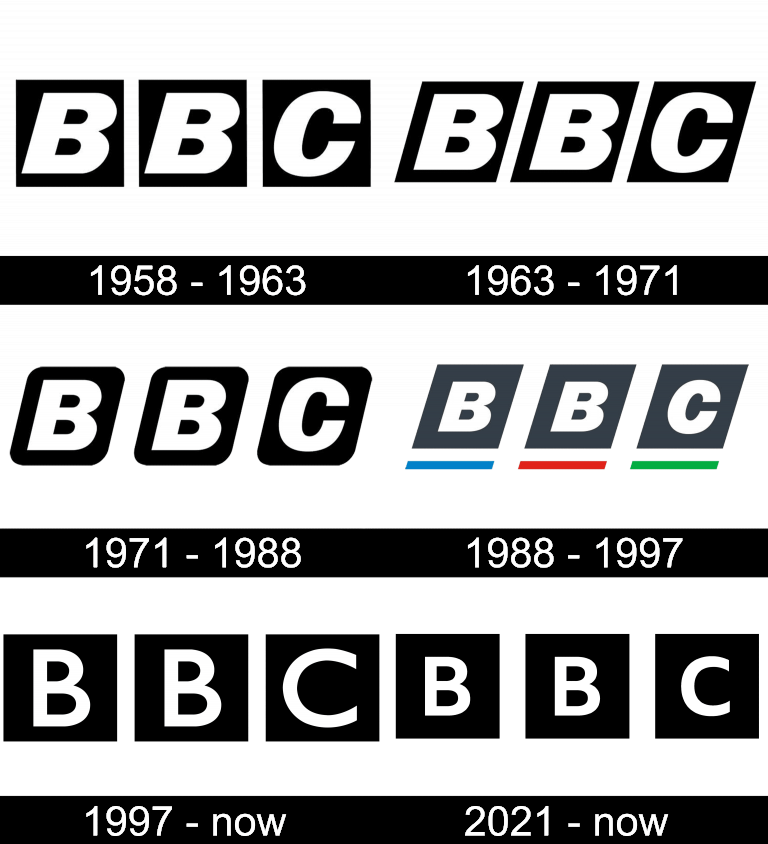
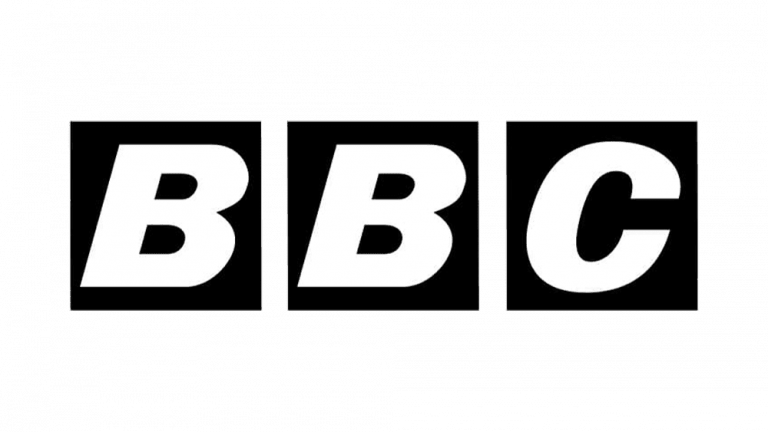
The BBC’s first widely recognized corporate logo emerged in 1958, establishing the geometric logic that would guide the company’s visual identity for decades. It featured three bold black squares aligned horizontally, each containing a crisp white letter. This early design set the tone for the BBC’s visual philosophy: minimalism, balance, and typographic clarity. Though austere, it conveyed authority and modernity at a time when television was transforming into a mass medium.
1963–1971: The Slanted Era
The 1963 update introduced subtle kinetic energy into the logotype. Each square was transformed into a parallelogram that leaned forward as if in motion, creating an italicized rhythm across the wordmark. The letters themselves matched the slant, reinforcing the sense of forward-thinking technological progress. While character sizes and color values remained unchanged, the shift added a distinctive dynamism suited to the BBC’s growing global impact.
1971–1988: Softer Geometry
The next major redesign softened the visual tone. The sharp parallelograms returned to upright squares, now with rounded corners that brought warmth and approachability to the corporate identity. The letters were subtly refined, appearing slightly narrower and more polished. This iteration accompanied an era of expanding television services and reflected a shift toward accessible, public-facing communication.
1988–1997: Introducing Color and Structure
In 1988, the BBC introduced the most radical departure in its logo history — the first to incorporate color. The black squares became dark grey, each underscored by a vibrant stripe: blue, red, and green. These colors were not decorative; they represented the broadcast RGB spectrum, connecting the BBC’s identity to technological precision and a new era of modern broadcast engineering. The typography grew sharper and more architectural, marking a departure from earlier rounded aesthetics.
1997–Present: The Lambie-Nairn Standard
Design studio Lambie-Nairn introduced the contemporary BBC logo in 1997 — a timeless distillation of the broadcaster’s visual DNA. The colored stripes were removed in favor of a return to stark black squares and pristine white lettering. The typography, set in Gill Sans, embodied British design heritage with its balanced geometry and humanist proportions.
In 2021, the BBC refined this design further by reducing letter size within the squares and adjusting their relative spacing, bringing the identity into perfect alignment with the BBC’s digital-first visual ecosystem.
Meaning and Symbolism
The BBC logo is built on the principle that the most powerful ideas are often expressed through visual restraint. Its symbolism lies not in imagery but in structure: three modules, three letters, three equal units working in harmony. The grid-like arrangement suggests order, reliability, and impartiality — core values embedded into the BBC’s founding mission.
The stark contrast of black and white underscores the broadcaster’s commitment to clarity and neutrality. Over time, while global media adopted increasingly expressive brand identities, the BBC remained committed to an aesthetic vocabulary that reflected editorial integrity rather than corporate flair.
The logo’s evolution reveals a balancing act between technological progress and brand continuity. From the colored RGB stripes of the 1988 version to the crisp modern standard of the 1990s and 2020s, each iteration affirms the BBC’s role as both a guardian of tradition and a pioneer of innovation.
Typography: A British Design Legacy
Typography has always been central to the BBC’s identity. The current logo employs a refined version of Gill Sans, one of the most influential typefaces in British design history. Created by Eric Gill in the 1920s, Gill Sans has long been associated with modernist clarity and civic communication. Its use in the BBC logo underscores the corporation’s role as an institution of public service.
Earlier logos experimented with heavier grotesques, slanted sans-serifs, and minimalist monolinear forms. Yet the core idea remained constant: typography should communicate the BBC’s authority without ornamentation.
In digital applications, the BBC later introduced BBC Reith, a proprietary typeface named after its founding director-general John Reith. While not used in the logo itself, Reith shapes the BBC’s digital and editorial environment and aligns perfectly with the brand’s typographic philosophy.
Color Palette: Timeless Monochrome
The BBC’s use of black and white is not a stylistic decision but a strategic one. The contrast embodies clarity, simplicity, and impartiality — principles that define the broadcaster’s identity.
Over the years, experimental additions like the RGB stripes of 1988 introduced technological meaning, but the return to monochrome in 1997 re-established the austere elegance that made the BBC logo timeless.
Black conveys authority, discipline, and gravitas; white conveys openness and transparency. Together, they create a visual equilibrium that perfectly mirrors the BBC’s editorial ethos.
BBC Logo: A Blueprint of Broadcast Identity
Across more than six decades, the BBC logo has become one of the most stable and enduring symbols in global media. Its power rests in disciplined refinement rather than dramatic reinvention. Every iteration reflects a meticulous understanding of how a public institution should present itself: with clarity, restraint, and cultural authority.
The BBC logo is not merely a graphic device — it is an emblem of trust, a cue for reliability, and a visual anchor in a rapidly shifting media landscape. Its endurance is a testament to the broadcaster’s commitment to timeless design and to the foundational belief that form should follow purpose.
FAQ — BBC Logo & Brand Identity
Why is the BBC logo so iconic?
Because its design is built on clarity, balance, and consistency. Its restrained aesthetic communicates trust, authority, and editorial neutrality.
Who designed the modern BBC logo?
The 1997 redesign was created by the design consultancy Lambie-Nairn, establishing the foundation still used today.
Has the BBC logo always used black and white?
Black and white have been the dominant colors, although a colorful version featuring blue, red, and green stripes was used from 1988 to 1997.
What font does the BBC use today?
The logo uses Gill Sans; the broader brand ecosystem employs the custom typeface BBC Reith.
Why did the BBC redesign its logo in 2021?
To optimize the identity for digital platforms by refining proportions and spacing while maintaining the historic grid-based structure.