
Balenciaga Logo History: Meaning, Symbolism & Brand Heritage

Balenciaga is one of those rare fashion houses whose identity feels simultaneously historic and futuristic, classical yet disruptive. Founded in 1917 by the Spanish couturier Cristóbal Balenciaga and formally established in Paris in 1937, the brand is considered one of the most influential pillars of haute couture — admired by Christian Dior, revered by Coco Chanel and studied by generations of designers for its architectural silhouettes and uncompromising discipline.
Over the decades, Balenciaga’s visual identity evolved from aristocratic elegance to stark minimalism. Its logo, unlike the brand’s often avant-garde collections, has remained deliberately restrained — a power move in the world of luxury, where understatement often signals confidence. With only a few major redesigns across a century, the Balenciaga logo represents a distillation of purity, modernity and cultural precision, serving as a quiet counterpoint to the brand’s sometimes provocative approach to fashion.
This is the complete heritage story of the Balenciaga logo — its origins, its symbolism, its transformations, and the philosophy behind its famously minimal presence.
The Meaning Behind the Balenciaga Name
The name of the brand is simply the surname of its founder, Cristóbal Balenciaga, a designer whose influence on modern fashion remains unparalleled. Born in the Basque region of Spain, Balenciaga grew up surrounded by craftsmanship, tailoring and artisanal work. His name has become a byword for discipline, innovation and technical mastery.
The brand itself is French by establishment, but its soul carries the rigor and sculptural mentality of Spanish couture. This dual heritage explains the aesthetic tension that has defined the brand for more than a century — at once severe and poetic, simple and radical.
Balenciaga Logo Evolution Timeline
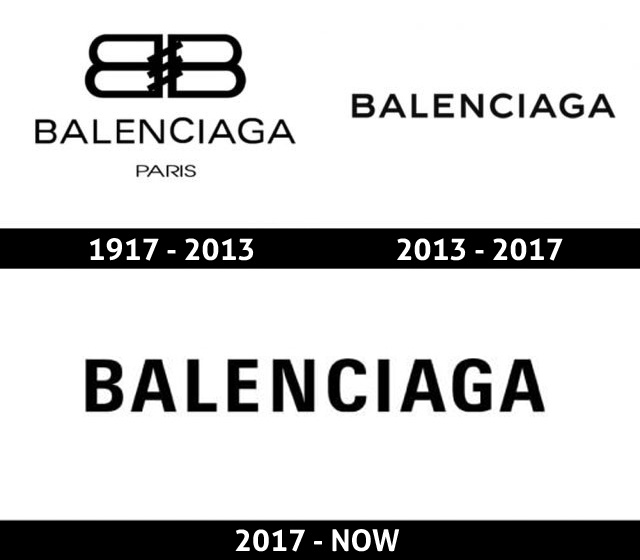
1917–2013: The Twin “B” Monogram
The earliest Balenciaga logo is a masterpiece of early 20th-century elegance. Introduced in 1917, it featured two capital “B” letters placed back-to-back and connected by three diagonal strokes, symbolizing stitching and the artisanal nature of the atelier. The emblem hovered above a clean, capitalized wordmark and was often paired with a discreet “PARIS” tagline.
This design reflected the house’s roots: couture craftsmanship, discipline and architectural purity. It was refined, minimal and balanced — a logo that announced prestige without shouting.
For nearly a century, this monogram remained the brand’s signature, appearing on boutiques, packaging and early accessory prints. It visually embodied Cristóbal Balenciaga’s devotion to structure and precision.
2013–2017: The Modernist Wordmark
In 2013, under the creative direction of Alexander Wang, Balenciaga simplified its official logo dramatically. The “BB” monogram was removed from formal branding, leaving a bold, uppercase wordmark in a compact geometric sans-serif typeface.
The letters were closer together, thicker and more contemporary — a visual shift aligned with the rising dominance of minimalistic luxury branding. Although the monogram disappeared from the primary identity, it continued to appear on certain accessories and archival collections.
2017–Today: Demna’s Radical Minimalism
When Demna Gvasalia stepped into the role of creative director in 2015, he redefined Balenciaga’s place in fashion. His aesthetic — sharp, street-inspired, industrial — demanded a logo that felt utilitarian rather than ornamental.
In 2017, Balenciaga introduced a new wordmark: narrower, taller, heavier, more condensed. It looked almost generic at first glance, but this anonymity was intentional. In a world filled with maximalist logos, Balenciaga leaned into a brutalist, near-standardized typographic identity — one that mirrored contemporary signage, technology branding and urban typography.
The monogram endured, but in new forms: two “B” letters without the connecting lines, or geometric versions arranged from square segments. These alternate marks maintain the brand’s heritage while echoing its continued evolution.
Symbolism and Heritage of the Balenciaga Emblem
Balenciaga’s visual identity is built on the tension between old-world couture heritage and avant-garde experimentation.
The original double-B monogram symbolized precision tailoring, as the connecting diagonals resembled stitching — a nod to craftsmanship. Over time, as the logo grew simpler, its symbolic weight shifted from artisanal detail to conceptual purity. Today’s stark logotype communicates:
Authority: The uppercase composition signals confidence and minimalism.
Universality: The condensed sans-serif resembles contemporary wayfinding typography.
Neutrality: The logo becomes a silent backdrop to bold fashion statements.
Cultural relevance: Its brutal simplicity echoes contemporary graphic trends and Balenciaga’s urban identity.
This stylistic restraint is intentional. Balenciaga’s collections often push boundaries; the logo stays quiet, ensuring the brand’s identity is rooted in timelessness rather than trend.
Typography
The current Balenciaga logotype is executed in a narrow, condensed sans-serif typeface with thick, uniform strokes. The style is reminiscent of fonts like Zurich STD Bold Condensed or Shilia Condensed Heavy but modified for improved balance and vertical tension.
The result is a logo that feels:
-
Mechanical, almost utilitarian
-
Geometric and uniform
-
Highly legible at all scales
-
Culturally aligned with modernist graphic design
Its visual silence is a strategic choice: it allows Balenciaga’s designs — dramatic silhouettes, deconstructed tailoring, and bold streetwear — to take center stage.
Color
Like many luxury houses, Balenciaga uses a monochrome palette for maximum versatility. Black lettering on a white background delivers timeless contrast, immediate recognizability and perfect adaptability across all physical and digital contexts.
Because the brand frequently experiments with neon tones, acidic colors, exaggerated volumes and conceptual runway settings, the stark black wordmark grounds its identity. It is a visual anchor in a world of aesthetic experimentation.
Conclusion: A Logo That Speaks Through Restraint
Balenciaga has long been a fashion house defined by dualities: historic yet futuristic, luxurious yet industrial, minimal yet dramatic. Its logo reflects this identity with a consistency that belies the radical changes in its creative direction.
From the stitched double-B monogram of Cristóbal Balenciaga to the condensed wordmark of the modern era, the brand has always favored precision over ornament. In a luxury landscape filled with loud monograms, Balenciaga’s quiet logo has become a statement of its own — an emblem of confidence, clarity and enduring relevance.
Balenciaga’s logo is not just a nameplate; it is a cultural artifact, a study in graphic restraint, and a symbol of a maison that continues to redefine fashion without ever losing sight of its heritage.
Balenciaga Logo FAQ – History, Meaning, Symbolism and Evolution
Is Balenciaga French or Italian?
Balenciaga is a French luxury fashion house headquartered in Paris, though its founder, Cristóbal Balenciaga, was born in Spain.
What does the Balenciaga logo mean?
The logo represents the brand name and, historically, its double-B monogram symbolized craftsmanship and tailoring. The modern logotype emphasizes minimalism and clarity.
Who owns Balenciaga today?
Balenciaga is owned by Kering, the French global luxury group that also oversees brands such as Gucci, Saint Laurent and Alexander McQueen.
Does Balenciaga still use the double-B monogram?
Yes, although not as the primary logo. Variations of the BB emblem still appear on accessories, textiles and special collections.