Atlanta Hawks Logo History: Meaning, Symbolism & Brand Heritage
Few NBA franchises carry a visual history as layered and migratory as the Atlanta Hawks. Long before the team settled in Georgia, the Hawks had already lived several lives, crossing cities, eras, and identities. Their logos tell that story clearly. Each redesign reflects not just a change in style, but a shift in geography, ambition, and cultural context.
Unlike franchises that lock into one emblem early on, the Hawks evolved visually alongside professional basketball itself. Much like the broader transformations seen in NBA logo history and the city-driven reinventions explored in the Los Angeles Lakers logo heritage, the Hawks’ branding mirrors the league’s growth from regional curiosity to global spectacle. The Atlanta Hawks logo heritage is, at its core, a story of adaptation.
Meaning and History: The Origin of the Hawks Identity
The franchise began in 1946 as the Tri-Cities Blackhawks, representing the Illinois–Iowa region. Even in its earliest incarnation, the hawk symbol was chosen to convey speed, aggression, and dominance, traits well suited to a young professional basketball league finding its identity.
Relocations followed quickly. The team became the Milwaukee Hawks in 1951, then moved to St. Louis in 1955, where it achieved its greatest on-court success, winning the 1958 NBA championship. It wasn’t until 1968 that the franchise finally arrived in Atlanta, a city whose cultural confidence and expressive energy would eventually shape the team’s most recognizable visual era.
Throughout these changes, the hawk remained constant. The logo meaning consistently revolved around vigilance, attack, and intensity, even as artistic styles shifted dramatically from cartoonish mascots to minimalist modern marks.
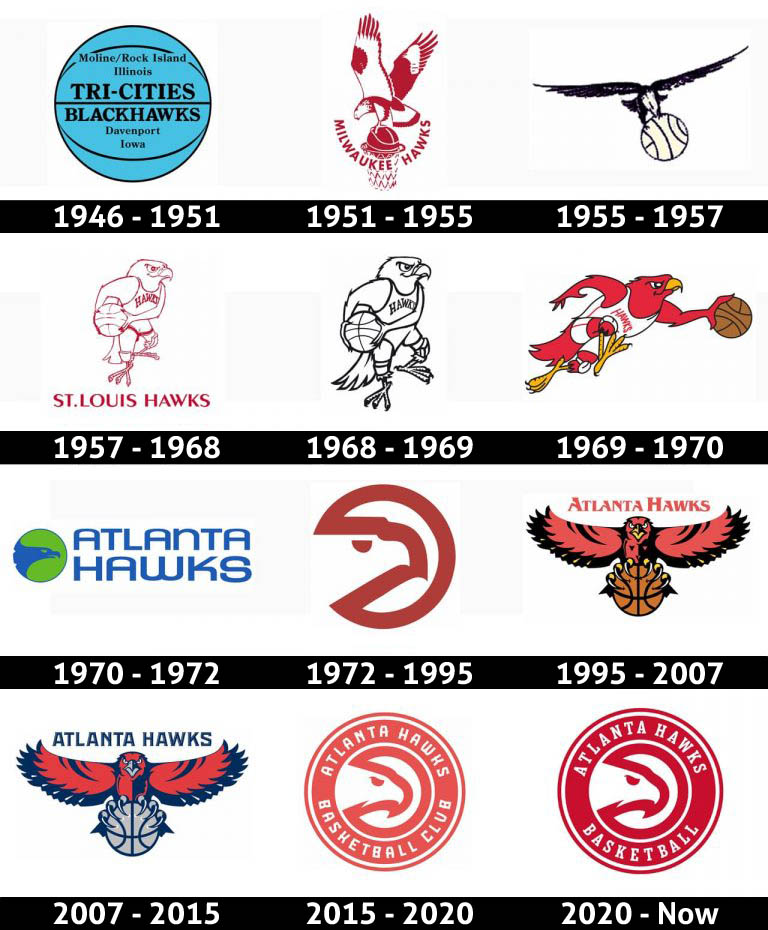
Atlanta Hawks Logo History Timeline
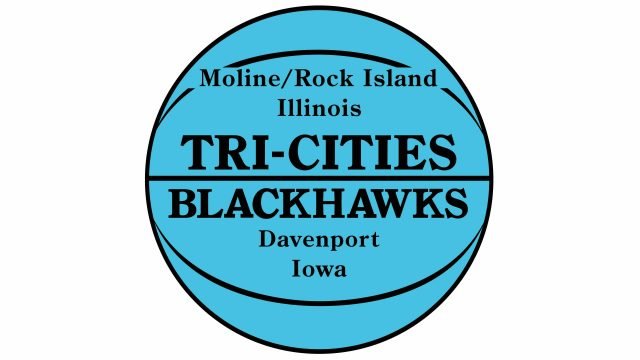
1946 – 1951: Tri-Cities Blackhawks
The earliest Hawks logo featured a teal basketball with black detailing and serif lettering. The design was restrained and formal, reflecting early professional sports aesthetics where clarity mattered more than flair. Typography dominated, with the basketball serving as a straightforward visual anchor.
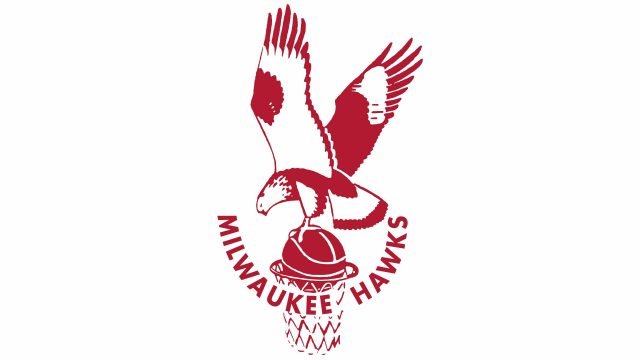
1951 – 1955: Milwaukee Hawks
With the move to Milwaukee, the hawk finally appeared as a character. The emblem showed a flying hawk clutching a basketball, rendered in turquoise and black. The arched wordmark beneath the bird framed the composition and introduced motion into the logo for the first time.
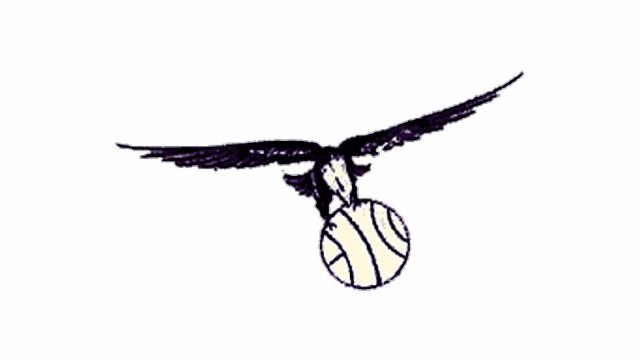
1955 – 1957: St. Louis Minimalism
After relocating to St. Louis, the Hawks adopted one of their most stripped-down logos. A hawk with wings fully extended held a cream-colored basketball, with no lettering whatsoever. This stark design emphasized strength and focus, relying entirely on symbolism.
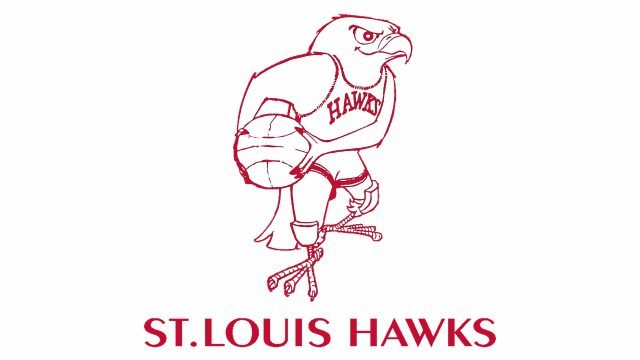
1957 – 1968: Cartoon Confidence
In 1957, the Hawks introduced a full-bodied cartoon hawk wearing a uniform and holding a basketball. Rendered in red and white, the logo leaned into personality and approachability, reflecting mid-century sports branding trends. This version coincided with the franchise’s championship era and became deeply associated with success.
1968 – 1969: Transitional Refinement
Minor adjustments followed the move to Atlanta. The hawk’s outline shifted from red to black, lettering was removed, and the bird’s tail gained sharper detailing. This brief iteration marked the transition from St. Louis to Atlanta.

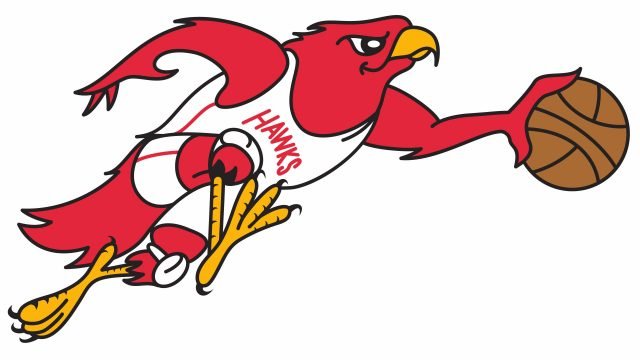
1969 – 1970: Motion and Power
The hawk was redrawn as a running figure, conveying speed and aggression. Multiple color variations existed, including red-dominant and white-contoured versions. The emphasis was on athletic movement rather than character charm.
1970 – 1972: Modern Experimentation
A radical redesign introduced a circular emblem with a hawk’s head profile in green and blue, paired with a two-line wordmark. This logo broke sharply from previous styles and reflected the design experimentation common in early 1970s professional sports.
1972 – 1995: Birth of the Modern Icon
In 1972, the foundation of today’s Hawks identity was established. A minimalist red circular badge featuring the hawk’s profile became the core symbol. Clean lines, balanced geometry, and restrained typography gave the logo longevity and adaptability.

1995 – 2007: Aggression and Detail
The 1995 redesign embraced intensity. A detailed red hawk with sharp claws gripping a basketball dominated the logo, rendered in red, yellow, and brown. This era favored visual impact and intimidation, aligning with the NBA’s more aggressive branding phase.
2007 – 2015: Color and Refinement
Color balance became the focus in 2007. The hawk’s body turned red, outlines shifted to dark blue, and metallic silver accents appeared on the beak, claws, and basketball. Typography was bold and authoritative, reinforcing professionalism.
2015 – 2020: Circular Minimalism Returns
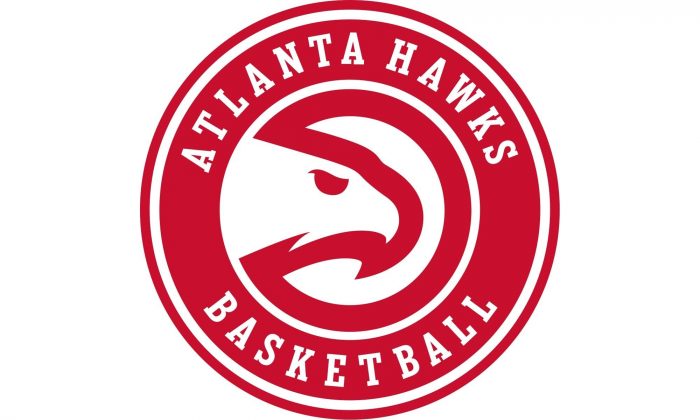
In 2015, the Hawks returned to a circular medallion design. A simplified hawk profile sat at the center, surrounded by uppercase lettering around the perimeter. The logo embraced flat design principles and historical continuity.
2020 – Today: Deeper Red, Sharper Identity
The current logo refined the 2015 concept by deepening the red tones, increasing contrast, and sharpening edges. The result is a stronger, more assertive emblem that feels modern while respecting the franchise’s past.
Logo Symbolism: The Hawk as an Idea
The hawk symbolizes vision, speed, and predatory precision. In Atlanta’s context, it also represents resilience. The bird’s profile, especially in modern logos, conveys focus rather than chaos, discipline rather than spectacle.
The circular framing reinforces unity and continuity, suggesting an organization grounded in tradition yet ready to strike.
Typography and Color Palette
Modern Hawks typography relies on geometric serif letterforms with sharp cuts and condensed proportions. This style conveys strength, structure, and heritage. Red remains the dominant color, symbolizing intensity and passion, while white provides contrast and clarity. Accent colors such as yellow and black support visual hierarchy without overwhelming the core identity.
Atlanta Hawks Logo Heritage and Cultural Presence
The Atlanta Hawks logo heritage reflects a franchise constantly recalibrating its identity without losing its core symbolism. Each redesign responded to its era, whether through cartoon optimism, aggressive realism, or minimalist modernism.
Within the broader context of NBA team logo heritage, the Hawks stand out for their willingness to evolve while maintaining a consistent symbolic anchor. The hawk never disappeared; it simply learned new ways to fly.
FAQ: Atlanta Hawks Logo Meaning and History
What does the Atlanta Hawks logo represent?
The logo represents speed, focus, and competitive intensity, symbolized through the hawk.
When did the Hawks move to Atlanta?
The franchise relocated to Atlanta in 1968.
Why does the Hawks logo use a circular design?
The circle symbolizes unity, continuity, and balance, framing the hawk as a central icon.
Has the Hawks logo changed often?
Yes. The Hawks have one of the NBA’s most frequently redesigned identities, reflecting relocations and evolving branding trends.