
Asana Logo History: Meaning, Symbolism & Brand Heritage
At first glance, the Asana logo gives very little away. There are no folders, no checkmarks, no arrows, and nothing that explicitly signals productivity software. And yet, the identity works. It communicates cooperation, rhythm, and shared momentum through abstraction rather than instruction. That choice is not accidental. Asana was built for teams, not tasks, and its visual language follows the same philosophy.
The Asana logo history reflects the evolution of digital collaboration itself. As work moved away from rigid hierarchies and toward flexible, cross-functional teams, the brand needed an identity that felt calm, human, and intelligent rather than mechanical. This places Asana in close conceptual proximity to identities explored in the Slack logo history and the Notion logo history, while situating it firmly within the broader Internet & E-commerce logo heritage shaped by clarity and emotional restraint.
Meaning and History: The Origin of the Asana Identity
Asana was founded in 2008 by Dustin Moskovitz and Justin Rosenstein, though the product did not launch commercially until 2012. The founders’ goal was not simply task management, but coordination: helping teams understand how work connects, evolves, and progresses together.
This intent directly informed the logo meaning. From the beginning, Asana avoided literal metaphors associated with productivity software. Instead of representing work as boxes or lists, the brand leaned into symbolism rooted in balance, flow, and shared focus. Even the name “Asana,” borrowed from yoga terminology, reinforces ideas of alignment and collective discipline rather than output alone.
Logo Symbolism: Synergy Through Abstract Form
Asana logo symbolism is built almost entirely around the circle. Circles have no hierarchy, no beginning or end, and no sharp edges. In design language, they represent unity, continuity, and cooperation. By using three circles rather than one, Asana introduces interaction into the system.
In the current logo, the circles overlap visually through color and light rather than geometry. The brighter inner areas suggest energy created at the point of connection. This is not accidental decoration. It is a visual metaphor for synergy: the idea that collaboration produces results greater than the sum of individual efforts. Rather than illustrating teamwork, the logo demonstrates it.
Asana Logo History Timeline
2008–2015: Early Minimalism with Subtle Collaborative Cues
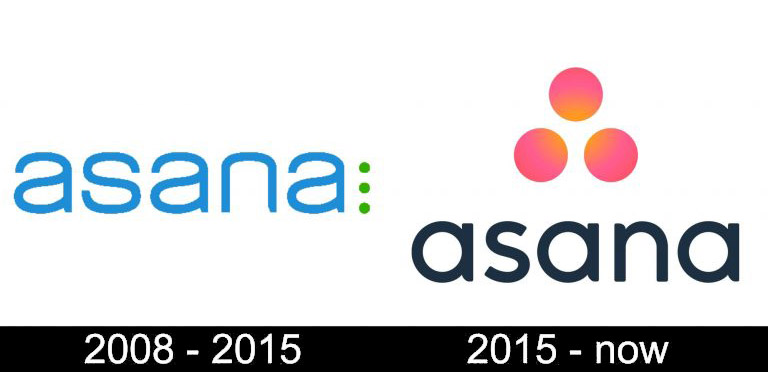
The original Asana logo already contained the core elements that would define the brand’s identity. A lowercase wordmark set in a rounded sans-serif typeface conveyed friendliness and accessibility. To the right of the wordmark, three small green circles were stacked vertically, understated and almost secondary in presence.
At this stage, the symbolism was restrained. The circles hinted at connection but did not yet carry strong visual authority. The blue wordmark aligned Asana with early SaaS conventions, emphasizing reliability and clarity over emotional expression. This version reflected a product still finding its voice, focused more on function than narrative.

2015–Today: Synergy-Centered Identity Through Color and Light
The 2015 redesign marked a decisive shift in how Asana communicated its purpose. Developed by Moving Brands, the new logo elevated the circular emblem from a supporting detail to the centerpiece of the identity.
The three circles became larger, softer, and more luminous, rendered in a warm pink tone with yellow highlights facing inward. The visual effect suggests light or energy forming at the center, reinforcing the idea that collaboration creates momentum. The emblem was repositioned to sit either above or beside the wordmark, ensuring it functioned as an independent symbol across digital environments.
The wordmark itself became more neutral and balanced. Letterforms were refined to standard proportions, with circular “a” shapes echoing the emblem. This created visual harmony between text and symbol, unifying the identity around a single geometric language.
Typography and Color Palette
Typography in the Asana logo is deliberately restrained. The sans-serif wordmark prioritizes legibility and calmness, avoiding extremes of minimalism or expressiveness. Retained tails and open counters prevent the type from feeling overly engineered, keeping it human and approachable.
Color is where the identity carries emotional weight. While the wordmark adapts to black or white depending on background, the emblem remains consistently radiant. The warm pink and yellow tones introduce optimism and creativity without sacrificing professionalism. Unlike productivity brands that rely on cold palettes, Asana’s color system reinforces psychological safety and openness.
Asana Logo as a Visual Expression of Collaboration
The Asana logo history demonstrates how abstract symbolism can outperform literal representation when executed with clarity and intent. By resisting obvious productivity tropes, Asana created a logo heritage that communicates its core promise through feeling rather than instruction.
The shift in 2015 did not reinvent the brand; it clarified it. Today, the Asana logo stands as a visual shorthand for cooperative work, shared focus, and collective progress—proof that effective collaboration can be expressed through light, balance, and form rather than words.
FAQ: Asana Logo Meaning and History
What does the Asana logo represent?
The logo represents collaboration and synergy, using three interconnected circles to symbolize shared energy and teamwork.
Why does the Asana logo use circles?
Circles symbolize unity, equality, and cooperation, aligning with Asana’s focus on team coordination.
When was the Asana logo redesigned?
The current logo was introduced in 2015 to better express the brand’s collaborative mission.
Who designed the current Asana logo?
The 2015 redesign was created by Moving Brands.