
Arizona Cardinals Logo History: Meaning, Symbolism & Brand Heritage

Few franchises in American sports carry the historical weight of the Arizona Cardinals. Established in 1898, the Cardinals are not only one of the founding members of the National Football League, but also the oldest continuously operating professional football club in the United States. While championships have been rare and postseason success limited, the Cardinals’ cultural relevance has never faded. Their logo heritage, centered around one of the most recognizable bird emblems in sports, tells a story of longevity, adaptation, and identity more than dominance.
Unlike franchises whose brands were built on dynasties, the Cardinals’ identity rests on persistence. Much like legacy teams such as the Chicago Bears or the Green Bay Packers, the Cardinals exist as living artifacts of the NFL’s origins. Their logo history reflects that role—evolving carefully, never radically, and always anchored to the cardinal bird as a symbol of passion and resilience.
Meaning and History: America’s Oldest Football Identity
The Cardinals’ journey began in Chicago at the end of the 19th century, long before the NFL itself existed. When the league was officially founded in 1920, the Cardinals were among its cornerstones. Over the decades, the franchise migrated from Chicago to St. Louis and eventually to Arizona in 1988, carrying its name and visual identity across cities and eras.
Despite limited on-field success—just two league championships, won in the 1920s and 1940s—the Cardinals maintained a strong emotional connection with fans. Their identity became less about trophies and more about continuity. The cardinal bird, chosen originally because of a faded jersey color that resembled cardinal red, evolved into one of the NFL’s most enduring symbols.
The logo meaning has always been direct. The cardinal represents intensity, vigilance, and spirit. Rather than relying on abstract symbolism or typography-driven marks, the franchise embraced a figurative emblem early on, allowing recognition to grow organically over generations.
Arizona Cardinals Logo History Timeline

1920–1934: Monogram Simplicity and Early League Identity
The earliest emblem associated with the Cardinals appeared during their Chicago years. It consisted of a wishbone-style capital “C” with a smaller “C” nested inside. Executed in a deep cardinal red, the double-letter mark was minimal, practical, and typical of early professional sports branding. At this stage, identity was functional rather than expressive.

1944: Wartime Merger and Temporary Typography
During World War II, the Cardinals temporarily merged with the Pittsburgh Steelers due to roster shortages. The resulting “Card-Pitt” identity replaced imagery with a bold wordmark. Burgundy tones and angular serif lettering maintained continuity with the Cardinals’ color heritage while signaling a provisional chapter in the franchise’s story.

1947–1959: The Cardinal Bird Emerges
In 1947, the franchise introduced the cardinal bird for the first time. Depicted perched on a white football outlined in black, the bird was rendered in soft red tones with a traditional illustrative style. This logo marked a turning point, transforming the Cardinals from a letter-based identity into a symbol-driven brand.

1960–1961: Transitional Mascot Imagery
Following the move to St. Louis, the Cardinals experimented with a symbolic character: a football player with a cardinal bird head, running with the ball. This emblem was expressive and narrative, reflecting mid-century trends in sports illustration. While short-lived, it demonstrated the franchise’s willingness to explore identity without abandoning its core symbol.

1962–1969: Athletic Bird Symbolism
The St. Louis Cardinals era introduced a more animated cardinal, dressed in football pants and charging toward goalposts. This caricature-style logo emphasized motion and competitiveness, aligning the bird more directly with athletic performance.

1970–1987: Birth of the Modern Cardinal Head
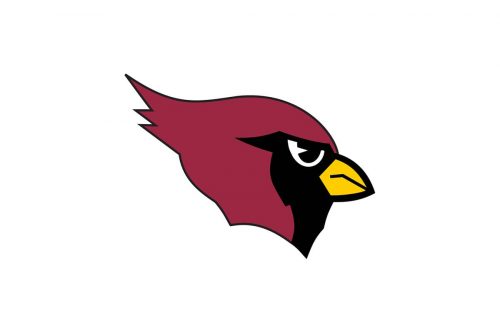
The 1970 redesign laid the foundation for the logo still used today. The emblem featured a streamlined cardinal head in profile, facing right, rendered in red with black outlines and a bright yellow beak. Clean lines and strong contrast gave the logo a modern, professional feel that stood apart from earlier illustrative styles.
1988–1993: Relocation Without Reinvention
When the franchise relocated to Arizona, the logo remained largely unchanged. Minor refinements improved clarity, but the organization wisely preserved visual continuity, allowing fans to carry the brand across state lines without disruption.
1994–2004: Subtle Identity Adjustment
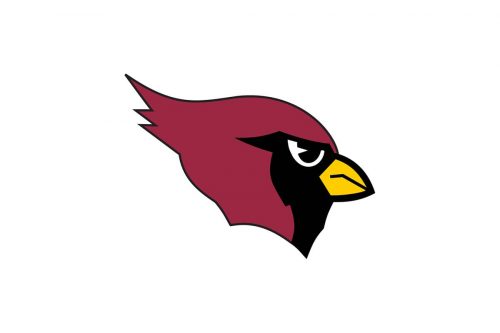
As the team transitioned from the “Phoenix Cardinals” to the “Arizona Cardinals,” the logo underwent barely noticeable refinements. The emphasis remained on the cardinal head, reinforcing stability during a period of organizational change.

2005–Today: Sharpened Aggression and Contemporary Edge
The 2005 redesign modernized the emblem without altering its essence. The bird’s head became more angular and forward-leaning, feathers sharpened, and contours refined. The updated logo conveyed aggression and intensity, aligning with modern NFL aesthetics while preserving decades of recognition.
Logo Symbolism: Passion, Vigilance, and Endurance
The Arizona Cardinals logo symbolism is rooted in clarity rather than complexity. The cardinal bird is not abstract or metaphorical; it is direct, emotional, and visually assertive. Its red coloration symbolizes passion and intensity, while black outlines add authority and focus. The yellow beak introduces contrast and vitality, preventing the mark from becoming visually heavy.
Over time, the bird’s posture evolved from passive to aggressive. The forward tilt and sharpened features of the modern logo reflect determination and competitive edge, qualities the franchise continues to emphasize even in rebuilding eras.
A Logo That Outlived Eras
The Arizona Cardinals logo history is a rare example of restraint in professional sports branding. While uniforms, stadiums, and even cities changed, the core symbol endured. In a league where rebrands are often driven by market trends, the Cardinals proved that consistency itself can be a competitive advantage.
Within NFL logo heritage, the Cardinals stand apart not because of dominance, but because of survival. Their logo is not a reminder of championships—it is a testament to legacy, persistence, and one of the longest continuous stories in American sports.
FAQ: Arizona Cardinals Logo Meaning and History
What does the Arizona Cardinals logo represent?
The logo represents passion, vigilance, and determination, symbolized by the head of a cardinal bird.
When was the current Arizona Cardinals logo introduced?
The modernized version of the cardinal head was introduced in 2005.
Why are the Arizona Cardinals called the Cardinals?
The name originated from the faded red jerseys worn by the team in 1901, which resembled cardinal red.
Is the Arizona Cardinals logo one of the oldest in the NFL?
Yes, the cardinal bird identity dates back to the 1940s, making it one of the league’s longest-running symbols.