American Express Logo History: Meaning, Symbolism & Brand Heritage
American Express has always understood the power of identity. Founded in New York City in 1850, the company evolved from an express mail business into one of the world’s most respected financial institutions. Through every shift in its global presence, its logo remained central to how the brand expressed trust, prestige, and security. While the modern eye immediately thinks of the bold blue square seen on cards across the world, American Express also carries a second emblem deeply tied to its heritage: the Roman gladiator. This duality—modern minimalism paired with classical symbolism—is a defining part of the brand’s story.
Meaning and Brand Identity
The American Express identity is built on strength and assurance. The blue square with white lettering represents clarity, service, and confidence. The gladiator, meanwhile, stands for protection and authority, qualities that reflect a company responsible for safeguarding the financial activity of millions of customers worldwide. Together, these elements form a visual system that balances modern branding with a legacy of reliability.
Logo Evolution Through the Years
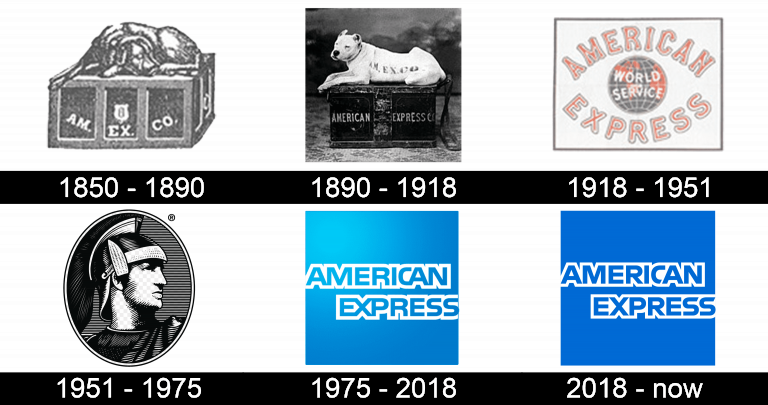
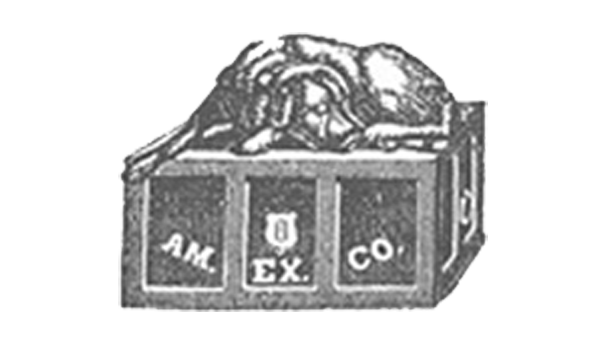
1850 — The Guarded Chest
The first American Express emblem embraced the style of the era: an ornate illustration featuring a large lockbox with “Am. Ex. Co.” written on the front. A black dog lay protectively on top, symbolizing loyalty, vigilance, and security. Executed in bold black and white, the design conveyed seriousness and stability during the company’s early years.
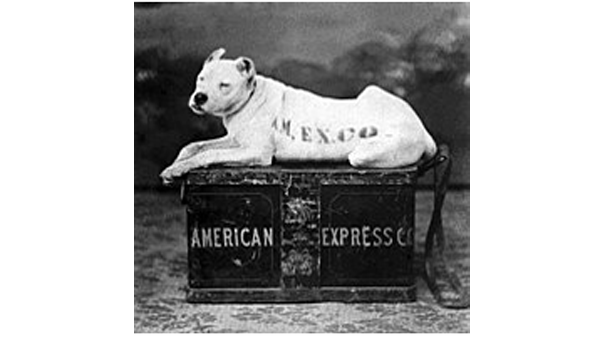
1890 — The White Bulldog
The brand refreshed the illustration by replacing the black dog with a proud white bulldog, reinforcing determination and strength. The lettering appeared both on the dog and the chest below, creating a more unified and recognizable composition. Despite its decorative nature, the emblem still spoke clearly about security and reliability.
1918 — The World Service Globe
As American Express expanded globally, the logo shifted to an entirely new concept: a blue and red globe with white meridians and the statement “World Service.” The words “American” and “Express” curved around the top and bottom of the sphere, emphasizing reach, movement, and international trust. This version marked the company’s transition into worldwide services.

1951 — The Roman Gladiator
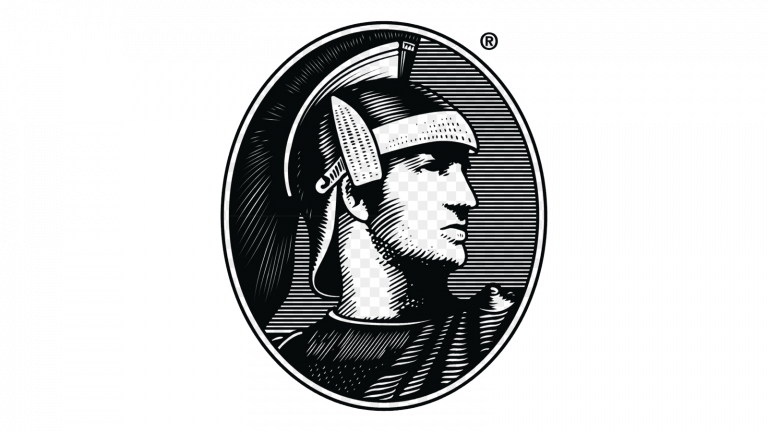
In the mid-20th century, American Express introduced the symbol that would become an enduring icon. A Roman gladiator—rendered in elegant, textured black-and-white lines—appeared inside a vertical oval medallion. The gladiator faced right, portraying readiness and vigilance. For the brand, this figure represented strength, honor, and protective service.
1975 — The Blue Square
A new era began when American Express adopted the bold blue square with stacked white typography. The crisp, geometric design was a complete break from earlier illustrations, aligning the company with modern aesthetics and the growing credit card market. This logo was created to work powerfully on physical cards and digital materials alike.

2006 — Modern Shading
Subtle gradients were added to the blue background, giving the emblem dimension and energy. The updated look maintained the original structure while adding a contemporary, consumer-friendly polish.
2018 — The Pentagram Refinement
Pentagram refined the logo by increasing precision, sharpening contours, and deepening the blue tone. The overlap of the “C” by the following “A” created a tighter, more contemporary rhythm, while soft diagonal cuts on the “S” added subtle elegance. This version elevated the entire mark without losing the impact of the now-historic 1975 square.
Symbolism of the Gladiator
Though the blue square is the primary corporate logo, the Roman gladiator remains one of American Express’s most treasured symbols. It appears on cards, checks, and security elements, representing trust, protection, and the brand’s longstanding heritage. The gladiator has become a visual shorthand for the company’s commitment to safeguarding its customers.
Shape, Font, and Color
The blue square relies on a bold, uppercase sans-serif wordmark, designed to maximize clarity and presence across card surfaces and digital environments. The typography is compact, clean, and highly legible at small sizes, ensuring instant recognition.
Blue and white define the identity. Blue reflects reliability, excellence, and stability, while white adds contrast and brightness. Together, they communicate a promise of security and a forward-looking spirit. The refined blue used since 2018 deepens these associations and enhances the brand’s premium positioning.

A Logo Built on Trust and Legacy
Across more than 170 years, American Express has carried its visual identity through illustrations, globes, gladiators, and the unmistakable blue square. Every iteration reflects a balance between heritage and innovation. Today, the modern wordmark and the enduring gladiator coexist as a powerful statement of trust, protection, and global service—qualities that continue to define one of the world’s most valuable financial brands.
American Express Logo – FAQ
What does the American Express logo represent?
It stands for trust, reliability, and modern financial service. The blue square expresses clarity and confidence, while the gladiator symbolizes protection and heritage.
Why does American Express use a gladiator?
The gladiator reflects strength, vigilance, and security—qualities the company associates with protecting its customers.
When was the modern blue square introduced?
The blue square debuted in 1975 and has remained the foundation of the identity ever since.
Did Pentagram redesign the logo?
Yes. In 2018 Pentagram refined the typography and color to create a sharper, more contemporary version.
Does American Express still use the gladiator?
Yes. Although the blue square is the primary logo, the gladiator still appears on cards and other brand materials as a legacy emblem.