
America West Airlines Logo History: Meaning, Symbolism & Brand Heritage
America West Airlines belongs to a very specific chapter in modern U.S. aviation: the rise of ambitious, airport-hub challengers that blended low-cost instincts with full-service reach. Its visual identity followed the same logic. Clean, confident, and built for fast recognition, the America West logo history shows how an airline can signal regional pride and modernity without relying on literal aircraft imagery. In the broader conversation around US Airways logo history and American Airlines logo history, America West remains especially interesting because its brand heritage didn’t end with a redesign—it ended with a merger, leaving its logos as time capsules of an era. Within Airlines Logos, America West’s marks are remembered for their geometric restraint and desert-inspired color decisions.
What makes the America West logo meaning worth revisiting is the way the airline used typography and minimal geometry to suggest place, reliability, and forward motion, even as the company’s identity evolved through the 1990s into the early 2000s.
America West Airlines Logo Meaning and History: The Origin of an Arizona Challenger Brand
America West Airlines was founded in 1983 and built its identity from Arizona, operating out of the Phoenix area as it expanded across the United States and into nearby international markets. The airline developed a reputation for operational innovation during its run, including early moves that helped normalize more streamlined travel processes in the 1990s. The brand story, however, ultimately became part of a larger consolidation wave. In 2005, America West merged with US Airways, and the America West name gradually disappeared from aircraft and consumer-facing branding, even though parts of its leadership and operational structure influenced the combined company.
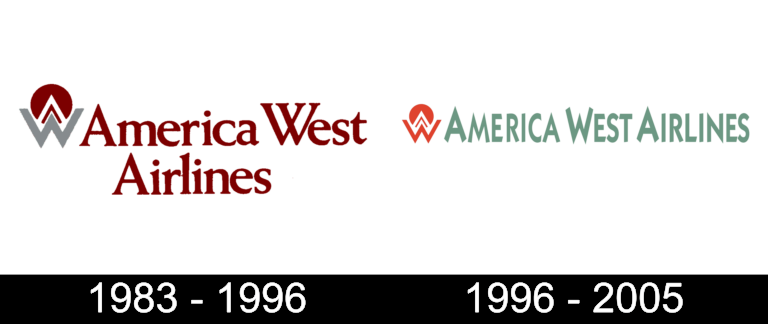
That corporate arc shaped the logo heritage in a quiet way. America West didn’t accumulate dozens of competing visual eras. Instead, it has a short, readable logo timeline, with design decisions that mirror the airline’s growth: early seriousness and structure, followed by a brighter, more contemporary identity that aligned with a more mass-market, modern travel feel.
America West Airlines Logo Symbolism: Geometry, Direction, and Desert Color Psychology
The America West logo symbolism is rooted in minimalism and meaning-through-structure. Rather than drawing wings, globes, or swooshes, the brand relied on a strong monogram concept and bold wordmarks to carry recognition. That restraint is important in aviation, where logos must remain legible on aircraft tails, signage, printed tickets, and small-scale applications.
In the earliest era, the emblem’s circle-and-“W” configuration communicated stability and clarity. The circle works as an anchoring shape, while the “W” adds directionality through angular strokes. The palette reinforced the airline’s regional identity. Burgundy reads as serious and established, while the neutral gray adds a corporate calm that feels intentionally “airline” rather than playful.
Later, the shift to brighter red, paired with green typography, signaled a new brand mood. Scarlet emphasizes energy and confidence, while the green wordmark introduced a warmer, more approachable tone. In practice, this made the logo feel less formal and more contemporary for the late-1990s travel market—still structured, but more human and more retail-friendly.
America West Airlines Logo History Timeline: From Monogram Formality to Modern Wordmark
1983–1996: The Burgundy-and-Gray Monogram Era
The original America West identity paired a restrained emblem with a two-line wordmark set in a bold serif style. The logo description centered on a simple geometric mark: a burgundy circle combined with a gray capital “W,” creating a compact symbol that was easy to place on aircraft and printed materials. The typography carried a more traditional airline voice, while the emblem introduced a modern edge through clean angles and minimal detail. This period defined the brand’s early logo meaning as dependable, structured, and regionally grounded.
1996–2005: The Scarlet Emblem and Green Wordmark Refresh
The 1996 redesign maintained the basic composition but reinterpreted the identity through a brighter, more contemporary palette. The emblem shifted to scarlet, increasing visibility and shelf presence in marketing. The wordmark moved into a stylized, bold sans-serif, rendered in green with distinctive diagonal cuts that suggested motion and modernity. This era sharpened the logo symbolism toward speed, approachability, and a more “1990s-forward” digital-friendly look, while still keeping the identity simple enough for aircraft use.
America West Airlines Logo Heritage Conclusion: A Short Timeline, a Clear Identity
The America West Airlines logo history is memorable precisely because it is concise. Across its lifespan, the airline leaned on a small number of strong design decisions rather than constant reinvention. The early monogram-and-serif system built authority, while the later scarlet-and-green refresh modernized the brand without losing recognizability.
As brand heritage, America West now lives mostly in aviation history and design archives, but its logos remain a clean example of how an airline can express place and purpose through geometry, typography, and disciplined color. The logo meaning still reads clearly today: a regional challenger that wanted to look modern, confident, and unmistakably established.
America West Airlines Logo History FAQ: Meaning, Symbolism, and Origin
What does the America West Airlines logo represent?
The logo represents a modern airline identity built around clarity and recognition, using a geometric “W” monogram and bold wordmarks to signal stability and forward motion.
Why did America West use a “W” monogram?
The “W” directly reinforces the brand name while creating a compact symbol that works well on aircraft, signage, and small-scale print applications, strengthening logo heritage through repetition.
What do the colors in the America West logo mean?
Burgundy and gray suggested seriousness and reliability in the early era, while the later scarlet and green refresh emphasized energy, visibility, and a more modern travel tone.
When did America West Airlines stop operating under its name?
America West merged with US Airways in 2005, and the America West name was phased out as branding transitioned to the combined airline identity.
How many major logo designs did America West have?
America West’s logo history is defined primarily by two major eras: the 1983 identity and the 1996 redesign.