Allegro Logo History: Meaning, Symbolism & Brand Heritage
Allegro has long been one of the defining names in Polish e-commerce, and its branding reflects that same everyday familiarity. In the wider landscape of OLX Logo History and Amazon Logo Meaning, Allegro’s identity stands out for one reason: it has stayed loyal to a high-energy color signature while steadily refining how its name looks and feels on screen. This evolution matters because Allegro’s logo history has been shaped by the realities of digital commerce—speed, trust, legibility, and instant recognition. If you’re exploring E-Commerce Logos, Allegro is a strong example of how a simple wordmark can become a national visual shortcut for buying and selling online.
Allegro Logo Meaning and History: Origin of the Brand and Its Visual Direction
Allegro was founded in 1999 in Poznań, Poland, as an online marketplace built around auctions and electronic payments. From the beginning, the brand needed a logo description that worked in the most practical setting possible: a website header, a search result, a browser tab, a checkout flow, and later a mobile app icon. That requirement explains why Allegro has always relied on a wordmark-first identity, with only occasional supporting graphics.
The Allegro logo meaning has consistently been tied to friendliness, momentum, and approachability. Instead of adopting corporate blues or minimalist monochrome, the brand leaned into warm yellows and oranges. Over time, Allegro’s design choices show a clear strategy: make the name look welcoming and energetic, then refine the typography to feel more modern, more readable, and more “digital-native” as the platform matured.
Allegro Logo Symbolism: Energy, Motion, and Marketplace Confidence
Allegro’s logo symbolism is built on emotional color and easy shapes rather than complex icons. The warm yellow-to-orange spectrum communicates activity and optimism—an intentional fit for a marketplace where “something is always happening.” These colors suggest urgency in a positive way: deals, bids, limited-time offers, and browsing excitement, which aligns naturally with e-commerce behavior.
Typography carries much of the symbolism, too. Rounded corners and soft curves signal friendliness and accessibility, reducing the “transactional coldness” that online payments can sometimes evoke. Later refinements add sharper discipline—cleaner geometry, more consistent letterforms, and more confident spacing—signaling a platform that has grown from early internet experimentation into a mature digital brand.
When Allegro introduced supporting graphic elements, they weren’t meant to replace the name. They functioned as cues of interaction and usability—reinforcing the idea of hands-on browsing, clicking, and purchasing—without breaking the brand’s core identity.
Allegro Logo History Timeline: Wordmark Evolution Across the Digital Era
1999–1999: The Yellow Wordmark and Early Online Marketplace Identity
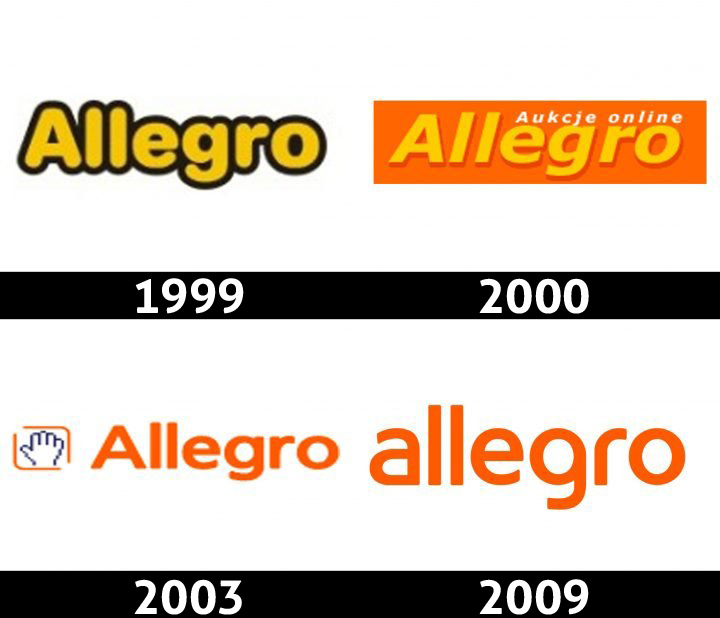
The original Allegro wordmark used plump, rounded letterforms in yellow with a dark outline. The logo description here is straightforward: friendly typography designed to feel approachable, with color doing the heavy lifting. This early phase established the brand’s warm palette and its preference for soft shapes, which would remain part of Allegro’s logo heritage even as the styling changed.
2000–2000: The Orange Background Era and Auction-First Positioning
The next version intensified the energy by placing yellow lettering on an orange backdrop, creating a bold, high-contrast badge that read well on early web layouts. The typography became lighter and italicized, adding motion and urgency. This period’s logo meaning leaned into speed and dynamism—an identity aligned with online auctions, quick decisions, and real-time competition.
2003–2008: The Orange Wordmark and the Introduction of a Hand Symbol
In 2003, the wordmark shifted toward orange and returned to a straighter, more stable posture, stepping away from the italic styling. A hand icon appeared alongside the name, reinforcing interaction and user action—clicking, bidding, buying. This update helped Allegro bridge an early auction identity with a broader marketplace direction, keeping the brand energetic while making it feel more structured.
2009–Today: The Lowercase Wordmark and Modern Allegro Brand Heritage
The 2009 redesign is the most defining long-term phase in Allegro logo history. The wordmark became fully lowercase, strengthening friendliness and modern digital tone. Subtle typographic choices—shortened terminals, refined curves, and simplified shapes—added motion without relying on slant or extra decoration. Supporting graphics received a more dimensional, polished treatment in certain applications, but the core identity remained a clean, confident wordmark. This era solidified Allegro’s logo heritage as a scalable digital system built for web, app, and commerce interfaces.
Allegro Logo Heritage Conclusion: Why the Orange Wordmark Endured
Allegro’s logo history shows a brand that understood early what many platforms learn later: color is memory, and typography is trust. By keeping its warm orange family at the center of the identity, Allegro created instant recognition across Poland and beyond. The updates were not about changing who the brand is. They were about making the same promise clearer in every new digital environment.
The Allegro logo meaning today is the result of two decades of refinement: energetic enough to feel like a marketplace, friendly enough to feel safe, and modern enough to live comfortably in apps, payment flows, and search-driven commerce. That is the core of its brand heritage—consistency with purpose.
Allegro Logo History FAQ: Meaning, Symbolism, and Origin
What does the Allegro logo mean?
The Allegro logo meaning is centered on an energetic, friendly marketplace identity. The warm orange palette signals activity and optimism, while the rounded wordmark communicates approachability and trust.
Why is Allegro orange?
Orange is a high-energy color associated with warmth, motion, and accessibility. In Allegro’s logo symbolism, it helps the brand feel active and memorable in fast-moving digital shopping environments.
When was Allegro founded?
Allegro’s origin dates to 1999, when it launched in Poznań, Poland as an online auction and commerce platform.
How many times has the Allegro logo changed?
Allegro’s logo history includes several updates, with major visible phases in 1999, 2000, 2003, and a long-running modern identity beginning in 2009.
What is the most recognizable part of Allegro’s logo heritage?
The most recognizable element is the bold lowercase wordmark paired with the brand’s warm orange color family, which has remained central to Allegro’s identity for years.