Air China Logo History: Meaning, Symbolism & Brand Heritage

The visual identity of Air China stands among the most recognizable in global aviation, combining national symbolism with a refined corporate presence. As China’s flagship carrier, Air China’s logo history reflects state authority, cultural continuity, and international ambition. Unlike airlines that frequently reinvent their branding, Air China has built its identity on consistency, allowing symbolism and typography to mature rather than be replaced.
Within airline logo history, Air China belongs in the same category as Japan Airlines logo history and Korean Air logo meaning, where national carriers rely on deep cultural references expressed through modern design systems. As part of the broader Asian airline logo heritage, Air China demonstrates how traditional symbolism can coexist with contemporary global branding.
Meaning and History: The Origin of the Air China Identity
Air China was established on July 1, 1988, following the restructuring of the Civil Aviation Administration of China into several independent airlines. From its inception, Air China was positioned as the country’s primary international carrier, responsible for representing China abroad while maintaining extensive domestic connectivity.
This role heavily influenced the logo meaning. Rather than adopting abstract aviation motifs, Air China embraced symbolism rooted in Chinese culture, authority, and longevity. The airline’s early visual identity emphasized stability and national pride, qualities essential for a state-owned carrier operating on the global stage.
As Air China expanded rapidly through the 1990s and 2000s, increasing its fleet and route network across Europe, the Americas, Asia, and Australia, its logo evolved only through refinement. This continuity reinforced trust and recognition, especially as the airline joined Star Alliance and strengthened its international partnerships.
Logo Symbolism: Phoenix Imagery and Cultural Continuity
The symbolism of the Air China logo is centered on the phoenix, a mythological bird deeply embedded in Chinese tradition. Unlike Western interpretations of the phoenix as a creature of rebirth, in Chinese culture it represents harmony, prosperity, virtue, and eternal continuity. This makes it particularly appropriate for a national airline tasked with long-term representation.
The bird’s stylized form is drawn in a flowing, calligraphic manner, reflecting traditional brushstroke aesthetics. Its circular, sun-like composition conveys balance and completeness, while also suggesting motion and flight. The emblem is widely interpreted as forming the letters “VIP,” reinforcing notions of prestige and importance.
Color symbolism is equally deliberate. Red signifies good fortune, vitality, and national identity, while black typography adds authority and contrast. Together, these elements create a logo that communicates cultural depth, confidence, and permanence.
Air China Logo History Timeline
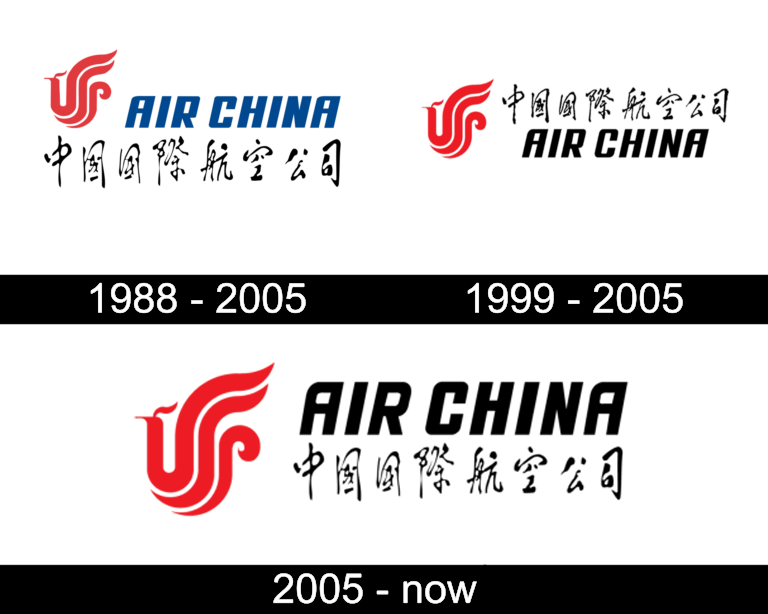
1988–2005: Foundational Phoenix and Bilingual Identity
The original Air China logo introduced in 1988 established the core elements still used today. A muted red phoenix emblem appeared to the left of a bold blue English wordmark, set in italicized uppercase sans-serif letters. Beneath the English name, the airline’s Chinese name was rendered in thin, handwritten-style characters, adding elegance and cultural authenticity.
This composition balanced international legibility with national expression and remained in use for nearly two decades, becoming firmly associated with Air China’s early global expansion.

1999–2005: Transitional Refinement and Color Adjustment
During the late 1990s, subtle refinements were introduced. The phoenix became more vivid, and the typographic hierarchy was clarified. The bilingual layout was preserved, with Chinese characters placed above or alongside the English name depending on application, ensuring clarity across global markets.
This period served as a visual transition rather than a full redesign, preparing the brand for a more unified modern identity.
2005–Present: Unified Modern Phoenix Identity
In 2005, Air China finalized its current logo system. The phoenix emblem was refined into a cleaner, more confident scarlet-red symbol with three flowing curves representing wings and tail. The English wordmark adopted a bold italic sans-serif typeface with softened letter corners, conveying motion and safety.
Below it, the Chinese name remained in a calligraphic style, preserving cultural continuity. This redesign strengthened consistency across aircraft liveries, digital platforms, and alliance branding, while maintaining the airline’s established visual heritage.
Air China Logo Heritage and Global Presence
The logo heritage of Air China is defined by restraint and respect for tradition. Rather than following global branding trends toward abstraction or minimalism, Air China retained its cultural core and refined it gradually.
When compared with identities discussed in Cathay Pacific logo history or Singapore Airlines logo symbolism, Air China stands apart for its unwavering use of mythological symbolism. This approach reinforces its role not only as an airline, but as a national ambassador.
Today, the logo is instantly recognizable worldwide and closely associated with China’s presence in international aviation.
Air China Logo as a Symbol of National Authority and Continuity
The Air China logo history illustrates how cultural symbolism, when executed with discipline and consistency, can create a timeless airline identity. Through the phoenix emblem, calligraphic elements, and restrained evolution, Air China has built a visual system that communicates heritage, power, and global reach. Within airline logo history and broader logo heritage analysis, it remains one of the strongest examples of national identity expressed through modern aviation branding.
FAQ: Air China Logo Meaning and History
What does the Air China logo represent?
The logo represents prosperity, harmony, longevity, and national identity through the phoenix symbol.
When was the Air China logo first introduced?
The original logo was introduced in 1988.
Why does Air China use a phoenix instead of a plane symbol?
The phoenix is a powerful cultural symbol in China, representing continuity and virtue beyond literal aviation imagery.
Is Air China part of a global alliance?
Yes, Air China is a member of Star Alliance.