
Afterpay Logo History: Meaning, Symbolism & Brand Heritage

Afterpay is one of the clearest examples of how a fintech brand can establish strong visual recognition in a remarkably short time. Emerging from Australia in the mid-2010s, the platform reshaped consumer behavior by normalizing interest-free installment payments at checkout. Its visual identity mirrors this promise: simple, fast, and frictionless, designed to feel intuitive rather than institutional.
Much like the clarity-driven approach discussed in the Zelle logo history and the minimalist confidence explored in the PayPal logo history, Afterpay’s logo heritage demonstrates how modern financial brands rely on restraint instead of symbolism-heavy tradition. Within the broader ecosystem of BNPL and fintech logo heritage, Afterpay stands out for preserving its original concept while refining execution.
Meaning and History: The Origin of the Afterpay Identity
Afterpay was founded in Australia in 2014 with a straightforward idea: allow customers to split purchases into four equal installments, starting with an upfront payment of 25%. The model removed interest, emphasized transparency, and appealed strongly to younger consumers wary of traditional credit products.
The platform gained traction rapidly, becoming one of the most widely adopted “Buy Now, Pay Later” services in Australia before expanding internationally. From the beginning, Afterpay positioned itself as a utility rather than a financial authority, a distinction that strongly influenced its logo meaning and overall visual language.
Logo Meaning: Movement, Progress, and Balance
The Afterpay logo meaning is built around the idea of controlled movement. Rather than referencing money directly, the logo communicates flow, direction, and balance, concepts closely tied to installment-based payments.
The paired arrowhead forms symbolize transactions moving forward in steps, not all at once. This visual metaphor aligns precisely with Afterpay’s core value proposition: progress without pressure.
Logo Symbolism: Direction Without Aggression
In terms of logo symbolism, Afterpay avoids traditional financial cues such as shields, coins, or initials. Instead, the arrow-like shapes suggest navigation and momentum. Importantly, these arrows are softened and open, signaling accessibility rather than force.
The symmetry introduced in the modern logo reinforces balance between consumer and merchant, payment and product, now and later. This neutrality is key to Afterpay’s appeal across retail categories.
Afterpay Logo History Timeline
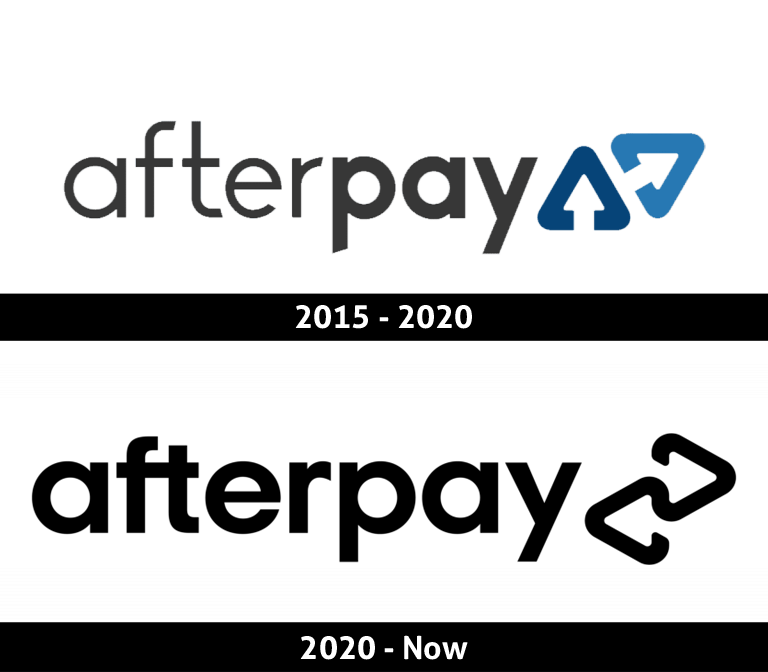
2015–2020: Dual-Arrow Momentum
The first official Afterpay logo was introduced in 2015, shortly after the platform’s launch. It featured a lowercase wordmark in dark gray, with typographic contrast between the lighter “after” and heavier “pay,” subtly emphasizing the action of payment as the core function.
The emblem consisted of two open, arrowhead-like triangular shapes in two shades of blue. The darker arrow stood vertically, while the lighter one leaned diagonally to the right, creating a sense of forward motion. The negative space within the shapes formed implied arrows, reinforcing movement and progress.
2020–Today: Refined Balance and Neutral Authority
In 2020, Afterpay refined its visual identity without altering its conceptual foundation. The wordmark was emboldened and unified, with all letters rendered in solid black at equal weight.
The emblem was simplified and reoriented. The two arrowheads were placed horizontally, pointing in opposite directions and connected by a short central line. This change shifted the symbolism from pure forward motion to equilibrium and flexibility.
The color palette was reduced to black and white, increasing adaptability across digital interfaces and partner branding environments.
Typography and Color Palette
Typography plays a defining role in the Afterpay logo description. The lowercase sans-serif wordmark projects approachability and modernity. One of its most distinctive features is the merged horizontal bars of the “f” and “t,” a subtle typographic gesture that enhances memorability without harming legibility.
Fonts similar to YD Yoonche Bold, Mont Bold, or Glence Heavy share comparable structure, though the Afterpay lettering includes custom modifications.
The modern color palette is intentionally minimal. Black and white convey professionalism, neutrality, and confidence, allowing the brand to integrate seamlessly into retailer environments. When used on promotional backgrounds, bright accent colors such as turquoise or green add energy without altering the core identity.
Logo Heritage in the BNPL Landscape
Afterpay’s logo heritage is defined by consistency and strategic restraint. While many fintech brands frequently redesign to chase novelty, Afterpay chose to evolve gradually, reinforcing recognition while adapting to scale.
Within discussions of BNPL logo history, Afterpay is often highlighted as a benchmark for visual clarity. Its logo communicates function instantly, without explanation, which is critical in checkout-driven user experiences.
Afterpay Logo as a Visual Promise
The Afterpay logo is a direct extension of the product itself. Clear, balanced, and modern, it communicates ease and control rather than obligation. By refining rather than reinventing its identity, Afterpay built a logo heritage that supports trust, usability, and long-term relevance in a rapidly evolving financial sector.
FAQ: Afterpay Logo Meaning and History
What does the Afterpay logo represent?
The logo represents flexible progress and balance, reflecting installment-based payments.
Why does the Afterpay logo use arrows?
The arrows symbolize movement through payments over time rather than immediate full payment.
When was the Afterpay logo redesigned?
The logo was refined and simplified in 2020.
Why is the Afterpay logo black and white?
Black and white ensure neutrality, adaptability, and professional clarity across platforms.