
Aerosmith Logo History: Meaning, Symbolism & Brand Heritage

Few rock bands have achieved the cultural longevity and global recognition of Aerosmith. Emerging in the early 1970s, the band became a defining force in American rock music, blending blues-based hard rock with mainstream appeal and theatrical flair. Alongside their sound, Aerosmith developed a visual identity that evolved dramatically over time, reflecting shifts in musical direction, cultural context, and branding maturity.
Just as the band’s music moved between raw experimentation and polished mastery, its logo history followed a similar trajectory. From ornate, emblem-heavy designs to stark minimalism and finally to a refined hybrid identity, the Aerosmith logo heritage tells a story of reinvention and return. Comparable to the enduring recognition explored in the Rolling Stones logo history and the symbolism-driven consistency behind the AC/DC logo history, Aerosmith’s emblem became a cornerstone of its brand mythology.
Meaning and History: The Origin of the Aerosmith Identity
Aerosmith was formed in Boston in 1970 and quickly rose to prominence through relentless touring and a string of influential albums. From the beginning, the band’s identity was closely tied to imagery associated with flight, freedom, and power, concepts deeply embedded in rock culture and American iconography.
The name “Aerosmith” itself evokes motion, machinery, and air, naturally lending itself to visual interpretations involving wings, emblems, and bold typography. As the band navigated early success, internal struggles, and later resurgence, its logo evolved alongside its narrative. Each redesign mirrored a specific era in the band’s career, making the Aerosmith logo history unusually rich and expressive.
Logo Meaning: Freedom, Power, and Rock Authority
The Aerosmith logo meaning revolves around dominance and liberation. Wings, stars, and bold lettering combine to express movement, ambition, and musical authority. Unlike logos designed purely for commercial branding, Aerosmith’s visual identity functions as a symbolic extension of its sound, aggressive yet melodic, rebellious yet refined.
The recurring wing motif directly references the band’s name while also aligning with rock’s long-standing association with transcendence and escape. Over time, the logo shifted from literal interpretations to more abstract and iconic forms, reflecting the band’s growing confidence in its legacy.
Logo Symbolism: Wings, Stars, and Iconography
In terms of logo symbolism, Aerosmith’s visual language draws heavily from aviation and Americana. Wings symbolize freedom, speed, and elevation, while stars suggest fame, ambition, and permanence. The frequent use of black and white reinforces contrast, power, and clarity, essential traits for a band whose identity needed to remain instantly recognizable across album covers, merchandise, and stage backdrops.
Unlike many bands that abandoned early symbolism in favor of typography alone, Aerosmith successfully merged both approaches, ensuring that its emblem could function independently of trends or eras.
Aerosmith Logo History Timeline
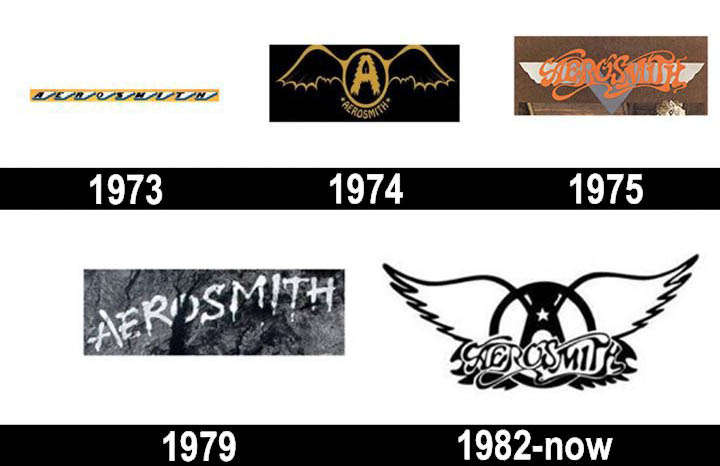
1973–1974: The Winged Letter Emblem
The first Aerosmith logo featured a horizontally stretched yellow badge with nine stylized white wings outlined in blue. Each wing carried one letter of the band’s name, rendered in black sans-serif type. The design was playful and experimental, capturing the exploratory spirit of the band’s early years while directly visualizing the “aero” element of the name.

1974–1975: The Bat Wing Oval
Introduced for the album Get Your Wings, this logo adopted a darker, more dramatic tone. A black and gold oval frame housed a stylized furry letter “A,” flanked by bat-like wings. The full band name arched along the bottom of the oval, accented by two five-pointed stars. This design leaned heavily into mysticism and theatrical rock imagery.
1975–1979: The Aviation Badge Era
In 1975, Aerosmith unveiled a logo featuring smooth orange lettering set in a custom typeface with elongated, flowing lines. The wordmark sat within a silver V-shaped badge resembling an aviation pin. This emblem blended speed, flight, and authority, reinforcing the band’s growing confidence and mainstream success.

1979–1982: Minimalist Typography Phase
The 1979 redesign marked a sharp departure from ornate symbolism. The band name appeared in thick white lettering against a structured, carbon-like black and gray background. This minimalist approach conveyed seriousness, stability, and a stripped-down musical identity during a turbulent period in the band’s history.

1982–Today: The Iconic Winged A
The definitive Aerosmith logo debuted in 1982 and remains in use today. It combines elements from earlier designs into a cohesive emblem. Smooth black lettering sits atop a black steering-wheel-like circle bearing a white five-pointed star. Two large white wings extend outward, outlined in black, forming a powerful and instantly recognizable symbol.
This logo represents the culmination of Aerosmith’s visual evolution, balancing ornament and restraint while honoring the band’s heritage.
Typography and Color Palette
Typography has always played a central role in the Aerosmith logo description. The current wordmark features a custom, fluid typeface with curved strokes and extended terminals, conveying motion and musical rhythm. The lettering feels organic rather than mechanical, aligning with the band’s blues-rock roots.
The color palette is intentionally limited. Black conveys power, elegance, and authority, while white represents clarity, confidence, and balance. Subtle blue accents on the wing edges add depth and dimension without overwhelming the core contrast.
Logo Heritage and Cultural Impact
The Aerosmith logo heritage extends far beyond album artwork. The winged emblem has become a global symbol of classic American rock, appearing on tour merchandise, stage sets, and popular culture references for decades. Its longevity places it among the most recognizable band logos in music history.
Within studies of rock band logo history, Aerosmith stands as an example of how visual consistency, once achieved, can reinforce legacy and transcend generational shifts in music consumption.
Conclusion: Aerosmith Logo as a Rock Icon
The Aerosmith logo is more than a graphic mark; it is a visual anthem. From its experimental beginnings to its refined modern form, the emblem reflects the band’s resilience, evolution, and enduring relevance. By embracing symbolism rooted in freedom and power, Aerosmith created a logo heritage that remains as influential as its music, securing its place among the most iconic identities in rock history.
FAQ: Aerosmith Logo Meaning and History
What does the Aerosmith logo represent?
The logo represents freedom, power, and rock authority, expressed through wings, stars, and bold custom typography.
When was the current Aerosmith logo introduced?
The iconic winged logo was introduced in 1982 and remains in use today.
Why are wings used in the Aerosmith logo?
Wings reference the band’s name and symbolize freedom, movement, and transcendence.
Has the Aerosmith logo changed often?
Yes, the band experimented with multiple designs between 1973 and 1982 before settling on its definitive emblem.