Aegean Airlines Logo History: Meaning, Symbolism & Brand Heritage
The visual identity of Aegean Airlines reflects the transformation of modern Greek aviation from a small private operator into one of Europe’s most respected network carriers. Built around maritime imagery, restrained symbolism, and a carefully refined color palette, the Aegean Airlines logo history mirrors the airline’s steady rise, strategic mergers, and integration into the global alliance system.
Within airline logo history, Aegean Airlines occupies a space comparable to Lufthansa logo history and TAP Air Portugal logo meaning, where national identity is expressed through abstraction rather than literal flags. As part of broader European airline logo heritage, Aegean demonstrates how regional culture can be translated into a timeless and internationally legible brand system.
Meaning and History: The Origin of the Aegean Airlines Identity
Aegean Airlines was founded in 1987 under the name Aegean Aviation, initially operating as a business aviation company. In the early 1990s, it became the first private airline in Greece, marking a turning point in the country’s aviation landscape. This shift toward commercial scheduled flights required a visual identity that balanced professionalism with national character.
Throughout the 1990s and early 2000s, the airline expanded rapidly, modernizing its fleet and broadening its route network. The merger with Cronus Airlines strengthened its domestic position, while the acquisition of Olympic Air in 2012 firmly established Aegean as Greece’s dominant carrier. These milestones shaped the logo meaning, which consistently emphasized reliability, openness, and a strong connection to the sea and sky.
In 2010, Aegean Airlines joined Star Alliance, a move that further influenced its branding direction toward clarity, elegance, and global consistency.
Logo Symbolism: Sea, Sky, and Hellenic Identity
The symbolism of the Aegean Airlines logo is deeply rooted in geography and cultural perception rather than explicit national emblems. The name itself references the Aegean Sea, a defining element of Greek identity, and this maritime influence is central to the logo’s visual language.
The recurring bird motif, often interpreted as seagulls, represents freedom, movement, and travel while maintaining a natural, human scale. The circular or arched form surrounding the birds suggests both the horizon line and the rising or setting sun, subtly merging sky and sea into a single symbolic gesture.
Color is equally meaningful. The use of deep and lighter shades of blue evokes the Greek flag without directly reproducing it, reinforcing national origin while remaining understated and internationally appropriate.
Aegean Airlines Logo History Timeline
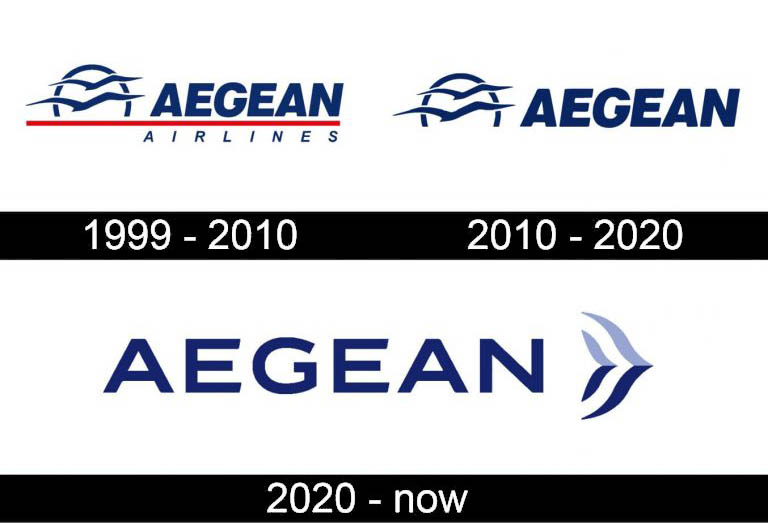
1999–2010: Emblem and Tricolor Divider Identity
The first widely recognized Aegean Airlines logo introduced in 1999 featured a complex yet balanced composition. At its core was a circular emblem containing two blue bird silhouettes. To the right appeared a two-level wordmark, with “Aegean” in bold italicized capitals above a thinner “Airlines” inscription.
A thick red horizontal line divided the two text levels, introducing contrast and visual hierarchy. This design combined elegance with assertiveness, reflecting the airline’s ambitions during a period of rapid growth and consolidation.
2010–2020: Minimalist Alliance-Era Refinement
The 2010 redesign marked a decisive simplification. The red divider line and the “Airlines” descriptor were removed, leaving a cleaner composition focused on the emblem and the “Aegean” wordmark. The circular frame around the birds was partially opened at the bottom, adding lightness and visual flow.
This minimalist identity aligned with Aegean’s entry into Star Alliance, projecting sophistication, efficiency, and international compatibility. The logo remained largely unchanged for nearly a decade, reinforcing brand stability.
2020–Present: Contemporary Horizon Symbol
In 2020, Aegean Airlines introduced a refined version of its emblem that enhanced symbolic clarity. The two birds were retained, now positioned against a larger arched form resembling a sun partially obscured by the sea horizon. This interpretation strengthened the marine and sky narrative inherent in the brand.
The typography remained modern and restrained, while the blue palette was subtly adjusted for digital environments and aircraft livery. The result is a logo that feels contemporary without abandoning its established visual heritage.
Aegean Airlines Logo Heritage and European Context
The logo heritage of Aegean Airlines is defined by continuity and measured evolution rather than radical change. Each redesign refined existing elements instead of replacing them, a strategy that supported long-term recognition and trust.
When compared with identities explored in Alitalia logo history or Iberia logo symbolism, Aegean stands out for its avoidance of overt nationalism. Its identity relies on atmosphere, landscape, and motion, making it both culturally specific and globally appealing.
Aegean Airlines Logo as a Modern Mediterranean Identity
The Aegean Airlines logo history demonstrates how a regional carrier can build a strong, enduring visual identity through symbolism, restraint, and consistency. By translating the sea and sky into abstract form, Aegean created a logo that reflects Greek heritage while meeting international branding standards. Within airline logo history and broader logo heritage analysis, it remains a benchmark for modern European airline design.
FAQ: Aegean Airlines Logo Meaning and History
What does the Aegean Airlines logo represent?
The logo represents the sea, sky, and freedom of travel through birds and horizon symbolism.
When was the first Aegean Airlines logo introduced?
A recognizable corporate logo was introduced in 1999.
Why did Aegean Airlines redesign its logo in 2010?
The redesign simplified the identity and aligned it with international alliance standards.
Is Aegean Airlines part of a global alliance?
Yes, Aegean Airlines has been a member of Star Alliance since 2010.