
AAA Logo History: Meaning, Symbolism & Brand Heritage

For more than a century, the American Automobile Association has existed as a parallel infrastructure for motorists, offering support, protection, and guidance in an ever-changing transportation landscape. Known universally as AAA, the organization is not merely a roadside assistance provider, but a system of trust built around mobility itself. Its logo heritage reflects this role with remarkable precision, evolving in step with technological progress, road development, and the changing relationship between people and automobiles.
Within the broader conversation around automotive logo history and brand heritage in mobility services, the AAA logo stands apart. Unlike commercial car brands, it was never designed to sell speed, luxury, or power. Instead, it communicates reliability, unity, and forward motion, translating abstract ideas like safety and infrastructure into visual form.
Meaning and History: The Origins of the AAA Identity
The American Automobile Association was founded in 1902, at a time when driving was neither simple nor safe. Roads were poorly marked, mechanical failures were frequent, and standardized traffic systems barely existed. AAA emerged by uniting independent automobile clubs across American cities, creating a national framework for motorists who needed information, advocacy, and emergency support.
From its earliest days, the organization’s visual identity was tied directly to its mission. The AAA logo meaning has always revolved around connection and assistance. Each redesign mirrored the Association’s expanding scope, from basic driver advocacy to mapping, navigation, tourism services, and eventually digital and satellite-based systems.
Rather than dramatic reinvention, the AAA logo heritage is defined by gradual abstraction, moving from literal mechanical imagery toward symbolic representations of roads, networks, and global reach.
AAA Logo History Timeline
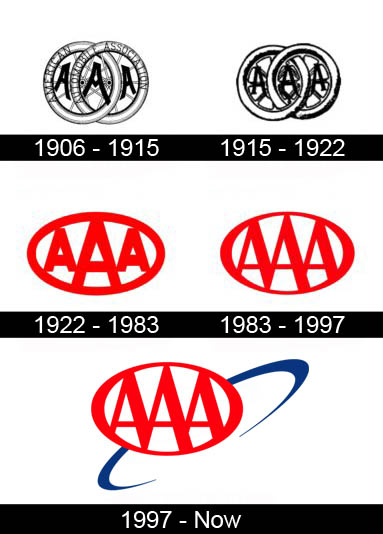
1906–1915: Wheels and Mutual Support
The first official AAA logo, introduced in 1906, featured two interlocked automobile wheels. Thin and spoked, they resembled early bicycle wheels, which was consistent with automotive design of the era. The wheels were linked like chain segments, a clear metaphor for cooperation and mutual assistance among drivers.
Inside each wheel appeared a capital letter “A,” forming the familiar triple-A abbreviation. The full name “American Automobile Association” was printed around the tire edges, emphasizing clarity and institutional legitimacy at a time when brand recognition was still emerging.
This logo reflected a world where driving was difficult and collective knowledge was essential.
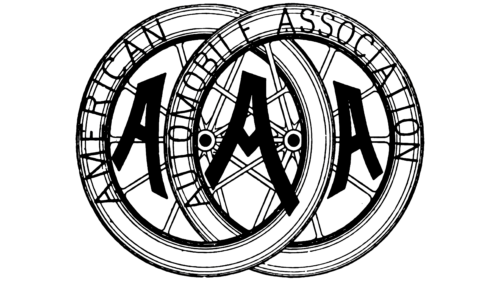
1915–1922: Reinforced Tires and Roadside Assistance
By 1915, roadside assistance had become a defining AAA service. As automobile technology evolved, so did tire construction, and the logo followed suit. The wheels grew bulkier, with segmented spokes resembling orange slices, mirroring real automotive wheels of the period.
Black elements appeared for the first time, reflecting the introduction of carbon black in tire manufacturing. The central “A” was placed between the spokes, reinforcing the idea of unity and shared responsibility. The logo symbolism during this era focused on durability, preparedness, and mechanical reliability.

1922–1983: Roads, Ovals, and National Unity
The 1922 redesign marked a significant conceptual shift. Literal wheel imagery was abandoned in favor of a stylized oval containing three capital “A” letters. The central “A” was emphasized, highlighting the word “Automobile” as the unifying element of the Association.
Thick linear strokes formed both the letters and the oval, evoking newly paved highways. This was no coincidence. In the early 1920s, America saw the introduction of multi-lane roads and standardized traffic systems. The logo’s structure echoed this transformation, symbolizing flow, direction, and organized movement.
This version became one of the longest-lasting in AAA logo history, reflecting institutional stability.
1983–1997: Cartography and Information Networks
In 1983, the logo was refined again. Lines became thinner, edges more dimensional, and the three “A” letters were connected at their bases in a zigzag formation. The oval enclosure remained, but now suggested segmentation, subtly referencing regional clubs operating under a national umbrella.
This period coincided with AAA’s major expansion into cartography and travel information. Highway atlases, tourist guides, and early data systems transformed how Americans traveled. The logo symbolism shifted accordingly, representing interconnected data, mapped routes, and shared information rather than mechanical support alone.
1997–Today: Global Reach and Digital Navigation
The modern AAA logo, introduced in 1997, represents the most abstract and future-oriented design in the organization’s history. The oval now resembles a stylized globe, with the red “AAA” lettering extending upward, breaking beyond the boundary.
This visual gesture symbolizes moving beyond traditional limits, embracing satellite navigation, GPS technology, and digital infrastructure. By the late 1990s, GPS systems were fully operational, enabling real-time route planning and location-based services. The logo reflects this shift from physical roads to global, computerized navigation networks.
The current emblem communicates progress, connectivity, and global awareness while maintaining continuity with past designs.
Logo Symbolism: Roads, Networks, and Forward Motion
The AAA logo symbolism has always been functional rather than decorative. Early wheels symbolized mechanical motion and shared effort. Later ovals represented roads, unity, and national systems. The modern globe-like form suggests planetary coverage and technological integration.
The upward movement of the red lettering beyond the blue oval reinforces the idea of expansion and advancement. It visually communicates that AAA is not confined to static infrastructure but evolves alongside technology and mobility itself.
Typography and Color Identity
AAA’s typography is bold, sans-serif, and uncompromising. Straight lines and heavy strokes evoke highways, stability, and ease of navigation. Legibility has always been a priority, reflecting the organization’s role as a guide rather than a marketer.
Color plays a deeply symbolic role. Red represents urgency, speed, and emergency response, recalling roadside breakdowns and SOS situations. Blue conveys trust, sky, and satellite technology, reinforcing the Association’s role in navigation and long-distance travel.
Together, these colors balance human vulnerability with technological reassurance.
Conclusion: A Logo Built for the Long Road
The AAA logo heritage is a rare example of institutional branding that evolved alongside infrastructure itself. From fragile early roads to satellite-guided navigation, the logo has consistently translated complex systems into simple, recognizable symbols.
Within the broader analysis of automotive logo history, service brand identity, and mobility infrastructure branding, AAA stands as a benchmark. Its logo does not promise excitement or luxury. It promises something far more enduring: that help is never far away, and the road ahead is navigable.
FAQ: AAA Logo Meaning and History
What does the AAA logo represent?
The logo represents unity, mobility, and assistance for drivers, evolving from mechanical imagery to global navigation symbolism.
What do the three letters AAA stand for?
They stand for American Automobile Association.
Why does the AAA logo look like a globe today?
The modern design reflects satellite navigation, global connectivity, and digital infrastructure.
What colors define the AAA brand?
Red and blue are the primary colors, symbolizing urgency, movement, trust, and technology.