
Mazda Logo History: Meaning, Symbolism & Brand Heritage

Few Japanese automakers have woven spiritual meaning, engineering innovation, and design evolution together as seamlessly as Mazda. Founded in Hiroshima in 1929 by Jujiro Matsuda, the company began as a manufacturer of cork and heavy machinery before unveiling its first automobile in 1931. Today, Mazda stands among the world’s top automakers, celebrated for its distinctive design philosophy, its mastery of rotary-engine engineering, and its characteristically human approach to driving.
Beyond its vehicles, Mazda has built one of the most poetic and symbolic logo heritages in the automotive world. The brand’s name carries two intertwined meanings: a Western adaptation of founder Jujiro Matsuda’s surname, and a tribute to Ahura Mazda — the ancient god of harmony, wisdom, and light. This duality has shaped every emblem the company has ever crafted.
Mazda’s logo story is not just a visual evolution but a journey through identity, culture, and philosophy. It reveals how a brand born in a devastated Hiroshima grew into a global automaker while keeping its core values — balance, motion, harmony — alive in each redesign.
Mazda Logo Evolution Timeline
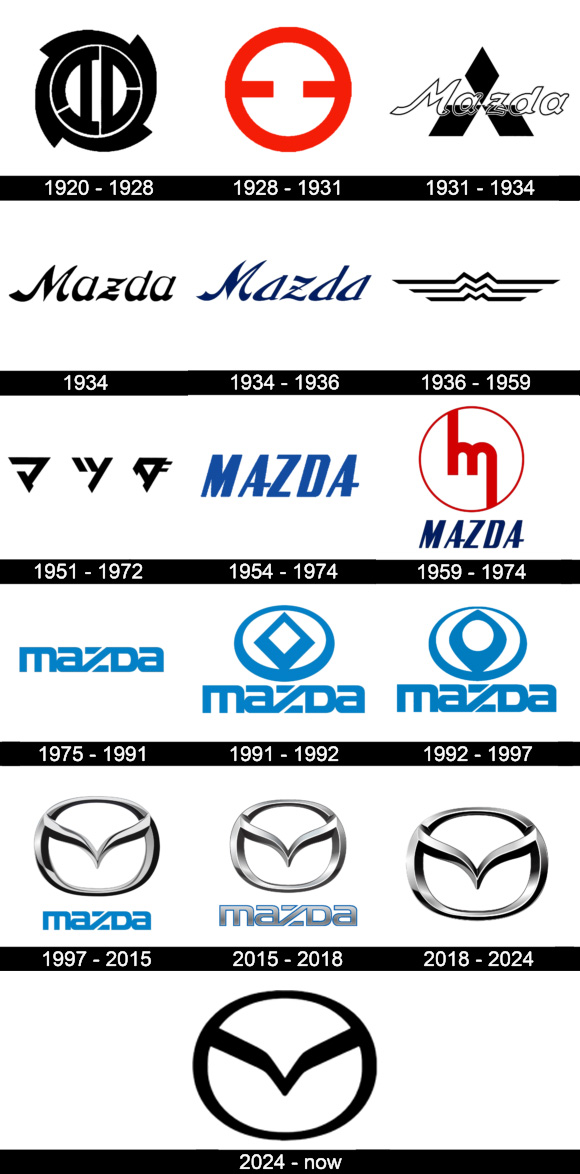
1920–1928: The Industrial Monogram
Mazda’s first emblem was introduced in 1920, long before its debut automobile. The badge featured a powerful abstract symbol composed of thick black lines arranged in a rounded circular form reminiscent of a shuriken, the iconic ninja throwing star. It communicated strength, precision, and industrial seriousness — a fitting identity for a company still producing tools and machinery.

1928–1931: The Minimalist Red Circle
In 1928, Mazda simplified its visual identity dramatically. A crisp red circle enclosed two bold white horizontal lines extending toward the center. The symbol remained abstract and geometric, suggesting technological rigor and Japanese minimalism. The logo’s clarity foreshadowed the company’s shift toward automotive production.

1931–1934: The Mitsubishi Diamond Era
Mazda’s first official automotive badge arrived in 1931 and was surprisingly unexpected: it featured the three-rhombus Mitsubishi diamond emblem. At the time, Mazda manufactured vehicles under contract with Mitsubishi, and the shared badge represented that collaboration. The word “Mazda,” set in an elegant, ornamental cursive, flowed across the geometric symbol in blue and white.
1934: The First Standalone Wordmark
By 1934, Mazda gained the confidence to separate its identity from Mitsubishi. The brand introduced its first exclusive wordmark, an italic script inspired by the previous version but rendered in clean, refined black lines. That same year, Mazda launched its first three-wheel truck — a milestone that marked its definitive entry into the automotive world.
1934–1936: The Elegant Script Identity
A refined script logo appeared shortly after, maintaining the italicized forms but now with even smoother contours and better readability. This logo accompanied Mazda’s early vehicle manufacturing phase and became a gentle, sophisticated reflection of the brand’s emerging personality.
1936–1959: The Hiroshima “Triple M”
Mazda introduced one of its most symbolic logos in 1936. Inspired by the emblem of Hiroshima, the design featured three gracefully curved lines forming three interconnected letter “M” shapes — representing Mazda Motor Manufacturer. The flowing geometric symbol was also a stylized interpretation of the rivers that shape Hiroshima’s geography and the dynamism of aviation. It was a culturally rooted, deeply meaningful badge that defined Mazda through the prewar and postwar years.
1951–1972: The Triangular Abstraction
In 1951, Mazda debuted a bold black-and-white emblem built from three inverted triangles arranged in abstract harmony. The combination of thick and thin lines gave the symbol a mysterious, modernist energy. This logo accompanied the company through its early global expansion and represented Mazda’s evolving engineering ambition.
1954–1974: The Blue Wordmark
In the mid-1950s, Mazda introduced a clean and modern blue wordmark. Executed in a narrow italic sans-serif typeface, the uppercase letters projected discipline and purpose. The restrained palette and sharp contours aligned Mazda with the rising precision of Japanese automotive design.

1959–1975: The Circular “M”
As Mazda began selling its first passenger cars, it introduced a new “M” enclosed within a circle. Its soft, bold lines emphasized approachability and design awareness. The emblem was deliberately crafted to be memorable and distinct, aligning with Mazda’s commitment to new engineering frontiers, including its early rotary-engine experiments.
1975–1991: The Iconic Futuristic Logotype
In 1975, Mazda unveiled a wordmark that became one of the most recognizable typographic emblems in automotive history. Its futuristic, geometric lettering — characterized by the distinctive “Z” with a horizontal stencil cut — reflected Mazda’s bold vision for the modern era. Remarkably, this logotype remains in use today and has become inseparable from the brand’s identity.
1991–1992: The Diamond of Light
Mazda returned to symbolic forms in 1991. The new emblem introduced a diamond shape representing light and the rising sun. Its geometry aligned with Mazda’s philosophical roots: harmony, wisdom, and the illuminating nature of innovation. A year later, the design was softened with smoother contours and gentler curves, becoming the foundation for the modern emblem.
1992–1997: The Softened Winged Diamond
The 1992 redesign refined the diamond into a more circular, flowing form. The logotype became lighter and slightly smaller. This balance between rounded geometry and dynamic lines conveyed loyalty, trust, and forward movement — qualities Mazda championed in its design and engineering.
1997–2015: The Birth of the Modern “Winged M”
In 1997, Mazda unveiled the emblem the world now instantly recognizes: a stylized “M” shaped like spread wings enclosed in an oval. The symbol represented vitality, creativity, and Mazda’s philosophy of motion. Its symmetrical curves suggested balance and aerodynamics, while the bright blue wordmark beneath it added a sense of flight and optimism. This logo marked Mazda’s global rise and remained unchanged for nearly two decades.
2015–2018: The Matte Silver Identity
Mazda refined its emblem in 2015 by replacing gloss with a matte silver finish. The wordmark also shifted from blue to silver, accented with a delicate blue outline that honored Mazda’s historical palette while signaling contemporary sophistication. The emblem became quieter, more luxurious, and more reflective of Mazda’s emerging premium direction.
2018–2024: Modern Minimal Luxury
A subtle redesign in 2018 rendered the emblem in a deeper silver-gray, paired with a lowercase wordmark that softened the identity. This iteration looked futuristic and sleek, presenting Mazda as a forward-thinking brand centered on precision and craftsmanship.
2024–Today: The New Flat Minimalist Mazda
Mazda’s 2024 redesign brought the logo fully into the era of digital clarity. The emblem was flattened into bold black lines, stripping away gradients and metallic tones in favor of strong geometry and clean angles. The result is a modern, innovative mark that retains the essence of the winged “M” while offering a more contemporary visual language suited for electric vehicles and digital platforms.
The Symbolism of the Mazda Emblem
Mazda’s emblem has always carried deeper meaning. The winged “M” symbolizes flight, evolution, and the brand’s commitment to movement — not just mechanical but philosophical. The shapes represent flexibility and vitality, echoing Mazda’s devotion to the “Jinba Ittai” philosophy: the harmony between driver and machine.
The oval surrounding the wings signifies an unbroken cycle of innovation, while the emblem’s overall symmetry expresses balance — a fundamental value in Mazda’s design language.
Font and Color: The Technical DNA of Mazda’s Identity
Mazda’s modern wordmark, still based on the 1975 logotype, is one of the most identifiable typographic marks in the industry. Its sans-serif geometry echoes futurism and mechanical precision. The stencil-like treatment of the “Z” distinguishes it from any comparable typeface.
The color palette has evolved from blue to silver to black. Mazda’s metallic tones were designed to complement its Kodo Design philosophy — elegant, minimal, almost sculptural. The new flat black emblem introduced in 2024 marks a shift toward digital adaptability and timeless simplicity.
What Does the Mazda Logo Represent?
At its core, the Mazda logo is a visual representation of progress. It symbolizes the brand’s origin in Hiroshima, its spiritual roots in Ahura Mazda, and its devotion to moving forward with harmony, light, and innovation. The winged metallic emblem, in particular, represents freedom, creativity and a future-oriented mindset.
Mazda’s logo changes have never been arbitrary; they reflect the company’s evolution from industrial tools to rotary engines, from compact sedans to premium crossovers, and now to electrification.
A Symbol of Harmony, Motion, and Light
Mazda’s logo history is the story of a brand constantly refining its identity without losing its soul. From abstract industrial shapes to the elegant winged “M” of today, each iteration reflects Mazda’s unwavering commitment to harmony, motion, and technological artistry. The modern emblem stands as a tribute to both the company’s ancient spiritual influences and its bold pursuit of automotive innovation. Few logos in the automotive world carry such depth — or such an enduring connection to the values that shaped them.
Mazda Logo FAQ: History, Meaning, Symbolism and Evolution
What does the Mazda logo symbolize?
The Mazda logo symbolizes flight, motion, creativity, and the spiritual ideals of harmony and light inspired by Ahura Mazda.
Why did Mazda change its logo over time?
Each redesign reflects Mazda’s technological evolution, design philosophy, and alignment with new vehicle directions, from rotary engines to modern electrification.
What does the name Mazda mean?
The name combines Jujiro Matsuda’s surname with Ahura Mazda, the ancient god of harmony and wisdom.
When did the winged “M” Mazda logo debut?
The modern winged “M” was introduced in 1997 and has since defined Mazda’s global identity.