
HP Logo History: Meaning, Symbolism & Brand Heritage
Few brands in Silicon Valley can claim a heritage as foundational—and as enduring—as Hewlett-Packard. Long before HP became synonymous with personal computers and printers, it was the quiet engine powering the early tech revolution. The company was born not in a corporate tower but in a small Palo Alto garage, now famously referred to as the “Birthplace of Silicon Valley.” From this unassuming beginning in 1939, HP’s identity grew into one of the most recognizable symbols of American innovation.
Across nearly a century, HP’s logo has reflected the company’s evolution—from experimental engineering shop to global technology powerhouse. What makes HP’s visual identity unique is its continuity: the “HP” monogram, enclosed in a circle, has remained its core symbol since day one. Yet each redesign subtly mirrors the shifts in technology, design culture, and the company’s own ambitions. What started as a simple italic monogram has evolved into a forward-leaning, ultraminimal emblem that speaks to the future of computing.
Welcome to a deep dive into the heritage, symbolism, and evolution of the HP logo—one of tech’s most enduring visual identities.
The Early Years: How HP’s Visual Identity Began (1939–1954)
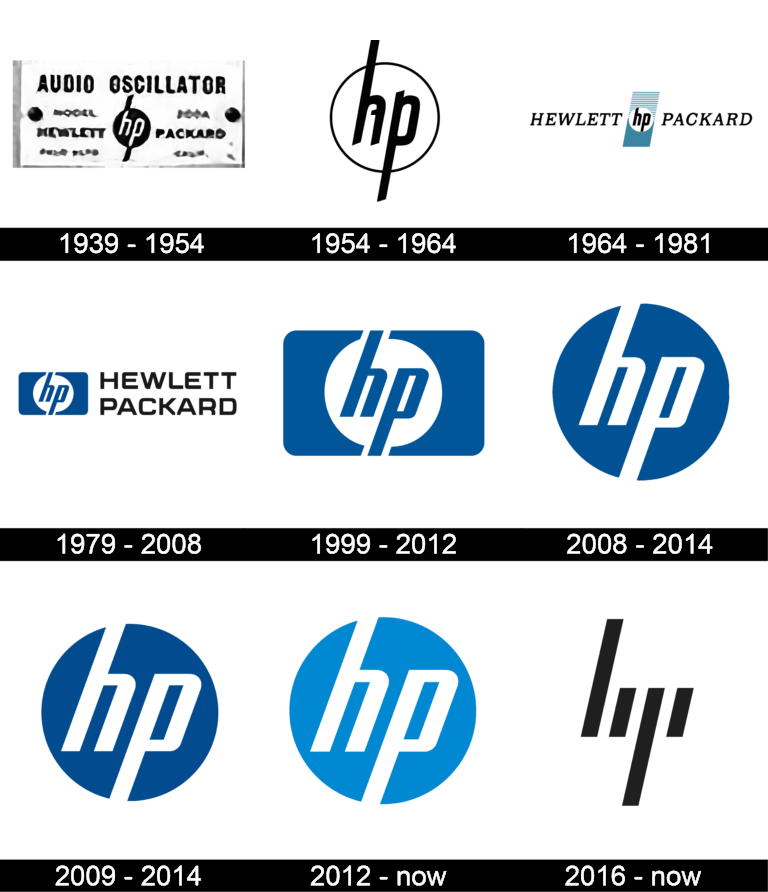
When Bill Hewlett and Dave Packard founded Hewlett-Packard in 1939, the technology industry as we know it didn’t exist. Their first logo—a circular badge featuring a slanted, lowercase “hp” with elongated strokes extending outside the circle—captured the experimental spirit of a new engineering era. Rendered in stark black and white, the emblem was technical, direct, and utilitarian.
This first monogram was paired with the formal “Hewlett-Packard” name printed on both sides of the badge in strong uppercase lettering. It functioned less like a consumer brand and more like a maker’s mark for professional equipment—appropriate for a company initially focused on test instruments and engineering solutions rather than personal devices.
Refinement and Simplification (1954–1974)
In 1954, HP embraced a cleaner, more modern look. The wordmark disappeared, leaving only the circular monogram. The sharply elongated descenders remained, but the composition became more balanced, more geometric, and more adaptable across printed manuals, machinery, and new product lines.
By the mid-1970s, as HP grew beyond engineering instruments into computing, a new iteration appeared: a vertically oriented blue-and-black badge with a white circle centered inside. The company name returned under the emblem in a refined serif typeface, slightly italicized to match the emblem’s forward-leaning energy. This marked the transition from engineering shop to global tech brand.
The Blue Era: HP Becomes a Household Name (1979–2008)
As the computing revolution accelerated, HP adopted the color palette that would define it for decades: blue, white, and black. The iconic blue rectangle with rounded corners became synonymous with reliability and professional technology. The monogram was cleaned up, the lines streamlined, and the brand leaned into simplicity and trustworthiness.
This era coincided with HP’s entry into personal computing and printing. Millions of people encountered the blue badge on home printers, desktop towers, and corporate machines. It was during these decades that HP solidified its reputation as a practical, user-friendly technology brand—reliable, approachable, and ubiquitous.
Toward Modern Minimalism (1999–2014)
In 1999, HP removed all secondary text and allowed the “hp” circle to stand entirely on its own. The lettering was refined again—this time cleaner, more geometric, and more assertive. This symbol became instantly recognizable worldwide.
In 2008, HP reversed its color scheme, placing a white monogram against a deep blue circular background. The effect was fresher and more modern, with a subtle sense of depth. Letter spacing increased slightly in 2009, giving the badge more clarity and precision—mirroring the streamlined industrial design of HP laptops and devices during this period.
By 2012, the blue shifted to a lighter sky tone, softening the brand’s visual personality and aligning with the era’s bright, friendly consumer tech aesthetic.
A Radical Leap: The Experimental “HP” Slash Logo (2016–Today)
Perhaps the most dramatic shift in HP’s visual identity arrived in 2016, when HP introduced a futuristic, ultra-minimal mark for its premium product lines. Created by Moving Brands, the logo is simply four parallel diagonal lines angled at 13°, representing the abstract forms of “h” and “p.” It is sleek, sharp, and unmistakably modern—with a hint of mystery.
Interestingly, HP had this concept in hand as early as 2011, but its boldness delayed adoption. For a company built on heritage, the jump from a classic circular badge to a near-symbolic abstraction was a major philosophical shift. Today, this mark appears primarily on HP’s premium laptops, gaming systems, and designer collaborations.
The “slash” emblem reflects a new vision of the brand: forward-thinking, future-oriented, minimal, and expressive. It captures HP’s belief that great design doesn’t need to explain itself—it can speak through innovation.
Symbolism and Meaning Behind the HP Logo
At its core, the HP logo—across all iterations—represents:
• Engineering heritage.
The original monogram reflects the company’s birth in precision instruments and scientific equipment.
• Forward motion.
The italic slant of early logos was a deliberate signal of innovation and progress.
• Approachability and trust.
Blue dominates HP’s identity because the brand long associated itself with stability, professionalism, and loyalty—key traits in technology.
• Minimalism as modernity.
The slash logo reduces HP to pure geometry, reflecting contemporary trends toward simplicity, symmetry, and abstraction.
Whether enclosed in a circle or sliced into diagonal strokes, the HP logo remains one of the most recognizable symbols in the tech world.

Typography and Color: Why HP Looks the Way It Does
HP’s heritage is built around a consistent use of:
Blue.
Symbolizing trust, intelligence, clarity, and technological reliability. HP’s blue has ranged from deep corporate navy to light contemporary sky tones.
White.
A supporting color representing simplicity, neutrality, and clean industrial design.
Sans-serif geometry.
Even when stylized or italicized, HP typography has always embraced clarity and legibility.
The experimental slash logo pushes typography into pure form—letters without letters—showing just how powerful HP’s identity has become.
The Heritage of HP’s Timeless Identity
Few technology brands have maintained such visual consistency while embracing radical reinvention. The HP logo tells a story of engineering roots, global expansion, and modern minimalism. Its evolution reflects the company’s journey from a garage start-up to an international innovator—and its ability to adapt without losing sight of its heritage.
From the iconic circular monogram to the futuristic slash emblem, HP has proven that great design can be both timeless and forward-looking. In every era, the logo captures the same core message: innovation, reliability, and a belief that technology should move the world forward.
FAQ: HP Logo & Branding
1. Why has HP kept the same basic “hp” monogram for so long?
Because it’s part of the company’s heritage. The circular monogram debuted in 1939 and remains one of the most recognizable marks in tech.
2. What does the angled “slash” logo represent?
Created by Moving Brands, the four diagonal lines represent abstract forms of “h” and “p.” The design symbolizes speed, innovation, and HP’s future-focused identity.
3. Why does HP primarily use blue?
Blue conveys trust, reliability, and intelligence—traits essential for a global technology company and historically associated with engineering precision.