
eBay Logo History: Meaning, Symbolism & Brand Heritage

Few online brands have shaped the digital economy the way eBay has. Launched in 1995 from a living room in San Jose, eBay turned the once-niche idea of online auctions into a global phenomenon. Its colorful logo—simple, bright, and unmistakably playful—became a visual landmark of early internet culture. Behind this symbol lies a deeper logo heritage story that mirrors eBay’s evolution from a quirky startup to a trusted multinational marketplace.
This article explores how eBay’s logo history evolved over time, what each redesign represented, and why its modern emblem remains one of the most recognizable symbols of e-commerce.
The Origins of eBay: From AuctionWeb to a Global Marketplace
eBay’s story begins in 1995, long before online shopping was part of everyday life. What started as a simple side project in Pierre Omidyar’s San Jose living room quickly evolved into one of the most influential digital marketplaces in history. Originally called AuctionWeb, the site was born from Omidyar’s interest in creating a level playing field where anyone could buy or sell anything through an open online auction system. Its first-ever listed item—a broken laser pointer—sold for $14.83, proving that even niche or unusual objects could find value in a global marketplace.
As users flocked to the platform, AuctionWeb began to outgrow its humble beginnings. Omidyar hired his first employee, introduced features like categories and feedback tools, and laid the groundwork for a trusted community-driven ecosystem. In 1997, the company officially rebranded to eBay, a shorter, catchier name inspired by Omidyar’s consulting firm, Echo Bay. The rebrand marked a turning point, signaling the shift from a small experimental website to a rapidly scaling platform capable of serving millions.
From there, eBay’s expansion was unstoppable. It went public, opened international branches, and diversified into new product categories and services. The introduction of secure payment systems, especially the acquisition of PayPal, helped cement eBay as a global leader in e-commerce. What began as a single-page experiment became a multibillion-dollar marketplace that transformed how people buy, sell, and trade around the world.
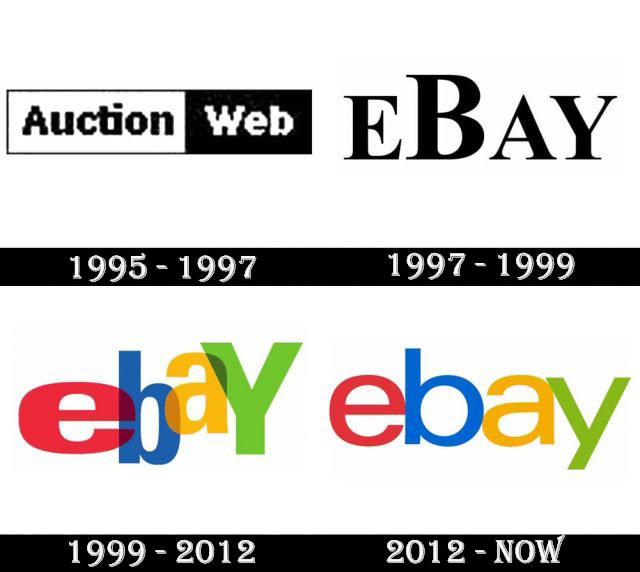
The Evolution of the eBay Logo
1995–1997: The AuctionWeb Beginning
The very first “logo” wasn’t a logo at all, but a functional black-and-white badge. A rectangular block divided into two halves—one white with black Auction, the other black with white Web. Bold pixel-style lettering gave it a techy, homemade feel. It suited the experimental nature of early internet startups.
It didn’t last long, but it set the foundation for eBay’s first attempts at brand identity.

1997–1999: The First eBay Wordmark
With the rebrand to “eBay” in 1997 came a minimalist logo: simple black lettering in a serif font, with an oversized “B” dominating the composition. This version felt confident and more corporate, as the brand transitioned from a hobby project to a real business.
It was clean—but not iconic yet.
1999–2012: The Iconic Color Explosion
1999 marked a major milestone in eBay logo history. Designer Elissa Davis introduced a vibrant new identity—one that instantly became synonymous with e-commerce in the early internet era.
Each letter was a different color:
Red, Blue, Yellow, Green
The letters overlapped like playful building blocks and jumped unevenly across the baseline. The aesthetic captured the wild, eclectic, always-surprising nature of eBay’s inventory.
This was eBay’s golden era of brand recognition. From collectibles to cars, the colorful lettering became synonymous with online shopping itself.
2012–Today: A Cleaner, Modern Classic
In 2012, global consultancy Lippincott refined the iconic concept. The familiar colors remained, but the letters were straightened, separated, and aligned on a single baseline.
A more contemporary, consistent, and minimalist design emerged—one that reflected eBay’s evolution from startup energy to stable global commerce.
The modern logo still retains its joyful palette, but with a more polished, trustworthy feel.
Symbolism & Meaning Behind the eBay Logo
1. The Colors
eBay has always used four signature colors:
Red, Blue, Yellow, Green.
Each letter having its own color emphasizes diversity, variety, and openness—fitting for a marketplace where anything can be bought or sold.
2. Community & Connection
The original overlapping letters symbolized interaction, movement, and a vibrant online community. Even with the modern clean version, the spirit remains intact.
3. Univers Typeface
Surprisingly, almost all eBay logos use versions of the Univers typeface.
Early versions used a very bold Univers, while the modern one uses a cleaner, thinner adaptation.
4. Logo Heritage Influence
eBay’s logo heritage is a perfect example of how a brand can modernize without losing its identity. The design has changed—yet remained emotionally familiar.
eBay’s Impact on E-Commerce
eBay created the blueprint for online auctions long before e-commerce became mainstream. It transformed:
-
Brick-and-mortar auction culture
-
Classified-style buying and selling
-
Peer-to-peer commerce
-
Online payment security (via PayPal)
-
Global collector and reseller markets
Its logo became a flagship symbol of early digital culture—colorful, inclusive, and optimistic.
5 Quick Facts About eBay’s Logo Heritage
1. The iconic colored letters were inspired partly by the original Apple logo and the Twister game.
2. “eBay” comes from Echo Bay, but the domain was already taken—so “eBay.com” was chosen.
3. The broken laser pointer that launched the company is often considered the first “symbolic product” of online auctions.
4. Elissa Davis designed the 1999 logo—her first major project at CKS Partners.
5. The 2012 redesign aimed for “clean, contemporary, consistent”—reflecting a matured global brand.
Conclusion
The eBay logo remains one of the digital world’s most recognizable symbols—a mix of playfulness, trust, and familiarity. Its logo history shows a thoughtful evolution: from rough early experiments to a polished, global identity. And despite modern refinements, its core personality has never changed.
That consistency is what gives the eBay logo its enduring power and its special place in the world of logo heritage.
FAQ
Why are eBay’s logo letters different colors?
The multi-color palette symbolizes variety, diversity, and the limitless range of items available on the marketplace.
Did eBay ever change its name?
Yes. It began as AuctionWeb and became “eBay” in 1997.
Who designed the colorful eBay logo?
Graphic designer Elissa Davis created the famous 1999 version.
Why was the logo redesigned in 2012?
To modernize the brand, improve consistency, and reflect a more polished marketplace.
What font does the eBay logo use?
A customized version of Univers.
Does eBay still use overlapping letters?
No, since 2012 the letters have been aligned and no longer overlap.