Aeropostal Alas de Venezuela Logo History: Meaning, Symbolism & Brand Heritage

The visual identity of Aeropostal Alas de Venezuela stands among the most historically significant in Latin American aviation. As one of the oldest airlines in the region, Aeropostal’s logo history reflects nearly a century of technological ambition, national pride, and shifting design philosophies. Its evolution mirrors Venezuela’s own aviation development, moving from heraldic emblems and ornate typography to a modern, streamlined airline identity.
Within airline logo history, Aeropostal occupies a position comparable to brands such as Avianca logo history and Aeroméxico logo meaning, where early aviation symbolism gradually transitioned into contemporary corporate branding. As part of broader Latin American airline logo heritage, Aeropostal’s visual identity illustrates how tradition and modernization can coexist within a national carrier.
Meaning and History: The Origin of the Aeropostal Identity
Aeropostal Alas de Venezuela was founded in 1929 by Italian aviator Arturo Ferrarin and French aviation pioneer Pierre-Georges Latécoère. From its earliest years, the airline was conceived as a strategic national project, designed to connect Venezuela internally and establish international routes that positioned the country within global aviation networks.
During the mid-20th century, Aeropostal became a technological leader in the region. In the 1940s, it achieved a historic milestone by becoming the first Latin American airline to operate transatlantic flights. This pioneering role strongly influenced the logo meaning, which emphasized wings, motion, and national authority rather than abstract corporate minimalism.
As aviation technology evolved and global branding standards shifted, Aeropostal’s visual identity adapted accordingly. While economic and political challenges later constrained operations, the airline’s logo remained a powerful symbol of Venezuela’s aviation heritage.
Logo Symbolism: Wings, Flight, and National Authority
The symbolism of the Aeropostal Alas de Venezuela logo has consistently revolved around flight, prestige, and national representation. Early logos relied heavily on wings, medallions, and heraldic structures, reflecting the era when aviation was associated with nobility, exploration, and state power.
Typography played a central symbolic role. Multi-level inscriptions with emphasized initials reinforced authority and readability, while later designs moved toward clarity and efficiency. Color palettes combining blue, yellow, red, and white echoed both aviation conventions and national identity, reinforcing Aeropostal’s role as a flag carrier.
In its modern form, symbolism became more abstract. The stylized bird introduced in the late 1990s distilled decades of wing-based imagery into a clean, forward-moving emblem that aligned with contemporary airline branding.
Aeropostal Alas de Venezuela Logo History Timeline
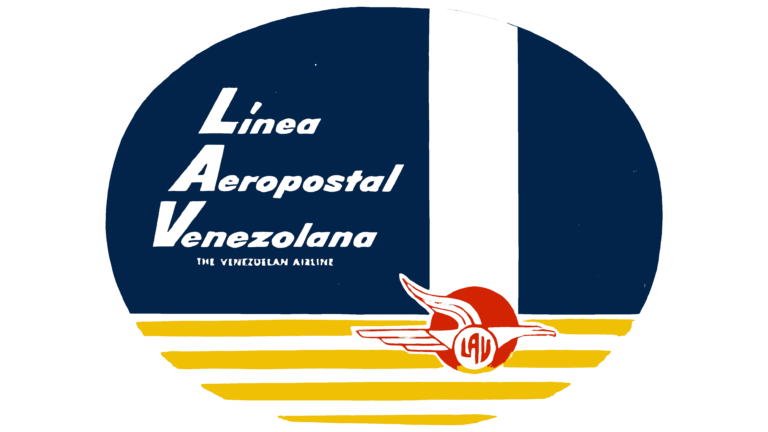
1930s–1940s: Heraldic Medallion and LAV Identity
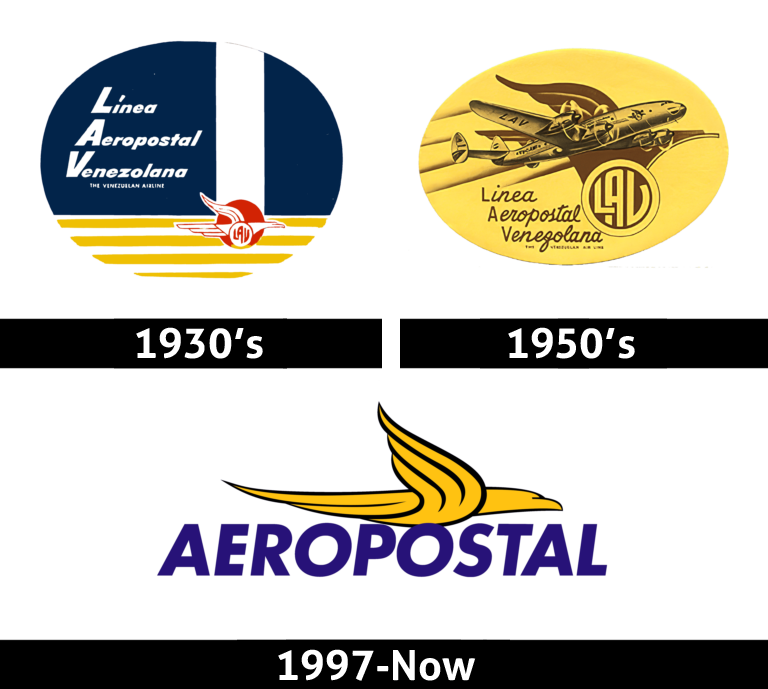
The earliest Aeropostal logos featured oval medallions rendered in navy blue, yellow, red, and white. Slanted three-level lettering emphasized the initials “LAV,” standing for Líneas Aéreas Venezolanas. Accompanying the typography was a heraldic winged emblem, conveying authority, tradition, and national pride during aviation’s formative years.
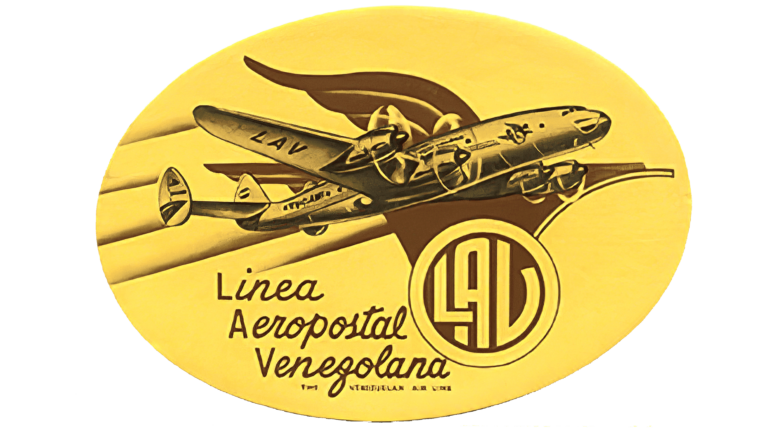
1950s–1960s: Illustrated Aircraft Emblem Era
In the 1950s, Aeropostal adopted a highly detailed logo depicting a retro aircraft drawn in brown gradient strokes against a yellow medallion. The airline’s name appeared in expressive cursive lettering, again arranged across multiple lines with emphasized initials. This version celebrated technological progress and the romance of flight characteristic of the post-war aviation era.
1997–Present: Modern Wordmark and Stylized Bird
The 1997 redesign marked a decisive shift toward modern airline branding. The ornate medallions and illustrative aircraft were replaced with a bold, uppercase “Aeropostal” wordmark in a slightly slanted geometric sans-serif typeface. Above it, a minimalist yellow-and-black bird emblem symbolized motion, direction, and renewal.
This identity aligned Aeropostal visually with international carriers, improving scalability across aircraft liveries, signage, and digital platforms while preserving symbolic continuity through flight imagery.
Aeropostal Logo Heritage and Regional Impact
Aeropostal’s logo heritage reflects the broader trajectory of Latin American aviation branding, where early romantic and heraldic designs gradually yielded to functional modernism. Unlike newer carriers without historical depth, Aeropostal carried decades of symbolic weight into each redesign.
When compared with identities discussed in Copa Airlines logo history or LATAM logo symbolism, Aeropostal stands out for its long reliance on emblematic storytelling before embracing abstraction. Even during periods of operational difficulty, its logo remained a recognizable marker of national aviation identity.
Aeropostal Logo as a Legacy of Venezuelan Aviation
The Aeropostal Alas de Venezuela logo history captures nearly a century of aviation evolution, from decorative heraldry to modern corporate clarity. Each redesign responded to changing technological, cultural, and economic realities while preserving the core symbolism of flight and national connection. Within airline logo history and broader logo heritage studies, Aeropostal remains a powerful example of how visual identity can embody both ambition and legacy.
FAQ: Aeropostal Alas de Venezuela Logo Meaning and History
What does the Aeropostal logo represent?
The logo represents flight, national identity, and aviation heritage through wings and bird symbolism.
When was Aeropostal Alas de Venezuela founded?
The airline was founded in 1929.
Why did Aeropostal redesign its logo in 1997?
The redesign modernized the brand and aligned it with contemporary international airline standards.
Is Aeropostal still operating today?
Aeropostal suspended regular operations in 2017 but remains an important symbol of Venezuelan aviation history.