
Air France Logo History: Meaning, Symbolism & Brand Heritage
The visual identity of Air France is among the most refined and historically layered in global aviation. Beyond its modern wordmark, the airline preserves a lesser-known but deeply symbolic heritage icon: the Hippocampe Ailé, or Winged Seahorse. Together, these elements tell a story of national pride, mythological symbolism, and careful brand evolution shaped by nearly a century of aviation history.
Within international airline branding, Air France occupies a space comparable to identities explored in Aerolíneas Argentinas logo history and Aeroflot logo meaning, where national heritage remains embedded in contemporary design. As part of the broader airline logo heritage, Air France demonstrates how a carrier can modernize visually while maintaining a strong connection to its origin and cultural symbolism.
Meaning and History: The Origin of the Air France Identity
Air France was founded on October 7, 1933, through the consolidation of several French airlines. From the beginning, the company positioned itself not merely as a transportation provider but as a national symbol representing French elegance, technical expertise, and global reach. This positioning strongly influenced its early logo meaning, which combined aviation imagery with mythological references.
The airline’s development paralleled key moments in European aviation history, including postwar expansion, the jet age, and later globalization. Strategic milestones such as the merger with Air Inter in 1997, the creation of the SkyTeam alliance in 2000, and the 2004 merger with KLM further reshaped Air France’s corporate identity. Despite these changes, the brand consistently emphasized continuity, refinement, and national representation.
Throughout these transformations, Air France balanced two visual narratives: a modern corporate logo for global competitiveness and a heritage symbol that anchored the brand in its historical roots.
Logo Symbolism: The Winged Seahorse and National Identity
At the heart of Air France logo symbolism lies the Hippocampe Ailé. Rooted in Greco-Roman mythology, the hippocampus is a creature with the upper body of a horse and the tail of a fish, traditionally associated with strength, guidance, and mastery over sea and air. By adding wings, Air France transformed this figure into a powerful metaphor for aviation, uniting land, sea, and sky.
The symbol conveyed authority, protection, and elegance, qualities closely aligned with early perceptions of air travel. Even after its removal from the primary logo, the Hippocampe Ailé continued to appear on aircraft fuselages and premium materials, reinforcing its role as a heritage emblem rather than a purely decorative element.
Color symbolism further strengthens the identity. The blue, white, and red palette directly references the French national flag, embedding state identity and trust into the brand. Over time, subtle adjustments softened these tones, aligning them with contemporary aesthetics while preserving symbolic meaning.
Air France Logo History Timeline
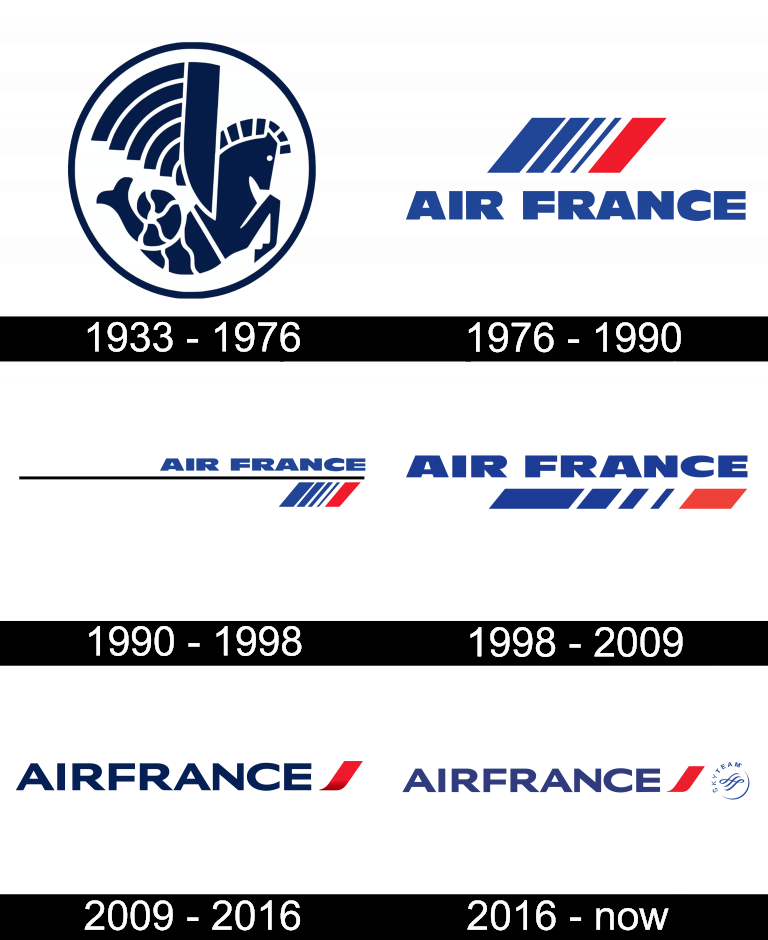
1933–1975: Hippocampe Ailé Primary Emblem Era
The original Air France logo introduced in 1933 featured the Winged Seahorse enclosed within a circular frame. Rendered in dark blue on white, the emblem emphasized mythology, prestige, and national symbolism. This design positioned Air France as both a technological pioneer and a cultural ambassador.
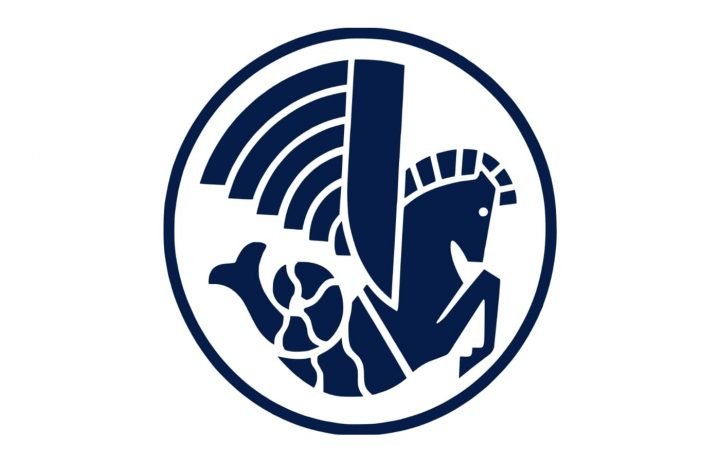
1976–1989: Tricolor Parallelepiped Identity
In 1976, Air France replaced the mythological emblem with a modern geometric mark. A blue, white, and red parallelepiped symbolized speed, structure, and modernity. The wordmark appeared beneath the symbol in bold blue lettering, marking a decisive shift toward corporate minimalism.
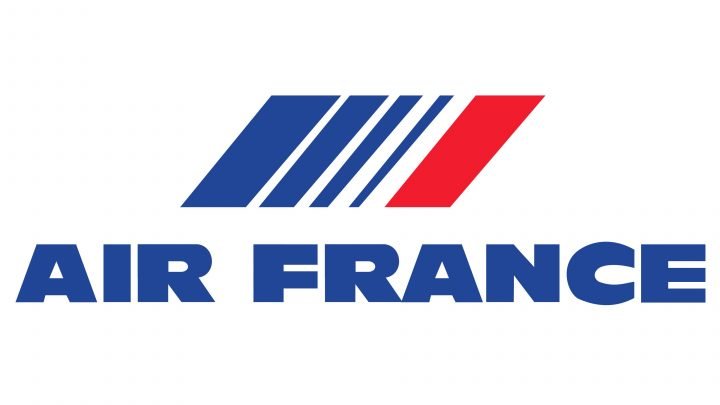
1990–1997: Rebalanced Corporate Composition
The 1990 redesign retained the same elements but altered their hierarchy. The wordmark moved upward and became smaller, while the tricolor symbol shifted to the lower corner. A black horizontal bar separated the elements, adding visual tension but reducing clarity.
1998–2008: Cleaned and Simplified Layout
In 1998, the black bar was removed, and the wordmark was enlarged to dominate the composition. The tricolor shape became more abstract, resembling a cropped fragment rather than a full geometric block, signaling refinement and visual restraint.
2009–2015: Introduction of the Red Ribbon Motif
The 2009 update lightened the typography and replaced the geometric symbol with a flowing red ribbon. This element suggested motion, comfort, and elegance, aligning with contemporary airline branding trends focused on passenger experience.
2016–Present: Softened Palette and Modern Authority
In 2016, the logo received subtle refinements. The color palette was softened, and proportions were fine-tuned to improve digital clarity. The result is a calm, confident identity that balances tradition with modern international appeal.
Air France Logo Heritage and Global Recognition
Air France’s logo heritage stands out for its dual identity system. While many airlines abandoned historic symbols entirely, Air France preserved the Hippocampe Ailé as a secondary emblem, allowing it to maintain continuity without compromising modern branding requirements.
Compared to carriers discussed in British Airways logo history or Lufthansa logo symbolism, Air France demonstrates a uniquely French approach: elegance over aggression, heritage over novelty. This strategy has helped the brand maintain strong recognition across global markets.
Air France Logo as a Dialogue Between Myth and Modernity
The Air France logo history illustrates how visual identity can bridge mythology and modern aviation. From the Winged Seahorse to the refined contemporary wordmark, the airline has preserved its symbolic depth while adapting to changing design standards. Within airline logo history and broader logo heritage studies, Air France remains a benchmark for cultural continuity, elegance, and thoughtful evolution.
FAQ: Air France Logo Meaning and History
What is the Hippocampe Ailé in the Air France logo?
It is a winged seahorse, a mythological symbol representing strength, guidance, and mastery of air and sea.
When was the Hippocampe Ailé first used by Air France?
The symbol was introduced in 1933 as the airline’s original primary logo.
Does Air France still use the Winged Seahorse today?
Yes, it is retained as a heritage icon and appears on aircraft and premium branding elements.
Why did Air France modernize its logo in 1976?
The redesign reflected a shift toward corporate modernism and international competitiveness.