Ryanair Logo History: Meaning, Symbolism & Brand Heritage
Within European aviation logo history, Ryanair occupies a defining position as a brand whose visual identity evolved in parallel with the liberalization of air travel across the continent. Founded during the mid-1980s, at a moment when European aviation was still dominated by national carriers and rigid fare structures, Ryanair emerged as a challenger not only in pricing strategy, but also in how an airline could visually communicate scale, trust, and ambition.
The Ryanair logo history reflects this transformation with remarkable clarity. Early iterations relied on experimental geometry and abstract forms, mirroring a young airline seeking recognition and legitimacy. As the company expanded and operational confidence grew, the logo gradually shifted toward stronger legibility and cultural anchoring, a transition also visible in easyJet logo history, where simplification played a central role in brand maturation. Eventually, Ryanair adopted national symbolism through the harp, aligning its identity with heritage and authority in a way comparable to the disciplined evolution explored in Lufthansa logo.
What makes Ryanair especially notable within airline logo is the balance it achieved between reduction and meaning. Over time, the brand distilled complex visual ideas into a clear, scalable mark that communicates reliability, national identity, and operational strength. Rather than abandoning its origin, the Ryanair logo evolved as a visual chronicle of growth, demonstrating how long-term branding success often lies not in reinvention, but in strategic refinement.
Meaning and History: The Origin of the Ryanair Logo
Ryanair was founded in 1985 by three Irish businessmen: Liam Lonergan, owner of Club Travel, Tony Ryan, founder of Guinness Peat Aviation, and Christopher Ryan. Initially registered as Darren Enterprises, the company later adopted the Ryanair name derived from the founders’ surname. After gaining early recognition and trust, the airline began operating charter flights before transitioning into scheduled services.
From its inception, Ryanair treated its logo as a strategic communication tool rather than a decorative mark. Each redesign aligned with a new phase of growth, operational confidence, and market positioning. Over time, the logo meaning shifted from abstract innovation toward national symbolism, culminating in a design that combines two enduring ideas: the Irish harp, a centuries-old national emblem, and a winged figure representing flight and aspiration.
Ryanair Logo History Timeline
1985–1980s: Experimental Geometry and Ambition
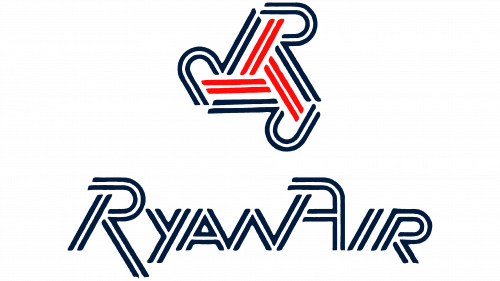
The first Ryanair logo, introduced in 1985, reflected the experimental spirit of a young airline entering a competitive market. The emblem centered on a stylized “R” constructed from three intersecting lines in blue and red. These geometric strokes created a sense of motion and technological progress, aligning with the airline’s ambition to establish itself as an innovative operator.
The accompanying “Ryanair” wordmark was built from horizontal and diagonal lines rather than traditional letterforms. Rendered in capital letters, the typography conveyed precision and seriousness, while its unconventional structure made the logo distinctive, if difficult to read. The blue-and-red palette balanced trust and energy, projecting both reliability and forward momentum.
1980s–1990s: Simplification and Improved Legibility
As Ryanair expanded its operations, the logo underwent its first major simplification. Designers removed repeated lines and internal red dashes, making both the emblem and wordmark easier to interpret. The letter “Y” was changed from lowercase to uppercase, and spacing adjustments improved overall alignment.
This refinement marked a clear step toward legibility and functional clarity, signaling the airline’s transition from experimentation to operational focus.
1990–1991: Uniform Weight and Corporate Tone
The 1990 update introduced bold letterforms of uniform size. Italics were intensified, and internal crossbars in letters such as “R” and “A” were opened, preventing them from fully connecting. This change gave the typography a lighter, more dynamic feel despite its increased weight.
The color palette shifted decisively to dark blue, reinforcing professionalism and stability. This version reflected Ryanair’s growing confidence and maturing corporate identity.
1991–2001: Winged Figure and Symbolic Identity
Between 1991 and 2001, Ryanair adopted one of its most symbolically rich logos. The centerpiece was a winged human figure shown in profile, enclosed within an arc. The extended wings formed four linear segments reminiscent of harp strings, subtly referencing Irish cultural heritage while emphasizing motion and freedom.
The wordmark “Ryanair” appeared in bold blue sans-serif lettering, projecting clarity and reliability. The blue-and-yellow palette reinforced trust and optimism, while the winged figure embodied aspiration, speed, and limitless possibility. This logo marked Ryanair’s transition into a confident, recognizable European airline.
2001–2013: Institutional Framing and Mass Recognition
In 2001, Ryanair introduced a more corporate and highly visible identity. The wordmark was rendered in bright yellow and placed inside a solid blue rectangle. Rounded letterforms softened the composition, balancing authority with approachability.
This design prioritized instant recognition across airports, aircraft, and digital platforms, reflecting Ryanair’s rapid expansion and increasing passenger volumes.
2013–Today: National Heritage and Visual Authority
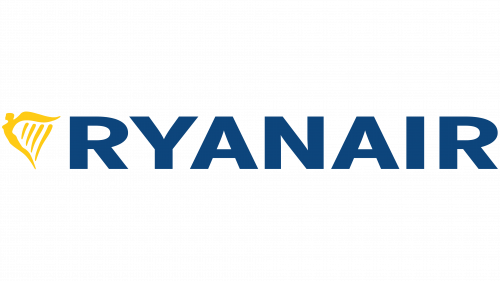
The current Ryanair logo reinterprets earlier heritage elements through modern restraint. The word “RYANAIR” appears in large uppercase dark blue letters set in a bold geometric sans-serif typeface. To the left, a stylized yellow harp references Ireland’s national symbol, grounding the brand culturally.
The minimalist execution removes gradients and excess detail, ensuring clarity and scalability. Together, the harp and wordmark form a balanced composition that communicates reliability, national identity, and operational strength.
Logo Symbolism: Harp, Flight, and National Identity
The symbolism of the Ryanair logo is built on two core ideas. The harp, Ireland’s national emblem since the 13th century, represents heritage, legitimacy, and continuity. Its inclusion reinforces trust and differentiates Ryanair within a crowded European market.
The winged figure introduced in earlier versions symbolized freedom and aspiration, bridging cultural identity with aviation purpose. Over time, these symbolic elements were refined into a cleaner, more institutional form, aligning with Ryanair’s scale and authority.
Ryanair Logo History and Strategic Refinement
The Ryanair logo history demonstrates how visual identity can evolve in parallel with business maturity. From abstract experimentation to disciplined national symbolism, each redesign responded to operational growth, market positioning, and audience expectations.
Today, the Ryanair logo stands as a clear expression of logo heritage, blending Irish cultural symbolism with modern corporate clarity. Its evolution underscores the power of simplification as a strategic branding tool, proving that strong identity is built through refinement rather than reinvention.
FAQ: Ryanair Logo Meaning and History
What does the Ryanair logo represent?
The logo represents Irish heritage, reliability, and freedom of flight through the harp and bold typography.
Why does Ryanair use a harp in its logo?
The harp is Ireland’s national symbol, reinforcing cultural identity and trust.
Has the Ryanair logo changed significantly over time?
Yes, especially in its early decades, with later versions focusing on refinement and clarity.
What colors define the Ryanair logo?
Dark blue and yellow dominate the palette, symbolizing professionalism, stability, and optimism.