
CIBC Logo History: Meaning, Symbolism & Brand Heritage

As one of Canada’s most prominent financial institutions, CIBC has built its reputation on structure, precision, and long-term stability. Founded in the early 1960s through the merger of two historic banks, the organization emerged during a period when corporate identity was becoming a strategic asset rather than a decorative afterthought. From the very beginning, CIBC treated visual identity as a reflection of institutional logic, balance, and trust.
The CIBC logo history reveals a brand that consistently experimented with geometry to communicate reliability and order. Unlike emblem-heavy competitors, CIBC relied on abstract forms and typographic discipline to express authority. This approach places the brand in close dialogue with identities explored in the Royal Bank of Canada logo history and the TD Bank logo history, while firmly anchoring it within the broader financial logo heritage shaped by mid-20th-century corporate modernism.
Meaning and History: The Origin of the CIBC Identity
CIBC, short for the Canadian Imperial Bank of Commerce, was established in 1961 in Toronto through the merger of the Canadian Bank of Commerce and the Imperial Bank of Canada. From its inception, the institution represented unification, scale, and national ambition. This foundational moment directly influenced the logo meaning, as early visual elements explicitly referenced the coming together of two entities under one roof.
Throughout its evolution, the CIBC logo heritage has remained tied to abstraction rather than illustration. Instead of relying on national symbols or figurative imagery, the bank favored geometric clarity. This design philosophy aligned with the modern banking narrative of efficiency, rationality, and global competence, allowing CIBC to project credibility both domestically and across North America.
Logo Symbolism: Geometry as Institutional Language
CIBC’s logo symbolism is rooted in structure. Squares, rhombuses, sharp angles, and mirrored forms appear repeatedly across decades of redesigns. These elements suggest balance, duality, and controlled strength, qualities essential to a financial institution managing complex systems of capital and trust.
The recurring use of paired shapes reflects the bank’s origin as a merger, while symmetry communicates stability and predictability. Even as colors and typography evolved, geometric abstraction remained the constant thread, making CIBC’s visual identity instantly recognizable within the financial sector without relying on literal symbols.
CIBC Logo History Timeline
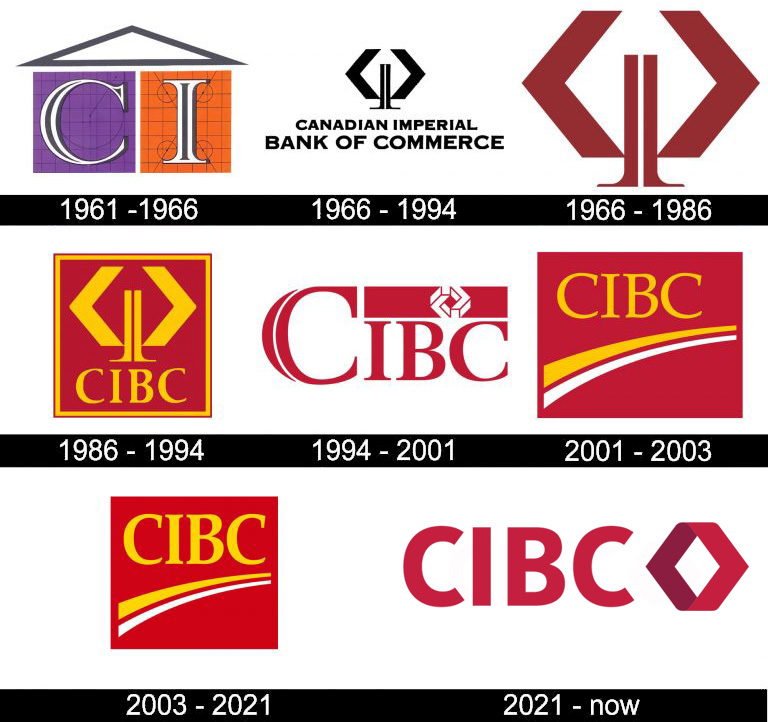
1961–1966: Merger Symbolism Through Dual Geometry
The original CIBC logo directly illustrated the bank’s formation. Two colored squares, one purple and one orange, were positioned beneath a white triangular roof outlined in dark gray. Each square carried a serif initial, representing the two founding institutions. This emblem made the concept of unification explicit, translating corporate structure into visual form.

1966–1994: Abstract Burgundy Emblem
In 1966, CIBC introduced a radically abstract logo. The new symbol featured sharp, “C”-like elements opening toward the center, paired with vertical forms resembling columns or the letter “I.” Rendered in a deep burgundy tone, the composition projected authority, heritage, and confidence. This design marked a decisive move away from literal storytelling toward symbolic abstraction.

1966–1986: Institutional Wordmark Integration
A secondary version introduced in the same year placed the abstract emblem above a two-level wordmark reading “Canadian Imperial Bank of Commerce.” Executed in bold uppercase sans-serif typography, this version emphasized institutional presence and formal clarity, reinforcing the bank’s national stature.

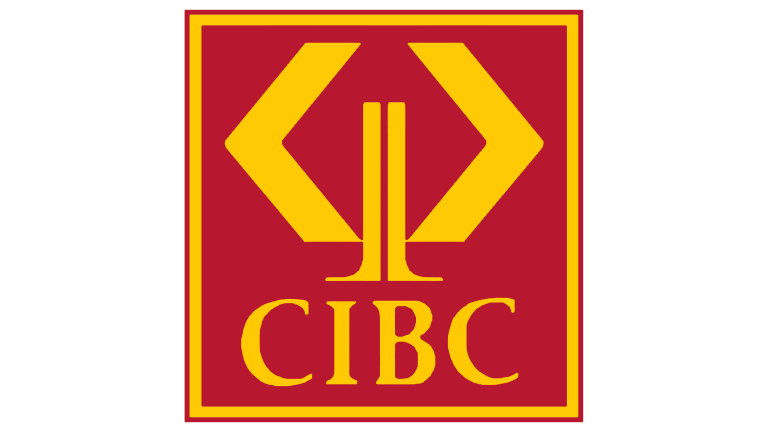
1986–1994: Abbreviation and High-Contrast Framing
The 1986 redesign replaced the long name with the “CIBC” abbreviation set in a bold serif typeface. The emblem appeared in yellow against a burgundy square framed by contrasting borders. This high-contrast treatment increased visibility and memorability, aligning with a more competitive financial landscape.
1994–2001: White-on-Burgundy Modernization
In 1994, the palette shifted, introducing white typography against burgundy fields. The enlarged “C” in the wordmark became a focal point, while the familiar geometric symbol appeared within a horizontal rectangle. This version balanced tradition with contemporary layout principles.

2001–2003: Dynamic Arches and Corporate Motion
The 2001 logo reintroduced yellow accents and added diagonal arches beneath the wordmark. These flowing lines suggested motion and progress, softening the rigidity of previous designs while maintaining a strong corporate tone.

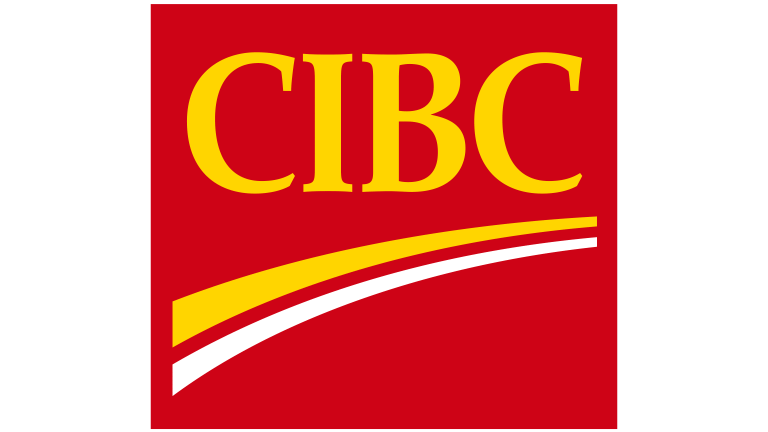
2003–2021: Refined Proportions and Color Depth
The 2003 update refined typography and color saturation rather than altering structure. The wordmark grew bolder, spacing improved, and the burgundy background gained depth. This phase focused on polish and consistency rather than reinvention.
2021–Today: Return to Geometric Heritage
In 2021, CIBC returned to its abstract roots. The refreshed identity reintroduced a geometric emblem inspired by earlier designs, now rendered as a flattened rhombus in layered burgundy tones. Paired with a narrowed sans-serif “CIBC” wordmark, the logo projects confidence, clarity, and modern restraint while honoring the bank’s visual legacy.
Typography and Color Palette
CIBC’s typography has shifted between serif and sans-serif styles, but always emphasized clarity and authority. The current sans-serif wordmark is bold yet restrained, supporting legibility across digital and physical platforms. Its proportions reinforce balance rather than aggression.
The color palette has long centered on burgundy, a hue associated with trust, depth, and institutional heritage. Occasional use of yellow added contrast and energy, while modern iterations rely on tonal variations within the same color family to communicate sophistication and continuity.
CIBC Logo as a System of Order and Trust
The CIBC logo history demonstrates how abstraction can become a powerful vehicle for brand meaning. By consistently relying on geometric symbolism and disciplined typography, CIBC built an identity that feels deliberate, stable, and intellectually grounded. Its logo heritage reflects a bank that values structure over spectacle and continuity over trend, making the visual identity a long-term strategic asset rather than a seasonal design choice.
FAQ: CIBC Logo Meaning and History
What does the CIBC logo represent?
The CIBC logo represents balance, stability, and institutional structure through geometric abstraction and disciplined typography.
Why does CIBC use geometric shapes in its logo?
The geometric forms symbolize order, unity, and reliability, reflecting the bank’s origins as a merger and its structured approach to finance.
When was the current CIBC logo introduced?
The current logo was introduced in 2021, bringing back abstract geometry in a modernized form.
What does the burgundy color in the CIBC logo symbolize?
Burgundy conveys trust, authority, and heritage, reinforcing CIBC’s reputation as a stable financial institution.