
Royal Bank of Canada Logo History: Meaning, Symbolism & Brand Heritage

With more than a century and a half of continuous operation, the Royal Bank of Canada represents one of the most enduring financial institutions in global banking. Founded in the 19th century and expanded far beyond its Atlantic Canadian origins, the bank has built its reputation on stability, authority, and international reach. Throughout this long trajectory, the visual identity of RBC has served as a symbolic anchor, reinforcing continuity even as the institution adapted to changing economic and geopolitical realities.
The Royal Bank of Canada logo history is particularly notable for its consistency. While many financial institutions have periodically abandoned their historical symbols in favor of abstract modernism, RBC chose a different path. Its logo heritage demonstrates how a traditional emblem can be refined rather than erased. Comparable long-term symbolic strategies can be observed in the HSBC logo history and the Barclays logo history, where heraldic imagery evolved gradually to preserve institutional memory. Within the broader banking logo heritage, RBC stands as a benchmark for disciplined, meaning-driven identity design.
Meaning and History: The Origin of the RBC Identity
The institution known today as the Royal Bank of Canada was founded in 1864 in Nova Scotia under the name Merchants Bank of Halifax. Its early visual identity reflected this origin, relying on conservative typography and monochrome presentation typical of 19th-century financial institutions. The transition to the Royal Bank of Canada name marked a shift in ambition, signaling national scope and imperial legitimacy.
Since 1901, every major iteration of the RBC logo has incorporated a lion. This decision anchored the brand in traditional heraldic symbolism associated with strength, authority, and guardianship. Over time, additional elements were introduced, most notably the globe, which first appeared in the early 1960s as the bank expanded internationally. The logo meaning evolved accordingly, moving from local authority to global financial presence, while maintaining visual continuity rooted in historical symbolism.
Logo Symbolism: Authority, Protection, and Global Reach
At the core of RBC’s logo symbolism is the lion, a figure deeply embedded in European heraldry and long associated with royalty, courage, and sovereignty. In the context of banking, the lion conveys protection of assets, institutional strength, and long-term reliability. Unlike abstract marks that rely on interpretation, the lion delivers immediate symbolic clarity.
The globe introduced into the emblem adds a second layer of meaning. Positioned beneath the lion’s paw, it represents oversight, reach, and international engagement. The crown placed above reinforces legitimacy and tradition, aligning the brand with its royal designation. Together, these elements create a logo symbolism system that communicates authority without aggression and scale without impersonality.
Royal Bank of Canada Logo History Timeline
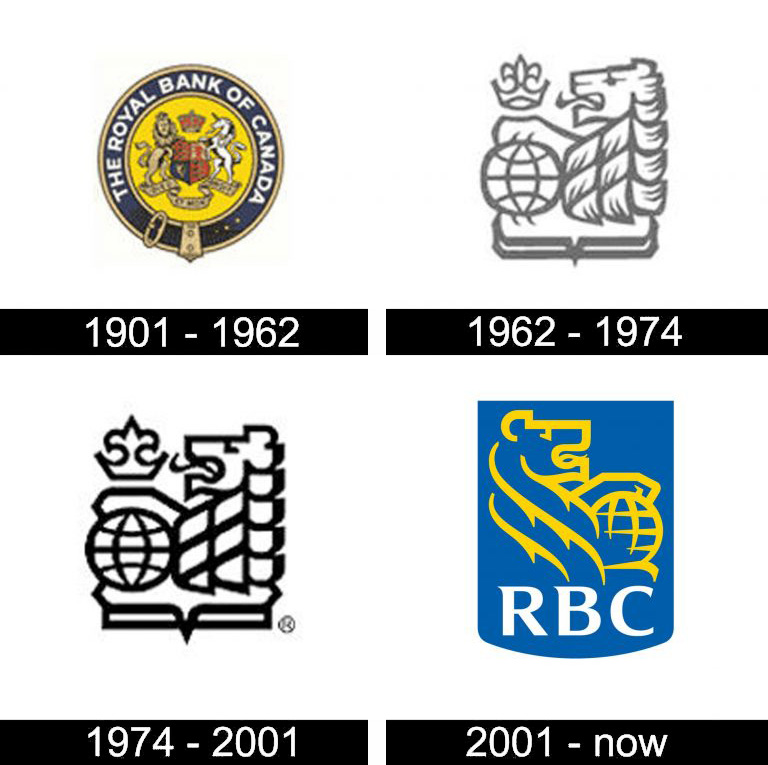
1901–1962: Heraldic Crest Establishing Royal Authority
The first official Royal Bank of Canada logo introduced a complex heraldic crest inspired by traditional coats of arms. It featured a lion alongside other symbolic elements, reinforcing authority, heritage, and institutional legitimacy. This design reflected RBC’s ambition to position itself as a nationally dominant and trustworthy financial institution.

1962–1974: Introduction of the Lion and Globe Symbol
In 1962, the emblem was simplified and standardized. The logo now centered on a lion resting its paw on a globe, with a crown positioned above. The globe symbolized RBC’s expanding international presence, while the lion continued to represent strength, protection, and authority.

1974–2001: Streamlined Heraldic Refinement
The 1974 redesign refined the emblem’s proportions and line work, reducing ornamental complexity while preserving its core symbolism. The result was a cleaner, more adaptable mark that maintained strong visual continuity during a period of global expansion.

2001–Today: Modern RBC Brand System with Wordmark
The 2001 update introduced the blue and yellow color palette and added the “RBC” abbreviation alongside the emblem. The lion’s profile was adjusted to face right, subtly signaling forward movement and modernization. This version remains in use today and represents the bank’s balance between tradition and contemporary global branding.
Typography and Color Palette
The RBC wordmark uses a custom serif typeface characterized by sharp terminals and confident proportions. The letterforms convey authority and distinction without appearing ornamental, reinforcing the bank’s professional image. While similar in structure to fonts such as Aviano Serif or Sava, the RBC typeface features unique modifications that ensure exclusivity.
Color plays a central role in the logo meaning. Deep blue symbolizes trust, stability, and expertise, while bright yellow introduces energy, optimism, and visibility. White accents enhance contrast and clarity, resulting in a palette that feels both authoritative and contemporary.
Royal Bank of Canada Logo as a Symbol of Enduring Authority
The Royal Bank of Canada logo history demonstrates the power of disciplined evolution. Rather than abandoning its past, RBC refined its visual identity in stages, preserving core symbolism while adapting to modern branding standards. The consistent presence of the lion across more than a century reinforces trust and continuity, making the logo heritage a strategic asset rather than a nostalgic artifact.
In an industry where credibility is paramount, RBC’s logo stands as an example of how meaning-driven symbolism can sustain relevance across generations, markets, and technologies.
FAQ: Royal Bank of Canada Logo Meaning and History
What is the symbol of the Royal Bank of Canada?
The symbol is a stylized lion resting its paw on a globe, representing strength, authority, and global reach.
Why does the RBC logo feature a lion?
The lion symbolizes power, protection, and institutional authority, values traditionally associated with long-standing financial institutions.
When was the globe added to the RBC logo?
The globe was introduced in 1962 to reflect the bank’s expanding international presence.
Has the RBC logo changed significantly over time?
While the design has been refined, the core symbolism has remained consistent since 1901, emphasizing continuity and heritage.