
Oracle Logo History: Meaning, Symbolism & Brand Heritage
Few technology companies have built their authority as consistently as Oracle Corporation. From its early focus on relational databases to its current position as a global provider of enterprise software, cloud infrastructure, and hardware solutions, Oracle has cultivated an image of stability, power, and long-term relevance. This positioning is clearly reflected in its visual identity, which favors restraint, clarity, and unmistakable recognition.
In the broader context of enterprise technology logo history, Oracle follows a path similar to IBM logo heritage and SAP logo history, where typographic discipline and color consistency reinforce corporate authority. Oracle’s logo meaning has remained tightly aligned with its mission: delivering reliable, large-scale systems for organizations worldwide.
Meaning and History: The Origin of the Oracle Identity
The company that would later become Oracle was founded in 1977 under the name Software Development Laboratories. Its early work centered on database technologies inspired by academic research in relational data models. In 1982, the company was renamed Oracle Systems Corporation, marking a decisive shift toward building a recognizable corporate brand around its flagship database product.
This transition created the need for a formal visual identity. Oracle developed two primary logo formats that would coexist over time: the Oracle Signature and the Oracle Red Badge. Both relied on the same core elements—strong typography and a bold red-and-white palette—while adapting to different use cases, including print, hardware, and on-screen environments.
As Oracle expanded its portfolio and acquired other technology firms, its logo heritage became a visual anchor, signaling continuity even as the company’s scope widened dramatically.
Logo Symbolism: Authority, Precision, and Enterprise Power
The Oracle logo symbolism is intentionally minimal. Rather than relying on illustrative imagery, the brand communicates meaning through typography, proportion, and color. This approach mirrors Oracle’s product philosophy, which emphasizes structure, reliability, and performance over decorative complexity.
Red plays a central role in the logo meaning. Known officially as Oracle Red (Pantone PMS 485), the color conveys energy, confidence, and assertiveness, distinguishing Oracle in a technology sector dominated by cooler hues. White provides contrast and clarity, reinforcing legibility and balance.
The custom sans-serif typeface further contributes to the logo description. Subtle modifications to letters such as “E,” “A,” and “R” create a distinctive yet disciplined wordmark, signaling both innovation and control.
Oracle Logo History Timeline
1979–1983: Relational Software Systems Identity
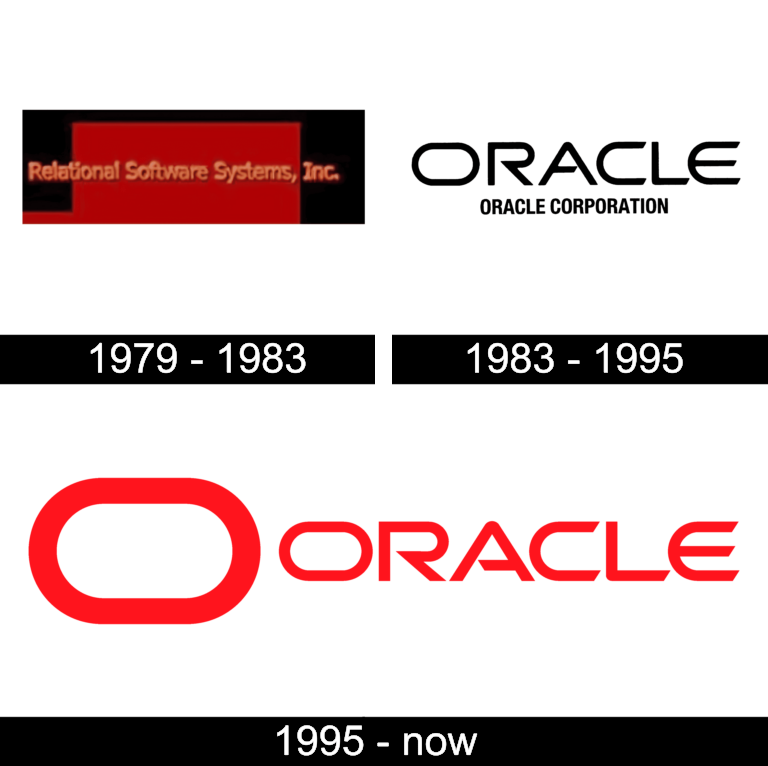
The earliest logo associated with the company appeared under the name Relational Software Systems, Inc. The wordmark was executed in a serif typeface reminiscent of typewriter lettering, reflecting the era’s connection between computing and traditional business practices. Rendered in red against a dark background, the logo conveyed a pioneering spirit during the formative years of database software development.

1983–1995: Oracle Corporation Wordmark Emergence
Following the renaming to Oracle Systems Corporation, a new logo was introduced in 1983. This version featured the word “ORACLE” in a heavy, uppercase sans-serif typeface, rendered in black on a white background. Below it, “ORACLE CORPORATION” appeared in smaller text using the same font family.
This design emphasized authority, clarity, and enterprise credibility, aligning with Oracle’s growing reputation as a leader in database technology.

1995–Today: Oracle Red and the Iconic Wordmark
In 1995, Oracle introduced the logo that would become its most enduring visual identifier. The wordmark shifted to a vivid red color, establishing Oracle Red as a core brand asset. In some applications, an abstract rectangular shape with a cut-out evoking the letter “O” appeared alongside the wordmark, reinforcing brand recognition.
This version has remained in use to the present day, with minor adaptations for digital environments, including gradient treatments for on-screen applications. Its longevity underscores the strength of the original design and its alignment with Oracle’s enterprise-focused identity.
Symbol Usage and Hardware Branding
Oracle hardware products often feature a combined emblem that includes the Oracle wordmark alongside a modified symbol from Sun Microsystems, Inc., which Oracle acquired in 2010. The Sun logotype, originally designed by Stanford professor Vaughan Pratt, evolved in color over time and was rotated in 1983, becoming a recognizable element within Oracle’s hardware branding system.
This dual-logo approach reflects Oracle’s expansion into hardware while preserving the legacy of acquired technologies within its broader ecosystem.
Oracle Logo Heritage and Corporate Continuity
The Oracle logo history demonstrates how consistency can become a strategic advantage. By maintaining a disciplined visual language built around typography and color, Oracle established a logo heritage that communicates authority, reliability, and scale.
In an industry defined by rapid change, Oracle’s logo meaning remains stable, reinforcing trust among enterprise clients and positioning the brand as a long-term technology partner rather than a transient innovator.
FAQ: Oracle Logo Meaning and History
What does the Oracle logo represent?
The logo represents authority, precision, and enterprise reliability through minimalist typography and bold color.
Why is red used in the Oracle logo?
Oracle Red symbolizes confidence, energy, and leadership, distinguishing the brand within the technology sector.
Has the Oracle logo changed often?
No. Since 1995, the core wordmark has remained largely unchanged, reflecting brand stability.
Is the Oracle logo trademarked?
Yes, the Oracle name and logo are fully trademarked and owned by Oracle Corporation.