Slack Logo History: Meaning, Symbolism & Brand Heritage

Few digital platforms have reshaped workplace communication as profoundly as Slack. Designed to simplify collaboration and reduce friction inside organizations, Slack quickly became a visual and functional staple of modern work culture. Its logo history reflects this ambition, translating abstract concepts like conversation, structure, and productivity into a compact, instantly recognizable mark.
Much like the clarity-driven evolution explored in Microsoft logo history and the system-oriented branding seen in Zoom logo heritage, Slack’s visual identity has always been tied to usability at scale. Within the broader context of technology platform logo heritage, Slack stands out for how intensely its logo meaning has been debated, refined, and scrutinized, highlighting the pressures placed on modern digital brands.
Meaning and History: The Origin of the Slack Identity
Slack Technologies was founded in 2009 in Vancouver, British Columbia, Canada, originally as part of a different software project. The communication platform itself was officially released in 2013, positioning Slack as a cloud-based collaboration tool built around IRC-style chat channels, private groups, and direct messaging.
From its origin, Slack aimed to replace fragmented workplace communication with a single, intuitive hub. This mission strongly influenced its visual identity. The logo history shows a clear attempt to balance friendliness and professionalism, avoiding overly corporate aesthetics while maintaining trust and clarity.
As Slack grew rapidly across industries, its logo became an interface element as much as a branding device. This dual role heavily influenced later design decisions, particularly the controversial redesign in 2019, which sought to improve legibility and scalability across countless digital contexts.
Logo Symbolism: Conversation, Structure, and Modularity
The Slack logo symbolism is rooted in communication and modularity. The original hashtag symbol directly referenced chat culture and channels, serving as a visual shorthand for conversation and organization. Its fragmented color treatment reflected diversity of teams and interactions but also introduced complexity.
The redesigned emblem introduced in 2019 replaced the hashtag with a more abstract form composed of four elongated bars and four rounded drops. This structure maintained four-part symmetry, symbolizing multiple participants, ideas, or channels converging into one system. The rounded ends softened the geometry, reinforcing approachability.
Color plays a central role in the logo meaning. By reducing the palette to four bold colors, Slack emphasized clarity and consistency while preserving energy and diversity. The refined black wordmark strengthened contrast and authority, ensuring readability across screens, devices, and backgrounds.
Slack Logo History Timeline
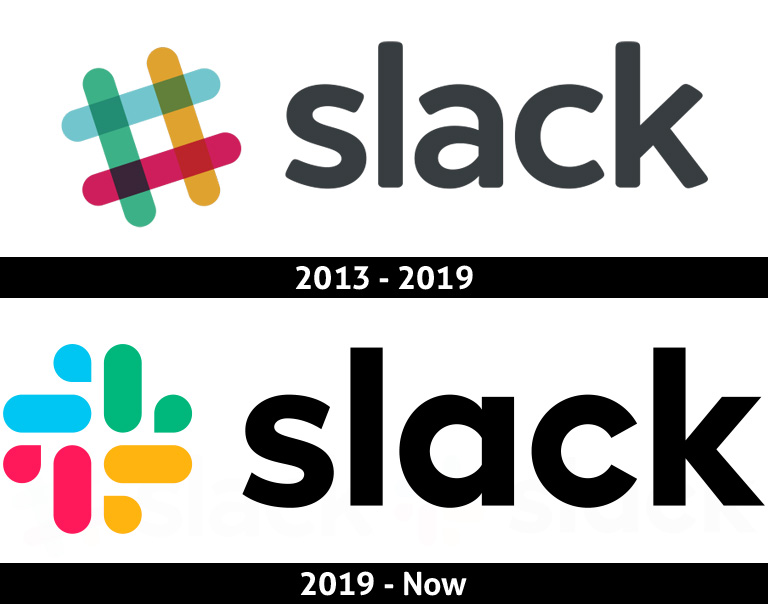
2013–2019: Hashtag Emblem and Multicolor Complexity
The original Slack logo featured a multicolored hashtag icon rendered in softened shades of red, blue, green, and yellow. Positioned beside it was a lowercase wordmark in a muted dark gray sans-serif typeface. While expressive and friendly, the emblem relied on a complex color system that often appeared blurred or inconsistent outside white backgrounds.
The hashtag symbol effectively communicated chat-based functionality but proved difficult to standardize at small sizes. This limitation became increasingly problematic as Slack expanded across platforms and devices, prompting the need for a more adaptable visual system.

2019–Present: Modular Geometry and Scalable Identity
In 2019, Slack unveiled a redesigned logo developed in collaboration with Pentagram, led by Michael Bierut, with active involvement from founder Stewart Butterfield and the in-house design team. The iconic hashtag was replaced by a symmetrical abstract mark built from four bars and four dots, each pair sharing one of the four brand colors.
The palette shifted to stronger, more saturated hues, while the wordmark transitioned from dark gray to solid black, increasing contrast and confidence. Although the redesign achieved its technical goals of scalability and clarity, it generated public controversy. Critics noted unintended visual associations in the negative space, while others compared it to existing logos.
Despite the backlash, the redesign aligned with Slack’s need for a robust, flexible identity capable of functioning as an app icon, interface element, and global brand symbol simultaneously.
Slack Logo Heritage and Modern Digital Branding
The Slack logo history illustrates the challenges faced by contemporary technology brands operating at massive scale. From a playful hashtag to a carefully engineered modular emblem, the logo meaning evolved in response to functional demands rather than aesthetic trends alone.
Within modern software branding, Slack’s logo heritage stands as a reminder that clarity, scalability, and usability often outweigh immediate public approval. Its identity continues to embody the platform’s core promise: structured communication made simple, even amid complexity.
FAQ: Slack Logo Meaning and History
What does the Slack logo represent?
The logo represents communication, collaboration, and modular structure, reflecting how teams interact within the platform.
Why did Slack change its logo in 2019?
The redesign aimed to improve readability, scalability, and consistency across different digital environments.
What is the meaning of the colors in the Slack logo?
The four colors symbolize diversity, energy, and multiple channels converging into one workspace.
Is Slack a registered trademark?
Yes, Slack is a registered trademark owned by Slack Technologies Inc.