
Microsoft Logo History: Heritage, Meaning & Symbolism
Founded in 1975 by Bill Gates and Paul Allen, Microsoft quickly became a pioneering force in the software industry. Today, it remains one of the world’s leading technology companies, shaping digital evolution through Windows, Office, Azure, Xbox and a wide spectrum of services.
Alongside its innovations, the Microsoft logo has evolved repeatedly, reflecting the company’s aspirations, philosophy, and transformation over nearly half a century. The emblem introduced in 2012 remains the most iconic and stable version — a modern symbol that represents Microsoft’s unified ecosystem.
Meaning and History
Microsoft has always used design as a way to express technological ambition. Its logos varied dramatically during the early decades — from experimental typography to strong italicized marks that conveyed speed and modernity. By 2012, the company embraced a minimalist, geometric symbol aligned with the flat design language used across its products. This evolution forms an important part of Microsoft’s visual heritage and brand identity.
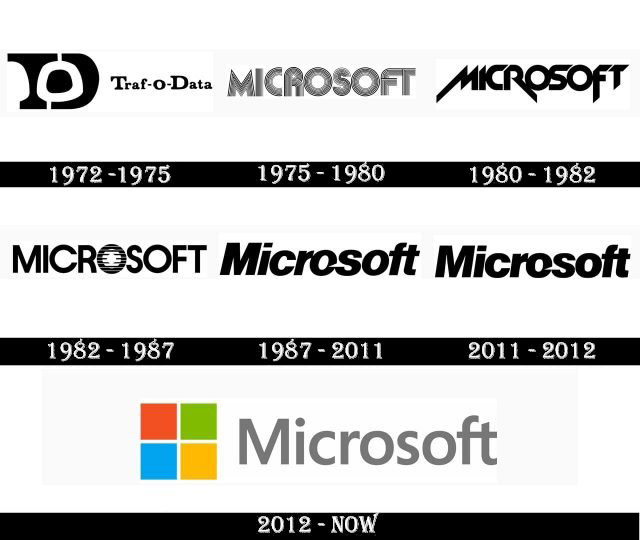
Microsoft Logo History: Evolution Through the Years
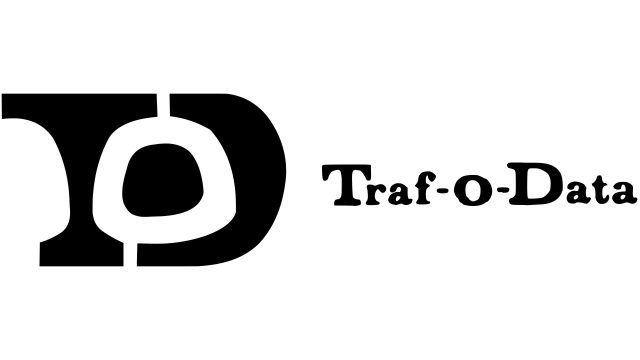
1972–1975: Traf-O-Data
Before Microsoft, Gates and Allen developed Traf-O-Data, a traffic data analysis project. Its logo was a stylized monogram composed of a split “D,” a central circular “O,” and a vertical bar forming a “T.” Together, the shapes suggested the abbreviation “TOD.” A rounded serif wordmark accompanied the emblem, surprisingly elegant for a company that was just beginning its journey in computing.
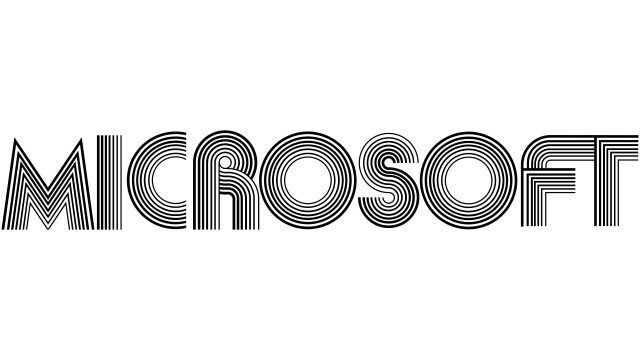
1975–1980: The First Microsoft Wordmark
After the company was renamed Microsoft, Simon Daniels created its first official logo. It featured bold uppercase letters formed from dense black-and-white linework. The style was futuristic, energetic, and clearly positioned Microsoft as a rising star in the world of early personal computing.
1980–1982: A Sharper Identity
In 1980, Daniels redesigned the logo in a sharper, more angular typeface based on New Zelek. The typography matched the design language of the early digital age: mechanical, technical, and forward-leaning.
1982–1987: The Striped “O”
The 1982 update introduced a cleaner sans-serif wordmark. Its standout feature was the striped “O,” which visually separated “Micro” from “Soft,” emphasizing the brand’s two conceptual halves. This detail became a small but memorable part of Microsoft’s early logo history.
1987–2011: The “Pac-Man” Era
In 1987, designer Scott Baker created what many still consider the definitive Microsoft logo. The black italicized Helvetica Black logotype suggested speed and engineering precision. Its most unusual feature was the triangular cut in the “O,” a detail that earned the nickname “Pac-Man logo”.
The slash was intended to convey movement and highlight the “soft” portion of the name, while also giving the logo a distinctive rhythm. This emblem remained unchanged for more than two decades — an extraordinary lifespan in the tech world.
2011–2012: Gentle Refinement
The 2011 variation made the wordmark slightly slimmer and adjusted spacing within the “M,” but preserved the overall legacy of the 1987 version.
2012–Today: The Modern Logo
In 2012, Microsoft introduced a new visual identity designed by Jason Wells. For the first time, the wordmark was paired with a standalone symbol: four colored squares forming a geometric window. These squares — blue, red, green, and yellow — represent Microsoft’s diverse product families and its commitment to simplicity, clarity, and openness.
Accompanied by a Segoe Semibold wordmark, the 2012 emblem became a hallmark of Microsoft’s modern brand heritage.
Symbolism
The Pac-Man Reference
The 1987 logo incorporated a subtle visual joke: a small slice removed from the “O,” resembling Pac-Man’s open mouth. Although playful, the cut was also symbolic. It highlighted the division between “micro” and “soft,” and created an impression of speed, innovation, and momentum — values central to Microsoft throughout the ‘80s and ’90s.
The Four-Color Window
The 2012 symbol expresses the idea of product unity and clarity. Each color historically corresponded with a major Microsoft domain: Windows for blue, Office for red, Xbox for green, and future-forward innovation represented by yellow.
Together, the squares form a window — a metaphor for digital access, transparency, and the open possibilities of technology.
Microsoft Office Logo Heritage
When Microsoft Office launched in the mid-1990s, its branding centered on a square emblem made of four puzzle-like shapes, each in a different color. This reflected the idea that Office applications were distinct tools working together in harmony.
In 2001, gradients and glossy effects were introduced, marking the early-2000s shift toward 3D design.
The 2003–2010 period saw a transition to a more unified four-square emblem.
By 2012, Office adopted its defining orange symbol — a simplified geometric form aligned with Microsoft’s new flat design philosophy.
Excel Logo Heritage
The earliest Excel designs played with the combination of “X” and “L,” visually forming “XL.” Although this clever detail appeared in many early versions, modern redesigns have shifted toward clarity.
By 2013, Excel embraced a clean blue-green color palette and a distinct “X” placed over a stylized sheet icon, creating a clearer association with spreadsheets and data.

Outlook Logo Heritage
Older versions of the Outlook logo frequently used gold tones and featured envelope motifs.
In 2013, Outlook’s identity was fully modernized with a deep blue palette — now symbolic of productivity software — along with a white “O” set against an envelope-shaped icon.

Word Logo Heritage
The Microsoft Word logo began as a simple wordmark, but from 1987 onward, the “W” became the central visual element. Early versions placed the letter on a paper background to emphasize writing and documentation.
In 2000, Word adopted its signature blue color scheme.
The 2013 emblem reinterpreted this into a simplified open-book shape, combining elegance with modern usability.
Azure Logo Heritage
Azure launched in 2010 with a variation of the classic Microsoft “window.” Later, this was replaced by a blue geometric emblem, and eventually by a minimalist wordmark that allowed the name “Azure” to stand on its own.
Across each redesign, Azure maintained a direct connection to Microsoft’s overall brand aesthetic.
Font and Color
Microsoft used Helvetica Black Italic extensively for decades, especially during the Pac-Man era.
The 2012 rebrand introduced Segoe, a digital-first sans-serif designed for clarity across multiple resolutions. Its clean geometry mirrors Microsoft’s modern design ethos.
The color palette of the current logo — blue, yellow, red, and green — mirrors the diversity of Microsoft’s services and reinforces visual consistency across the ecosystem.

FAQ
What is Microsoft?
Microsoft is a global leader in technology, offering software, hardware, cloud solutions, and a wide range of digital services. It was founded in 1975 and operates in more than 190 countries.
What is Microsoft’s current logo?
The 2012 logo features four colored squares arranged as a window, paired with a gray Segoe wordmark.
Why was the 1987 logo called the Pac-Man logo?
Because the triangular cut in the “O” resembled Pac-Man’s open mouth, creating a sense of movement and personality.
What do the four colors in the Microsoft logo represent?
They reflect Microsoft’s major product families and symbolize creativity, diversity, and technological openness.