Fujifilm Logo History: Meaning, Symbolism & Brand Heritage

Few Japanese technology brands illustrate long-term adaptation as convincingly as Fujifilm. Founded in the early twentieth century as a photographic film manufacturer, Fujifilm has repeatedly reinvented itself in response to technological disruption, moving from chemical film to digital imaging, medical systems, biotechnology, and advanced materials. Its visual identity reflects this evolution with unusual clarity, documenting not only aesthetic change but strategic survival.
Within the broader context of logo history in imaging and optics, Fujifilm’s trajectory can be compared to brands such as Canon, Nikon, and Olympus, all of which faced similar existential challenges during the digital transition. Unlike many legacy competitors that struggled to redefine themselves, Fujifilm managed to preserve relevance while maintaining a coherent logo heritage that bridges tradition and innovation.
The Fujifilm logo meaning cannot be understood in isolation. Each redesign corresponds to a shift in corporate direction, market positioning, or technological focus. From early patriotic symbolism to globally standardized minimalism, the brand’s visual language has continuously adapted without losing its core identity.
Meaning and History: The Origin of the Fujifilm Identity
Fujifilm was established in 1934 under the name Fuji Photo Film Co., created to support Japan’s domestic photographic industry. In its early decades, the company was deeply rooted in chemical engineering and film production, a heritage that shaped both its technological development and visual expression.
The brand name itself draws directly from Mount Fuji, a national symbol of permanence and balance. This connection influenced the logo origin, especially in the earliest designs, which emphasized tradition, craftsmanship, and national pride. As the company expanded internationally, these elements were gradually abstracted, making the identity more universal while retaining symbolic depth.
Fujifilm’s ability to translate scientific expertise into new industries, particularly medical imaging and biotechnology, required a visual identity capable of transcending photography. This necessity drove the gradual simplification and modernization of the logo, aligning form with corporate transformation.
Fujifilm Logo History Timeline
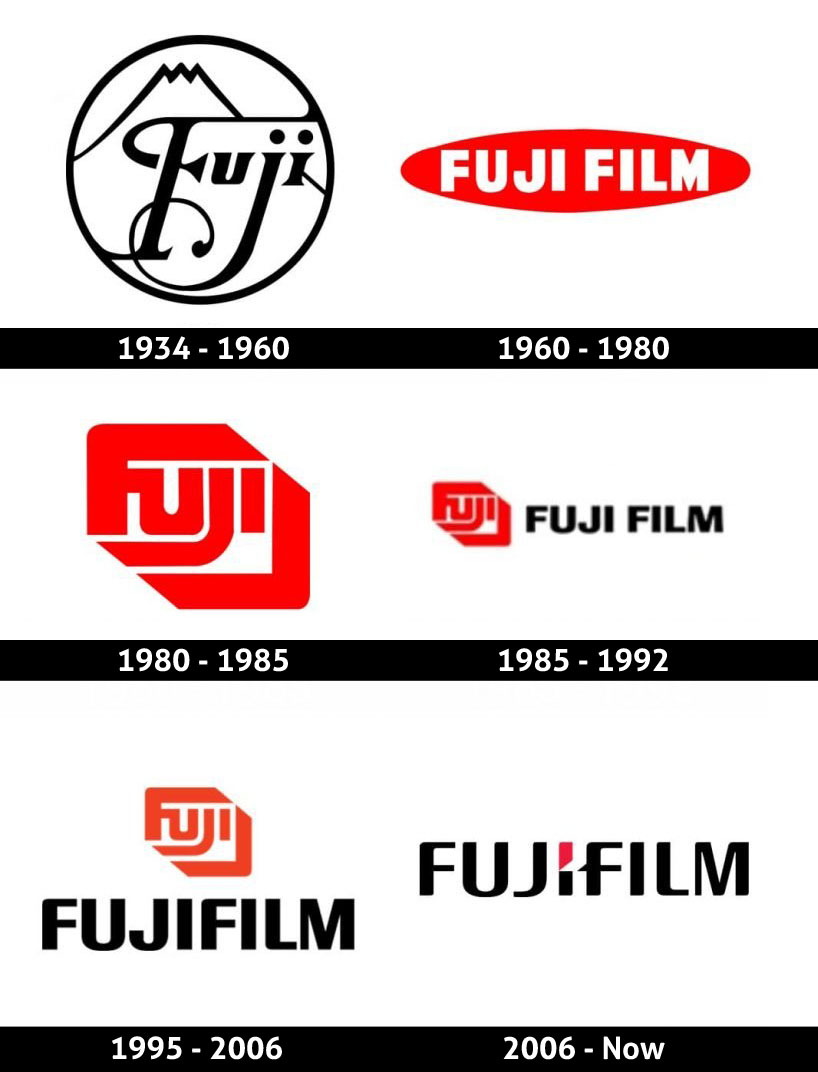
1934–1960: The Mount Fuji Emblem Era.
The original Fujifilm logo featured a circular black-and-white emblem inspired by the silhouette of Mount Fuji. Thin lines and elegant typography reflected precision, craftsmanship, and respect for tradition. The italicized wordmark echoed the mountain’s contours, reinforcing the brand’s national and cultural roots.
This period established Fujifilm’s foundational logo symbolism, linking the company to stability, heritage, and scientific rigor.

1960–1980: The Patriotic Red Oval.
In 1960, Fujifilm introduced a bold red oval with white uppercase lettering. This redesign marked a shift toward international visibility and industrial confidence. The red-and-white palette directly referenced the Japanese flag, reinforcing national identity while enhancing shelf recognition.
Typography became heavier and more condensed, signaling seriousness and manufacturing strength. This logo reflected Fujifilm’s emergence as a global photographic brand.

1980–1992: The Diagonal Eye Mark.
The 1980 redesign introduced one of Fujifilm’s most iconic identities. The stylized wordmark appeared diagonally stretched, evoking the shape of a camera lens or human eye. This abstracted visual metaphor represented vision, perception, and imaging technology.
Used in red or black on white, this mark became globally recognizable and remains closely associated with Fujifilm’s photographic legacy.

1985–1992: Dual Identity Refinement.
In 1985, Fujifilm briefly combined the iconic emblem with a more traditional black wordmark. This hybrid approach balanced innovation with corporate clarity, reflecting a period of brand consolidation as digital technologies began to influence imaging.

1992–2006: Unified Corporate Wordmark.
The 1992 update refined contours and merged the brand name into a single word: Fujifilm. Softer angles and improved spacing modernized the logo while preserving familiarity. During this period, additional color combinations appeared, reflecting diversification beyond photography.
This phase marks a transition from product-centric branding to broader corporate identity.
2006–Today: Minimalist Global Identity.
In 2006, Fujifilm adopted its current logo. The iconic emblem was removed, replaced by a clean, modern wordmark. A distinctive red accent within the letter “i,” divided by a white triangle, became the sole graphic feature, subtly referencing innovation and precision.
This minimalist identity supports Fujifilm’s expansion into healthcare, biotechnology, and advanced materials, allowing the logo to function across diverse industries without visual friction.
Logo Symbolism: Vision, Adaptation, and Precision
The Fujifilm logo symbolism evolved from literal representation to conceptual clarity. Early designs symbolized national heritage and craftsmanship, while later iterations focused on perception and technological vision.
The modern logo communicates adaptability. Its restrained form reflects confidence in the brand’s substance rather than reliance on decorative elements. The red accent introduces energy and continuity, linking contemporary design to historical color usage.
In terms of logo description, Fujifilm’s current identity prioritizes neutrality and scalability, essential for a multinational corporation operating far beyond photography.
Typography and Color Palette
The Fujifilm wordmark uses a custom sans-serif typeface with softened angles and bold strokes. This balance between geometry and approachability reinforces both scientific credibility and accessibility.
The red-and-black palette remains central to the brand’s visual language. Red conveys innovation and vitality, while black provides authority and precision. Together, they sustain visual continuity across decades of transformation.
A Logo That Mirrors Strategic Evolution
The Fujifilm logo heritage is a case study in intelligent adaptation. Few brands have navigated technological disruption as successfully, and even fewer have managed to reflect that journey so clearly through visual identity.
Positioned alongside imaging leaders like Canon and Nikon, Fujifilm stands out for its willingness to redefine itself without abandoning its roots. Its logo meaning and symbolism illustrate how branding can evolve in parallel with corporate strategy, maintaining trust while embracing change.
Within the broader examination of logo history, logo symbolism, and logo origin, Fujifilm represents a rare example of continuity through reinvention.
FAQ: Fujifilm Logo Meaning and History
What does the Fujifilm logo represent?
The logo represents vision, technological adaptation, and continuity through minimalist typography and strategic color use.
Why did Fujifilm remove its emblem in 2006?
The change supported diversification beyond photography, allowing the logo to function across healthcare, biotech, and materials industries.
Has the Fujifilm logo changed frequently?
Yes, but each redesign reflects a major strategic or technological shift rather than cosmetic trends.
What does the red accent in the Fujifilm logo mean?
It symbolizes innovation, energy, and continuity with the brand’s historical identity.