
Chicago Bears Logo History: Meaning, Symbolism & Brand Heritage
Few franchises in American professional football carry the historical weight and cultural authority of the Chicago Bears. Founded at the dawn of the National Football League, the Bears are inseparable from the league’s formative years, and their visual identity reflects that legacy with unusual clarity. While many teams have cycled through radical redesigns, Chicago’s branding story is defined by patience, symbolism, and a deep respect for continuity.
The Chicago Bears logo history belongs in the same conversation as the disciplined evolution explored in the Green Bay Packers logo history and the early-century foundations examined in the Detroit Lions logo heritage. Across the wider narrative of NFL logo history, the Bears stand as one of the clearest examples of how restraint and symbolism can outlast trends. Their logo meaning is not tied to spectacle, but to identity, geography, and tradition.
Meaning and History: The Origin of the Chicago Bears Identity
The franchise was established in 1920 as the Decatur Staleys, a company team sponsored by A.E. Staley. When the club relocated to Chicago in 1921, its transformation into the Chicago Bears marked more than a name change. It signaled the birth of an identity rooted in physicality, endurance, and Midwestern toughness. Team founder George Halas deliberately aligned the Bears’ name with the Chicago Cubs, reinforcing a city-wide sports hierarchy in which football players were metaphorically larger, stronger counterparts.
Early Bears logos reflected the illustrative style common to American sports branding in the first half of the 20th century. These designs emphasized narrative imagery rather than abstraction, mirroring a period when logos functioned as mascots and illustrations rather than scalable brand systems. Over time, however, the franchise shifted toward symbolic efficiency, culminating in one of the most recognizable lettermarks in professional sports.
The origin of the Chicago Bears logo heritage is therefore inseparable from the evolution of the NFL itself, moving from regional storytelling toward modern visual discipline.
Chicago Bears Logo History Timeline
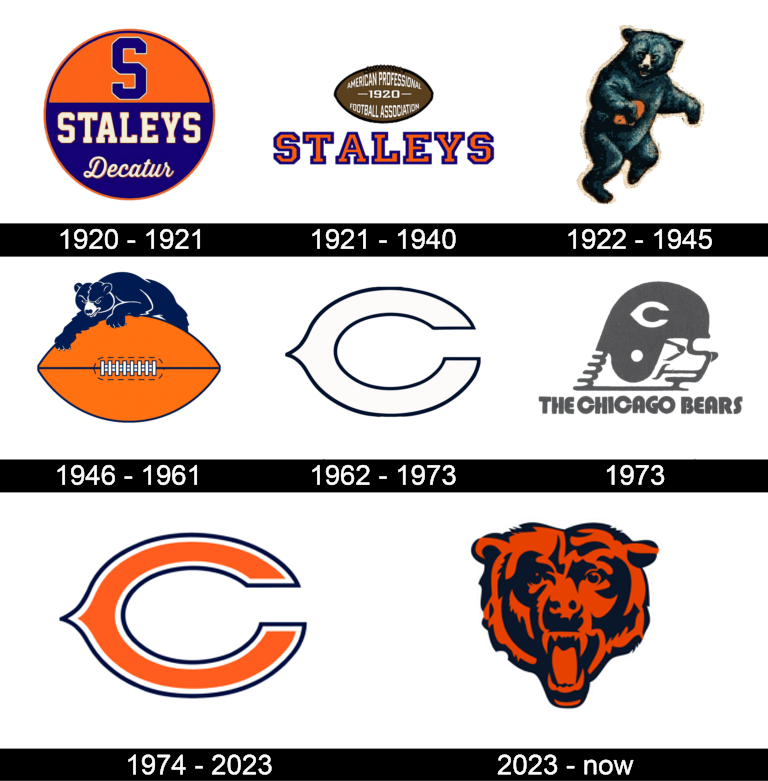
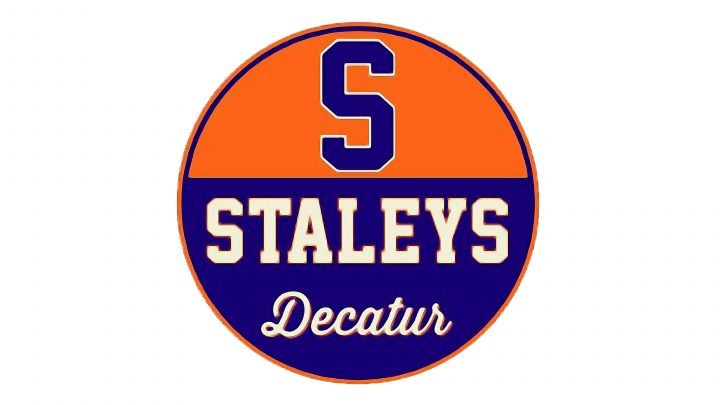
1920–1921: Decatur Staleys Corporate Identity.
The original logo of the franchise dates back to its founding years as the Decatur Staleys. The emblem was directly borrowed from the visual identity of A.E. Staley’s business and was used only briefly, reflecting the club’s origins as a company-sponsored team rather than a fully independent sports organization.
The design took the form of a circular badge divided horizontally into two sections. The upper half was orange and featured a bold blue letter “S” outlined in white, while the lower half was blue and contained the full team name. “Staleys” appeared in a strong serif typeface, with “Decatur” written beneath it in a lighter cursive script. White lettering with thin orange outlines gave the logo a bright, structured appearance typical of early corporate insignias.
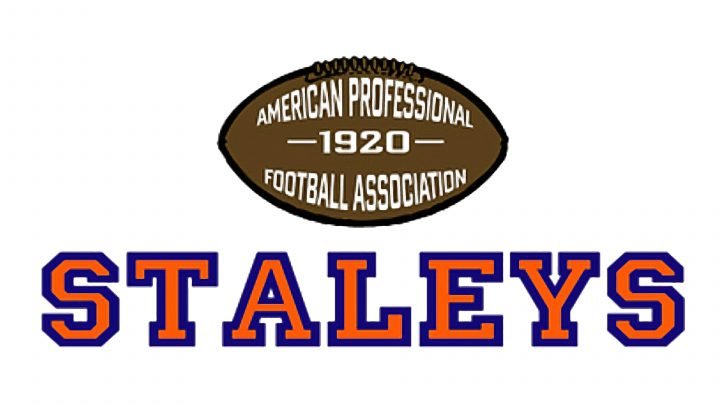
1921–1940: Chicago Staleys Transitional Era.
After relocating from Decatur to Chicago in 1921, the team adopted the name Chicago Staleys, prompting a redesign of its visual identity. The new logo replaced the corporate badge with a more sport-oriented symbol centered around an American football.
This version featured a brown football as its primary element, accompanied by the word “Staleys” written in bold uppercase letters beneath it. The lettering, rendered in red with a blue outline, introduced a sense of energy and competitive spirit while balancing the subdued tones of the football graphic. The redesign marked a shift toward a more athletic identity, even as the franchise continued its search for a permanent visual direction.
1922–1945: The First Chicago Bears Emblem.
In 1922, the franchise officially became the Chicago Bears, and the bear made its first appearance in the team’s visual identity. The logo depicted a black and brown bear running with an orange football, a clear departure from typographic and object-based designs.
This emblem emphasized motion, strength, and confidence, aligning the team’s image with its new name. The use of a bear symbolized power and resilience, helping establish a distinct personality that separated the Bears from their earlier corporate roots.

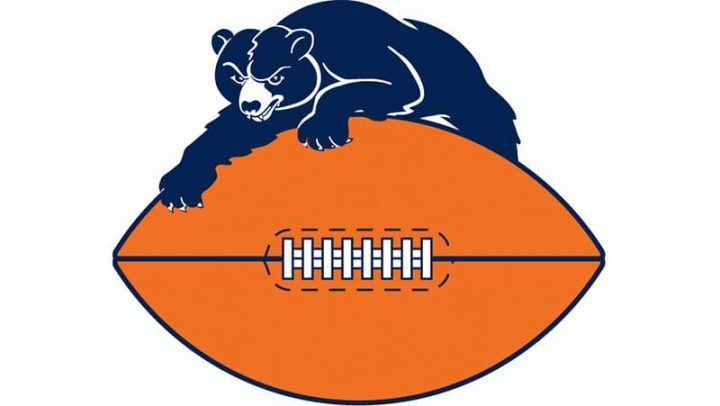
1946–1961: Bear on Football Illustration.
The logo introduced in 1946 refined the earlier concept by placing a black bear atop an orange football. The animal appeared more aggressive and imposing, reinforcing the idea of dominance and physicality that defined the team’s playing style during the mid-20th century.
The color palette of black, orange, and white conveyed energy and professionalism, while the illustration itself functioned as a clear visual metaphor for control and strength. This era represents the peak of illustrative storytelling in Chicago Bears logo history.
1962–1973: The Introduction of the Wishbone “C”.
A pivotal transformation occurred in 1962 with the debut of the wishbone “C”. For the first time, the Bears abandoned figurative imagery in favor of a stylized lettermark. The white “C,” outlined in black, featured a distinctive sharp inner point that made the symbol instantly recognizable.
Although visually similar to other letter-based sports logos of the era, the wishbone shape gave the emblem its own identity. This shift marked the beginning of a more modern, abstract approach to branding that prioritized clarity, scalability, and longevity.

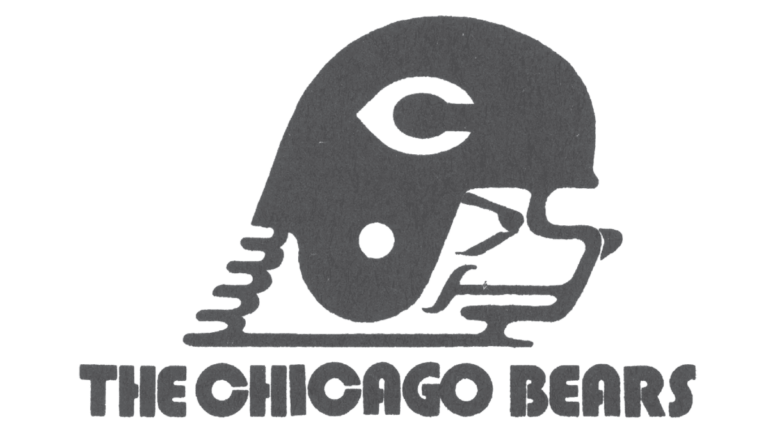
1973 (Proposed): Unused Bear Helmet Concept.
In 1973, a proposed redesign explored a radically different direction. The concept featured a gray, abstract illustration of a bear wearing a helmet, shown in profile. Below the image appeared a bold serif wordmark in uppercase letters.
The design was ultimately rejected, as it lacked the authority and visual strength associated with the Bears’ established identity. Its brief consideration highlights the franchise’s experimentation before fully committing to the wishbone “C” as its core symbol.
1974–2023: The Iconic Orange Wishbone “C”.
In 1974, the wishbone “C” was refined into its definitive form. The letter was filled with orange and outlined in white and black, significantly improving contrast and visibility. Subtle adjustments to the contours gave the emblem a more professional and balanced appearance.
This version became one of the most enduring symbols in professional football. While secondary marks were introduced over time, the orange wishbone “C” remained the primary logo for nearly five decades, representing energy, tradition, and stability.
During this period, a bear head logo introduced in 1993 was occasionally used in alternate and supporting roles, but the “C” continued to define the franchise’s visual identity.
2023–Today: The Roaring Bear Head Identity.
In 2023, the Chicago Bears introduced a significant redesign that elevated the bear head to primary logo status. The new mark features an aggressive, open-mouthed bear rendered in intensified shades of orange and blue, emphasizing strength, intensity, and modern competitiveness.
While the color palette remains consistent with the team’s historical branding, the move away from the wishbone “C” signals a strategic shift toward a more expressive and character-driven identity.
Logo Symbolism: Tradition, Luck, and Identity
The Chicago Bears logo symbolism is deceptively simple. The wishbone “C” functions on multiple levels, serving as the initial of “Chicago” while also evoking the traditional wishbone associated with luck earned through effort. This dual meaning aligns closely with the franchise’s self-image as a team built on hard work rather than flash.
Color plays a central role in the logo description. Orange conveys energy, visibility, and optimism, while black represents strength and resilience. White provides balance and clarity, ensuring legibility across all applications. Unlike logos that rely on detailed imagery, the Bears’ mark succeeds through abstraction, allowing it to remain relevant across generations and media formats.
A Legacy of Visual Restraint
The Chicago Bears logo history demonstrates how enduring identity is often achieved through reduction rather than reinvention. By transitioning from illustrative mascots to a symbolic lettermark and then committing to it for decades, the franchise created one of the most stable visual identities in professional sports.
Within the broader study of NFL logo heritage and American sports branding, the Bears exemplify how a logo’s meaning, origin, and symbolism can be distilled into a form so simple that it becomes timeless. Their logo is not just a design, but a visual shorthand for nearly a century of football history.
FAQ: Chicago Bears Logo Meaning and History
What does the Chicago Bears logo represent?
The logo represents tradition, strength, and earned success, symbolized through the wishbone-shaped letter “C”.
When was the current Chicago Bears logo introduced?
The modern orange wishbone “C” was introduced in 1974 and remains in use today.
Why did the Bears move away from the bear illustration?
The shift allowed for greater clarity, scalability, and symbolic strength, aligning with modern sports branding principles.
What does the wishbone shape mean in the Bears logo?
The wishbone symbolizes luck achieved through effort, reinforcing the franchise’s hard-working identity.