Bayer Logo History: Meaning, Symbolism & Brand Heritage

In the history of pharmaceutical branding, few corporate identities have achieved the level of universality and longevity associated with Bayer. Founded in the nineteenth century and deeply embedded in modern medicine, Bayer’s visual identity is one of the rare examples where a logo transcended branding to become a functional mark of trust, safety, and authenticity. Within pharmaceutical logo history, the Bayer Cross stands alongside identities such as Novo Nordisk logo heritage and Pfizer logo history as a benchmark of symbolic endurance.
More than a century after its introduction, the Bayer logo continues to appear not only on packaging and corporate materials, but directly on pharmaceutical tablets themselves. This unusual application transformed the logo from a mere identifier into a guarantee of origin and quality, reinforcing Bayer’s reputation across generations.
Meaning and History: The Foundations of the Bayer Identity
Bayer was founded in 1863 in Barmen, Germany, initially as a dyestuffs factory. Over time, the company expanded into chemicals and pharmaceuticals, eventually becoming one of the most influential names in global healthcare. One of Bayer’s most significant breakthroughs was the development and patenting of acetylsalicylic acid under the name Aspirin, a product that remains one of the most widely used medicines in human history.
The company’s scientific contributions extended beyond pain relief. In the 1930s, Bayer researcher Gerhard Domagk demonstrated the effectiveness of Prontosil, one of the first antibacterial drugs, marking a milestone in modern medicine. These innovations positioned Bayer not only as a manufacturer, but as a pioneer of pharmaceutical science.
As Bayer’s influence grew, the need for a clear and authoritative visual identity became essential. The company’s logo evolution reflects its transition from a regional chemical producer to a global healthcare authority.
Bayer Logo History Timeline

1881 – 1886: Heraldic Origins
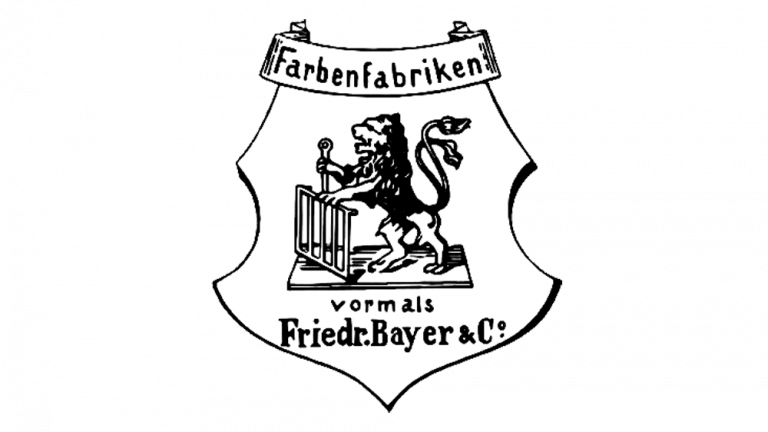
Bayer did not introduce a formal logo until 1881. The earliest emblem was based on the coat of arms of Elberfeld, featuring a lion motif. This design reflected regional pride and aligned with nineteenth-century corporate traditions rooted in heraldry and civic symbolism.
1886 – 1895: Ornamental Complexity
The 1886 logo expanded on heraldic themes, incorporating a dense composition of symbolic elements. Lions, foliage, branches, and decorative details formed an engraved emblem that emphasized craftsmanship and prestige. While visually rich, the design lacked the clarity needed for a rapidly expanding industrial brand.

1895 – 1904: Medical Authority Emerges
In 1895, Bayer simplified its identity. The emblem now featured a winged lion standing atop a globe, holding a scepter entwined with snakes—a clear reference to medicine and healing. This version marked Bayer’s growing focus on pharmaceuticals and scientific authority.

1904 – 1928: Birth of the Bayer Cross
The defining moment in Bayer logo history came in 1904 with the introduction of the Bayer Cross. The logo consisted of the word “BAYER” written horizontally and vertically, intersecting at the letter “Y,” all enclosed within a circle.
Registered as a trademark the same year, the logo was approved for use across pharmaceuticals, disinfectants, dyes, and chemical products. By 1910, Bayer began stamping the logo directly onto tablets, particularly Aspirin, as a method of counterfeiting prevention. This decision turned the logo into a functional seal of authenticity and accelerated its global recognition.

1929 – 1989: Consolidation and Recognition
For much of the twentieth century, the Bayer Cross remained visually unchanged. The circular emblem with intersecting wordmarks became the foundation for all subsequent visual expressions. Its clarity and symmetry allowed it to function effectively at any scale, from factory signage to tablet imprints.

1989 – 2002: Corporate Expansion
In 1989, Bayer introduced a more complex logo system. The Bayer Cross was positioned alongside a large sans-serif wordmark, accompanied by green and blue horizontal lines. These colors would soon become central to Bayer’s visual identity, symbolizing growth, health, and scientific progress.

2002 – 2010: Color and Modernity
The 2002 update marked the first fully colored version of the Bayer Cross. Blue and green gradients were introduced, giving the emblem a contemporary appearance while preserving its historic structure. This update signaled Bayer’s transition into a modern, innovation-driven global corporation.

2010 – 2017: Subtle Refinement
In 2010, the logo underwent minimal adjustments. Lettering shifted to dark gray, removing gradients and visual effects. This refinement emphasized clarity and neutrality, aligning with evolving corporate design standards.

2017 – Today: Digital Optimization
The most recent update in 2017 prepared the Bayer logo for digital environments. Gradients were removed, colors were refined, and the emblem was optimized for screens and small-scale applications. Despite these changes, the Bayer Cross remained unmistakably intact, preserving over a century of visual continuity.
Logo Symbolism: Science, Trust, and Precision
The Bayer Cross is one of the most conceptually elegant symbols in corporate branding. Its intersecting typography represents unity and balance, while the enclosing circle suggests protection, completeness, and continuity. Unlike figurative symbols, the cross relies entirely on typography, reinforcing Bayer’s scientific identity.
Its direct application onto tablets elevated the logo’s role, transforming it into a mark of safety and legitimacy. Few logos in pharmaceutical logo history have achieved such functional symbolism.
Typography and Color Philosophy
The lettering within the Bayer Cross uses a clean, modern sans-serif typeface, similar to Bristone Bold or Tapas Sans. Straight lines and balanced proportions convey professionalism and precision.
Bayer’s color palette centers on blue and green. Blue communicates trust, stability, and medical authority, while green symbolizes growth, life, and sustainability. Together, they reflect the company’s dual focus on healthcare and agricultural science.
Bayer Logo Heritage and Global Recognition
Bayer’s logo heritage demonstrates the power of restraint. Rather than redesigning its identity to follow trends, the company preserved its core symbol while adapting its execution to new technologies and media. This approach ensured immediate recognition across cultures and generations.
The Bayer Cross is not merely a logo; it is a historical artifact of modern medicine.
Bayer Logo History as a Symbol of Medical Authority
The Bayer logo history is a testament to the enduring strength of purposeful design. From heraldic lions to one of the most recognizable pharmaceutical symbols in the world, Bayer’s visual identity evolved alongside scientific progress while maintaining its foundational structure.
Within pharmaceutical logo history and European industrial heritage, the Bayer Cross stands as a symbol of trust, innovation, and responsibility. Its continued relevance proves that true brand power lies not in reinvention, but in consistency guided by meaning.
FAQ: Bayer Logo Meaning and History
What does the Bayer logo represent?
The Bayer Cross represents scientific precision, trust, and unity through intersecting typography within a protective circle.
Why is the Bayer logo stamped on tablets?
It was introduced to prevent counterfeiting and became a symbol of authenticity and quality.
Has the Bayer logo changed over time?
Yes, but changes were subtle refinements that preserved the original structure introduced in 1904.
What do the blue and green colors symbolize?
Blue represents trust and medical authority, while green symbolizes growth, health, and progress.