Wrangler Logo History: Meaning, Symbolism & Brand Heritage

Among the most enduring names in American apparel, Wrangler occupies a special place. The brand is inseparable from the mythology of the American West, from working cowboys and rodeos to the global denim culture that followed. While Wrangler-branded jeans officially appeared only in the mid-20th century, the company’s roots stretch back to the closing years of the 19th century, giving its visual identity a depth rarely matched in fashion.
In discussions surrounding logo history, logo meaning, and brand heritage, Wrangler stands alongside iconic American labels such as Levi’s logo history, Lee Jeans brand heritage, and Carhartt logo symbolism. Each of these brands built trust not through luxury narratives, but through durability, labor, and authenticity.
Meaning and History: From Overalls to Iconic Denim
Wrangler’s origin predates its name. In 1897, C.C. Hudson, then only twenty years old, left Spring Hill Farm in Tennessee and relocated to Greensboro, North Carolina. There, he began working in a factory producing overalls for laborers.
After the factory closed in 1904, Hudson and his partners acquired sewing machines and founded the Hudson Overall Company. By 1919, the business had grown enough to support the construction of its own factory and was renamed the Blue Bell Overall Company. The company became known for practical, durable workwear, including its popular Big Ben line.
A decisive moment arrived in 1943, when Blue Bell acquired the Casey Jones Work-Clothes Company, along with the legal rights to the name “Wrangler.” Though the name had been used sparingly, it carried strong associations with cowboy culture. When Blue Bell developed a new jeans line specifically for cowboys in 1946, “Wrangler” emerged as the perfect fit—direct, functional, and deeply American.
Wrangler Logo History Timeline
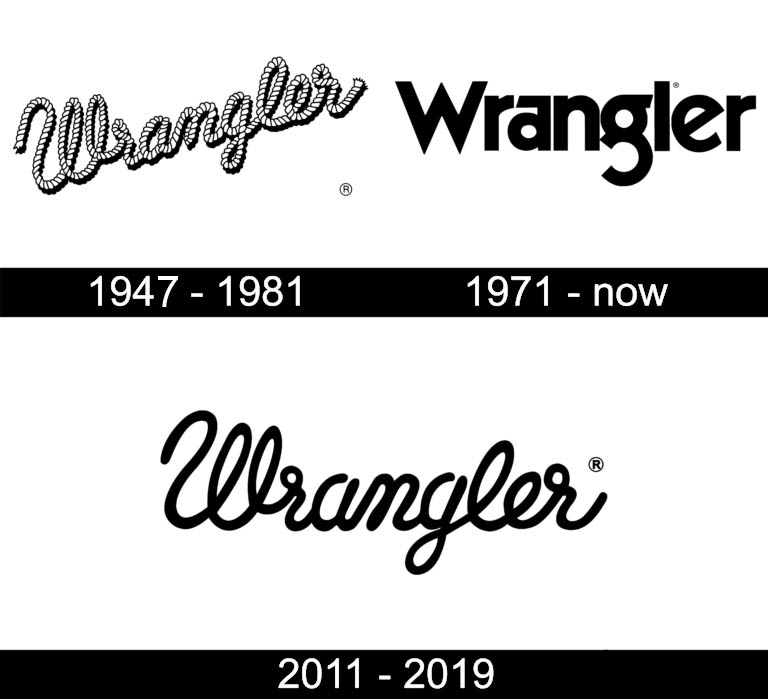
1947–1981: The Lasso Script and Cowboy Identity
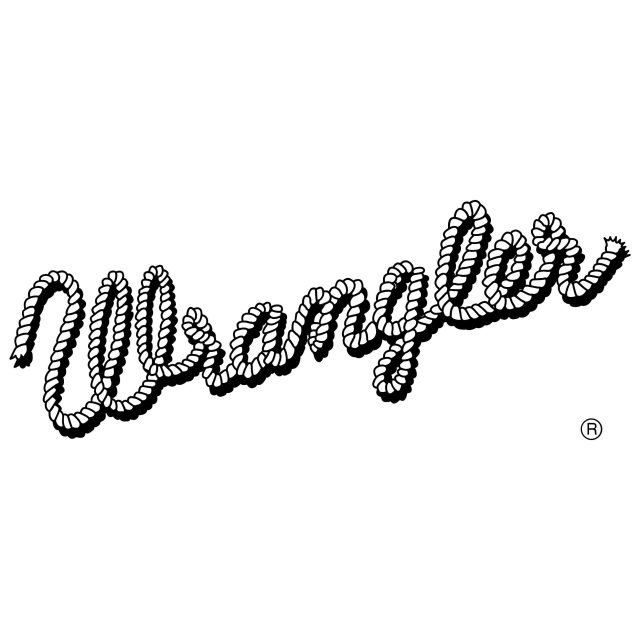
The original Wrangler logo introduced in the late 1940s was a direct visual translation of cowboy life. The wordmark was designed to resemble a lasso forming the entire word “Wrangler” in one continuous stroke. This approach dictated the use of a script typeface that mimicked handwritten lettering, reinforcing the idea of a single rope without breaks between letters.
The capital “W” featured prominent double loops, while the lowercase “r” characters included subtle curls, enhancing the rope-like effect. The baseline of the wordmark was intentionally angled upward at the end, giving the logo a sense of motion and optimism.
Early advertising often presented the logo in red with a black outline, a bold combination that emphasized visibility and strength. Although minor refinements occurred over the decades—adjustments to stroke thickness, spacing, and angle—the core identity remained remarkably consistent throughout the mid-20th century.
1971–Today (United States): Strength Over Ornament
In the early 1970s, Wrangler introduced a radically different logo for the U.S. market. This redesign abandoned the lasso motif entirely in favor of a heavy, angular wordmark. The new typography was bold and assertive, with sharp cuts and pronounced geometry.
One of the most distinctive elements of this logo is the letter “G,” whose lower portion forms an open circular shape. This detail adds visual tension while maintaining the logo’s industrial feel. Compared to the earlier script, this version communicates durability, authority, and confidence rather than romantic imagery.
This logo has remained in use in the United States ever since, becoming closely associated with Wrangler’s modern identity and global expansion.
2011–2019 (International): A Return to Roots
In 2011, Wrangler introduced a redesigned logo for international markets. This version drew inspiration from the original handwritten script, reintroducing a sense of heritage and fluidity. However, the literal lasso imagery was omitted, resulting in a cleaner, more contemporary wordmark.
This hybrid approach balanced nostalgia with modernity, appealing to global audiences while preserving the brand’s historical DNA.

Logo Symbolism: Work, Freedom, and Authenticity
The symbolism of the Wrangler logo has always been grounded in labor and independence. The original lasso design symbolized control, skill, and the working cowboy’s daily tools. It reflected a lifestyle defined by open spaces, physical effort, and self-reliance.
The later block-style wordmark shifted this symbolism toward strength and endurance. Its rigid geometry mirrors the toughness of denim itself, emphasizing Wrangler’s commitment to products designed for real work rather than fashion cycles.
Across all versions, the logo meaning remains consistent: Wrangler stands for authenticity earned through use.
Typography and Visual Language
Wrangler’s typographic evolution reflects its changing role in fashion. The early script conveyed personality and narrative, aligning with Western folklore. The modern block lettering prioritizes clarity and impact, suitable for global branding and mass production.
Despite these differences, both typographic approaches share a focus on legibility and presence. Wrangler logos are designed to be recognized from a distance, whether stitched onto denim or printed on packaging.
Color and Brand Recognition
Red has long been Wrangler’s signature color. It evokes energy, resilience, and confidence, while also ensuring strong contrast against denim blues. Black and white versions are used where neutrality or versatility is required, but red remains central to the brand’s identity.
This consistent color strategy reinforces Wrangler’s recognizability across decades and markets.
Conclusion: A Logo Forged in Workwear Heritage
The Wrangler logo heritage tells the story of an American brand that grew from workwear necessity into a global denim icon. Rather than constantly reinventing itself, Wrangler allowed its visual identity to evolve only when function demanded it.
Within the broader context of logo history, brand heritage, and American fashion identity, Wrangler demonstrates how authenticity can be preserved through clarity and restraint. Like Levi’s, Lee, and Carhartt, Wrangler proves that the strongest logos are those built on real experience, not abstraction.
FAQ: Wrangler Logo Meaning and History
What does the Wrangler logo represent?
The logo represents cowboy heritage, durability, and authentic American workwear.
When was the Wrangler logo first introduced?
The first Wrangler logo appeared in 1947.
Why did Wrangler change its logo in the 1970s?
The redesign reflected a shift toward a stronger, more industrial brand identity.
Is the original script logo still used?
Yes, inspired versions of the original script are still used in international markets.