
Crunchyroll Logo History: Meaning, Symbolism & Brand Heritage

Over the past two decades, Crunchyroll has transformed from a niche fan-driven website into the most influential anime streaming platform in the world. More than any other service, Crunchyroll shaped how Japanese animation is consumed globally, legitimizing anime as a mainstream entertainment category outside Japan. Its visual identity evolved in parallel with this transformation, reflecting shifts in audience scale, corporate structure, and cultural responsibility.
Within the broader ecosystem of logo history, logo meaning, and anime streaming brand heritage, Crunchyroll occupies a central position. When examined alongside Funimation logo history, WCOstream logo evolution, or even global platforms such as Netflix brand identity, Crunchyroll’s logo heritage reveals how simplicity and emotional symbolism can support massive global expansion without losing authenticity.
Meaning and History: From Fan Platform to Global Gatekeeper
Crunchyroll was founded in 2006 as a user-driven streaming site focused primarily on East Asian media, especially Japanese anime. In its early years, the platform existed on the fringes of legality and mainstream recognition, operating largely as a fan hub rather than a corporate service.
As licensing agreements, simulcasts, and industry partnerships became central to Crunchyroll’s business model, the brand underwent a philosophical shift. It moved from being a community platform to becoming an official gateway between Japanese studios and international audiences. This evolution required a visual identity capable of communicating legitimacy, friendliness, and cultural respect.
The Crunchyroll logo meaning centers on accessibility and emotional connection. Unlike brands that emphasize power or exclusivity, Crunchyroll’s identity focuses on invitation and shared experience.
Crunchyroll Logo History Timeline
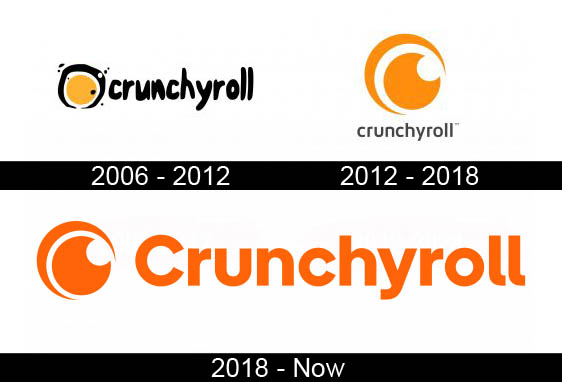
2006–2012: Early Identity and Community Roots
The earliest Crunchyroll logo reflected its experimental origins. Typography was playful, informal, and heavily web-oriented. The visual language prioritized approachability rather than polish, aligning with a platform built by and for anime fans.
At this stage, the logo functioned primarily as a digital marker rather than a strategic brand asset.

2012–2018: Birth of the Iconic “Eye”
A major turning point arrived when Crunchyroll introduced its now-famous emblem: an abstract circular shape resembling both a smiling face and an eye. Rendered in bright orange, the symbol immediately set the brand apart.
The “eye” served multiple symbolic roles. It referenced watching and streaming, curiosity, and emotional engagement. At the same time, its curved lines and asymmetry suggested friendliness rather than surveillance or control.
Typography during this era was clean, rounded, and sans-serif, reinforcing modernity and clarity as Crunchyroll expanded its licensed catalog.

2018–Today: Refinement and Corporate Maturity
Following its acquisition by Sony and eventual consolidation with Funimation, Crunchyroll refined its identity without altering its core symbol. The orange hue was standardized, spacing adjusted, and typographic proportions optimized for global use across apps, events, and merchandise.
The emblem remained unchanged in concept, signaling brand confidence. Rather than reinventing itself, Crunchyroll chose refinement, aligning with its position as the primary legal gateway for anime worldwide.
Logo Symbolism: Watching, Smiling, Belonging
The Crunchyroll logo symbolism is deceptively simple. The circular emblem reads simultaneously as an eye, a smile, and a spiral. This ambiguity is intentional. It allows the symbol to operate emotionally rather than literally.
As an eye, it represents watching and attention. As a smile, it conveys enjoyment and positivity. As a spiral, it suggests immersion and continuity, ideas central to serialized storytelling and fandom culture.
The bright orange color reinforces warmth, creativity, and enthusiasm, distinguishing Crunchyroll from darker, more corporate streaming brands.
Typography and Visual Language
Crunchyroll’s wordmark uses a rounded, modern sans-serif typeface designed for legibility across digital environments. The softened letterforms complement the emblem’s curves, creating a cohesive visual system.
Unlike earlier anime distributors that relied on aggressive or stylized typography, Crunchyroll’s typographic restraint reflects its role as an intermediary between cultures. The brand avoids visual noise, allowing content to take center stage.
Crunchyroll Logo Heritage in the Anime Industry
What makes Crunchyroll’s logo heritage notable is its balance between fandom and institution. The brand never abandoned its roots, yet successfully transitioned into a corporate entity responsible for licensing, production, and global distribution.
Within discussions of anime logo evolution, streaming platform brand identity, and digital media logo symbolism, Crunchyroll stands alongside Funimation, Netflix, and legacy studios such as Toei Animation, but remains visually distinct due to its emotional focus.
The logo functions not as a seal of authority, but as an invitation to participate.
A Logo Designed for Community at Scale
The Crunchyroll logo heritage demonstrates how a brand can scale globally without losing emotional accessibility. By committing early to a symbol rooted in viewing, joy, and connection, Crunchyroll avoided the pitfalls of over-corporatization.
In the wider landscape of logo history, brand heritage, and logo symbolism in digital media, Crunchyroll represents a modern archetype. Much like Funimation logo evolution or The North Face logo symbolism in their respective domains, Crunchyroll proves that clarity and emotional intelligence can be stronger than complexity.
Its logo does not dominate the viewer. It welcomes them.
FAQ: Crunchyroll Logo Meaning and History
What does the Crunchyroll logo represent?
The logo represents watching, enjoyment, and emotional engagement with anime content.
Why is the Crunchyroll logo orange?
Orange conveys creativity, enthusiasm, and friendliness, aligning with fandom culture.
What is the meaning of the eye-like symbol?
It symbolizes viewing, curiosity, and immersion, while also resembling a smile.
Has the Crunchyroll logo changed significantly over time?
No. The core emblem has remained consistent, with only refinements for clarity and scale.