Denver Nuggets Logo History: Meaning, Symbolism & Brand Heritage
The visual identity of the Denver Nuggets tells a story deeply tied to geography, local history, and cultural symbolism. Unlike many NBA franchises that centered their branding around abstract concepts or aggressive mascots, the Nuggets consistently drew inspiration from Colorado’s landscape and mining heritage. Across decades of redesigns, two recurring themes shaped the team’s visual language: the towering Rocky Mountains and the miner figure known as Maxie the Miner.
Within the broader framework of NBA logo history and basketball brand heritage, the Denver Nuggets represent a franchise whose identity evolved through refinement rather than erasure. Even as styles shifted and leagues merged, the Nuggets maintained a clear connection to place, using symbolism to communicate resilience, hard work, and regional pride.
Meaning and History: Origins of the Denver Nuggets Identity
Founded in 1967, the Denver Nuggets emerged during a period of rapid expansion in professional basketball. From the beginning, the franchise’s branding leaned heavily on local symbolism. Colorado’s mining past and mountainous terrain provided a natural narrative framework that distinguished the team from its peers.
The club’s visual identity evolved through multiple name changes and league transitions, most notably the shift from the Denver Rockets to the Denver Nuggets. Throughout these changes, the brand oscillated between illustrative mascots and landscape-based emblems, gradually moving toward a more refined and heraldic visual system.
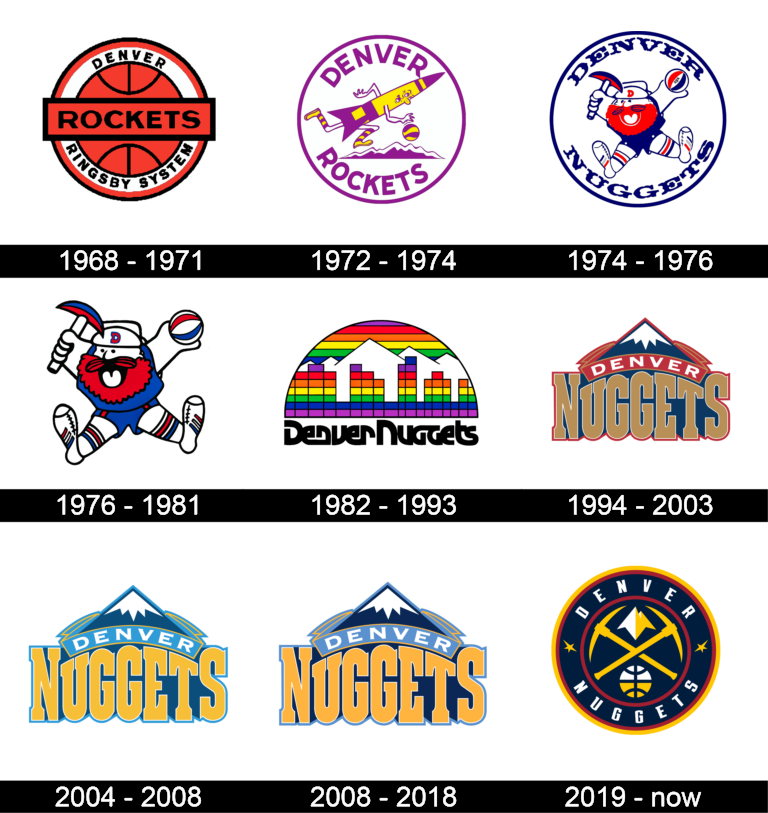
Denver Nuggets Logo History Timeline
1967–1971: Denver Rockets Beginnings
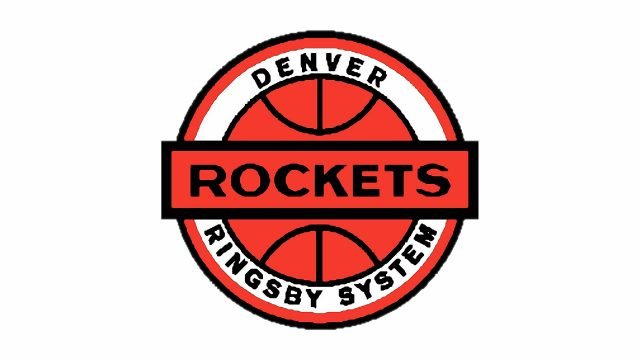
The first logo in franchise history was introduced when the team was known as the Denver Rockets. The emblem was clean and minimal, featuring a red basketball set inside a white circle with a double black-and-red outline. A horizontal red banner crossed the composition, carrying a bold sans-serif “Rockets” wordmark.
The inscription “Denver Kingsby System” surrounded the basketball along the perimeter, referencing the club’s original ownership. This early design reflected the straightforward branding approach common in late-1960s professional sports.
1971–1974: Caricature and Color Shift
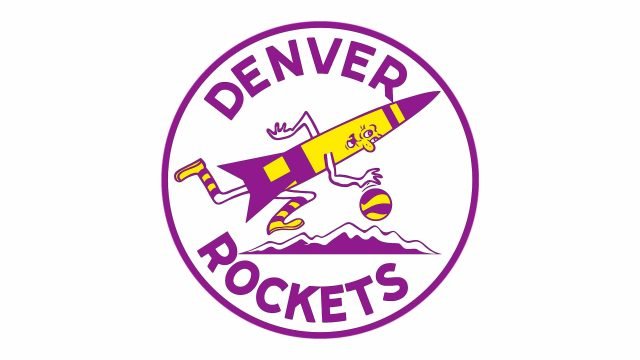
A dramatic redesign arrived in 1971, replacing minimalism with playful illustration. The color palette shifted to yellow and purple, while the logo adopted a caricature-style composition. A colorful rocket character ran across a backdrop of mountain peaks while carrying a basketball.
Typography wrapped around the circular emblem in uppercase purple sans-serif lettering. This version introduced the mountain motif for the first time, foreshadowing its long-term importance to the franchise’s identity.
1974–1976: Birth of the Nuggets and Maxie the Miner
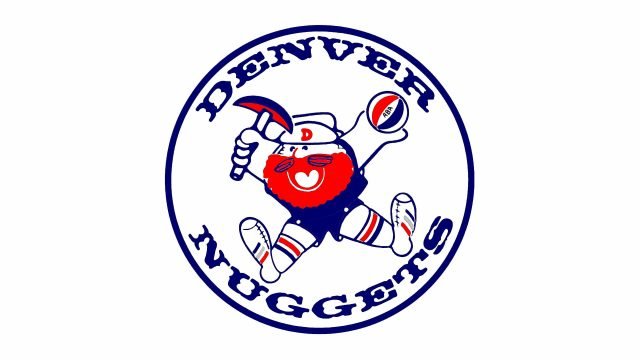
Following the ABA–NBA merger in 1974, the franchise was forced to abandon the Rockets name due to naming conflicts. The new identity, Denver Nuggets, debuted alongside a new logo.
This redesign introduced Maxie the Miner, a bearded cartoon miner rendered in blue, red, and white. He appeared jumping above a bold sans-serif wordmark, immediately establishing mining heritage as the emotional core of the brand.
1976–1981: Refinement of the Mascot Era
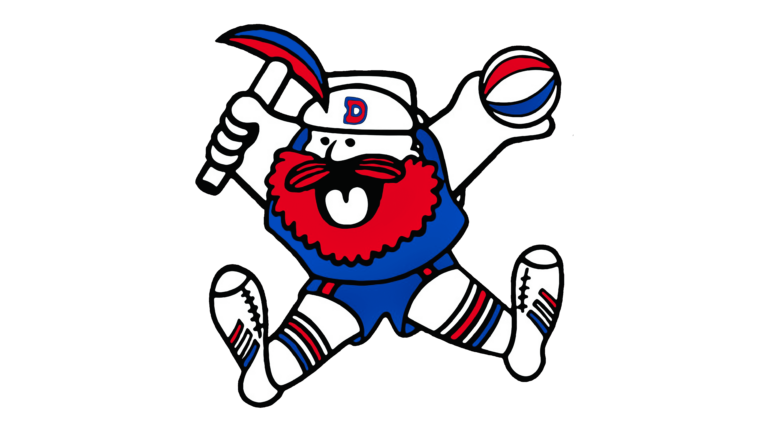
The late-1970s logo retained Maxie the Miner but refined his appearance. Colors were deepened, outlines cleaned, and details sharpened. Darker reds and stronger contours gave the mascot a more confident and visually striking presence.
This version represented the peak of the mascot-driven era in Nuggets branding.
1981–1993: Landscape and Disco-Era Aesthetics
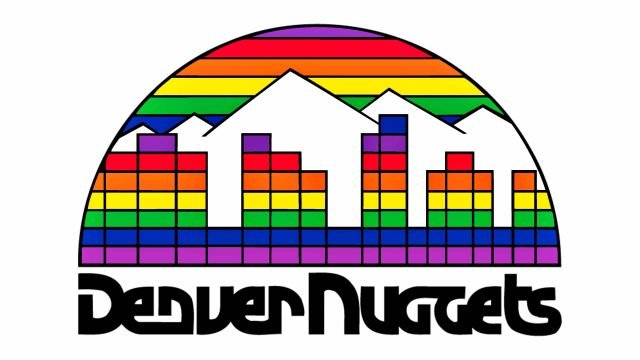
In 1981, the Nuggets shifted away from character illustration toward landscape symbolism. The new logo featured a semi-circular form rendered in a rainbow-inspired palette, with white mountain peaks dominating the center.
Below the image, a black wordmark reused typography from earlier versions. This redesign reflected early-1980s design trends while reinforcing Colorado’s geographic identity.
1993–2003: Mountains as the Primary Symbol
A more disciplined and elegant identity emerged in 1993. The logo centered on stylized white and royal blue mountains, topped by a red arched banner with a white “Denver” inscription. Beneath it, an enlarged gold “Nuggets” wordmark appeared in a bold serif typeface.
This version marked a turning point, establishing the mountains as the franchise’s primary symbol rather than a secondary motif.
2003–2008: Color Modernization
In 2003, the Nuggets refreshed their palette. Lighter shades of blue, white, and gold gave the emblem a brighter and more contemporary appearance. The overall structure remained unchanged, but the update conveyed growth, optimism, and renewed energy.
2008–2018: Depth and Cold-Tone Refinement
Another refinement followed in 2008. Blues and golds were darkened for greater contrast, while the arched banner shifted to a light blue tone, visually referencing Colorado’s alpine climate and snow-covered peaks.
This iteration balanced modern aesthetics with established symbolism.
2018–Today: Heritage Reimagined
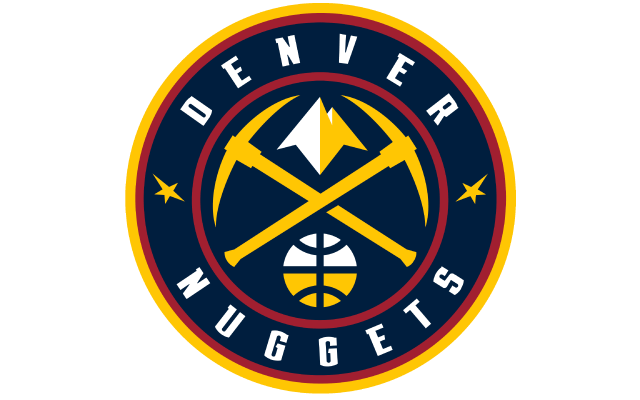
The current Denver Nuggets logo, introduced in 2018, represents a full return to heritage symbolism. The circular badge features a dark blue background with a white inner frame and a double gold-and-red outline.
At the center, two crossed mining hammers sit above a yellow-and-white basketball and beneath stylized mountain peaks. White lettering wraps around the perimeter, separated by two gold stars. This emblem unites mining history, geography, and modern sports branding into a single, cohesive mark.
Logo Symbolism: Mining, Mountains, and Identity
The symbolism of the Denver Nuggets logo is rooted in labor and landscape. Crossed pickaxes and hammers reference the mining industry that shaped Colorado’s early economy. Mountains symbolize endurance, elevation, and challenge, aligning naturally with competitive sports.
The circular format suggests unity and continuity, while stars add a subtle sense of achievement and aspiration.
Typography and Color System
The “Nuggets” wordmark closely resembles Aachen Bold, a slab serif typeface known for strength and readability. Its heavy structure reinforces stability and authority.
Color plays a crucial role in the identity. Navy blue and light blue create depth and dimension, gold adds contrast and prestige, and white provides balance and clarity. Together, these elements form a mature and recognizable visual system.
Conclusion: Denver Nuggets Logo Heritage
The Denver Nuggets logo heritage illustrates how a franchise can evolve while staying anchored to its roots. Through decades of redesigns, the team gradually transitioned from playful mascots to a refined heritage emblem that communicates place, history, and professionalism.
Within the broader context of NBA brand identity, sports logo evolution, and basketball visual heritage, the Nuggets stand as a strong example of how regional symbolism can be transformed into a timeless brand asset.
FAQ: Denver Nuggets Logo Meaning and History
What does the Denver Nuggets logo represent?
The logo represents Colorado’s mining heritage, mountainous landscape, and the values of resilience and hard work.
Who is Maxie the Miner?
Maxie the Miner was a mascot-style figure used in early Nuggets logos to emphasize local mining history.
Why do the Nuggets use crossed pickaxes in their logo?
The crossed pickaxes symbolize labor, tradition, and the historical foundations of the region.
What colors define the Denver Nuggets brand?
Navy blue, light blue, gold, and white are the official team colors.