
Chevrolet Corvette Logo History: Meaning, Symbolism & Brand Heritage
Few automotive nameplates carry the same cultural weight as Corvette. Introduced in 1953 by Chevrolet, Corvette quickly evolved from an experimental roadster into a defining symbol of American performance engineering. Over seven decades, the model has represented speed, innovation, and national pride, becoming one of the most recognizable sports cars in the world.
The Corvette logo history mirrors this evolution with remarkable consistency. While materials, proportions, and styling have changed, the core concept of the emblem has remained intact since its debut. This continuity gives the Corvette logo meaning a depth rarely found in automotive branding, positioning it as a textbook example of enduring logo heritage shaped by performance and identity rather than trends.
Meaning and History: The Origin of the Corvette Logo
The name “Corvette” comes from a class of small, fast naval ships designed for agility and speed. This association with maneuverability and power influenced both the car’s positioning and its visual identity. From the beginning, Chevrolet sought to give Corvette a badge that felt distinct from the parent brand, signaling that this was not just another Chevrolet model, but a flagship performance icon.
The logo origin dates to 1953 and is credited to Robert Bartholomew, a Chevrolet designer involved in the Corvette’s early development. His task was to create an emblem that communicated racing heritage, craftsmanship, and prestige. The result was the now-famous crossed-flags motif, a symbol that has defined Corvette for generations.
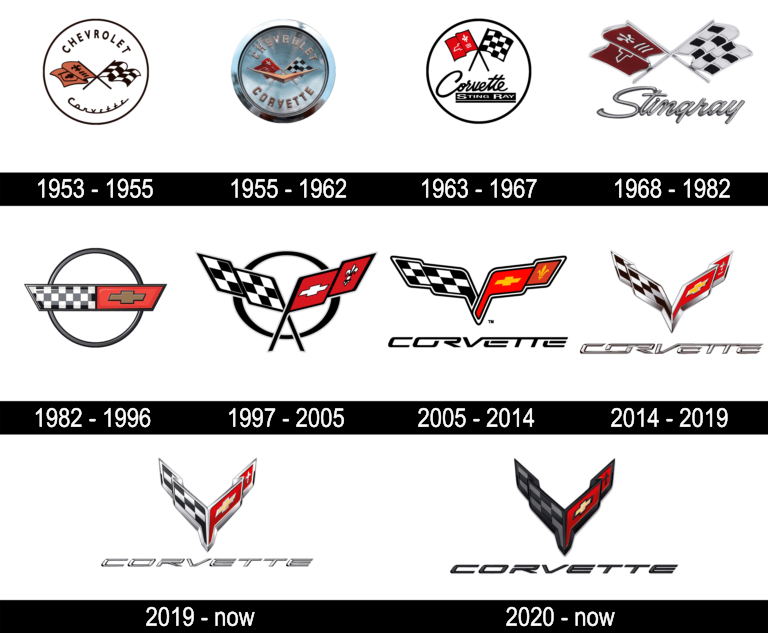
Corvette Logo History Timeline
1953–1955: Racing Roots and European Heritage
The original Corvette logo featured a circular badge with two crossed flags. One was a black-and-white checkered racing flag, universally associated with motorsport. The other was red and featured a fleur-de-lis along with horizontal stripes. The fleur-de-lis referenced the French heritage of Louis Chevrolet, honoring the brand’s origins.
Typography played a secondary role, with “Chevrolet” appearing prominently above the emblem and “Corvette” written below in elegant cursive. This version emphasized heritage and sophistication as much as performance.
1955–1962: Chrome, Power, and Confidence
In 1955, the logo was refined and placed inside a glossy silver medallion. The typography shifted toward a more geometric sans-serif style, reflecting the growing power and confidence of the Corvette lineup. The emblem began to look less ornamental and more mechanical, aligning with the car’s improving performance credentials.
1963–1967: Performance Takes Center Stage
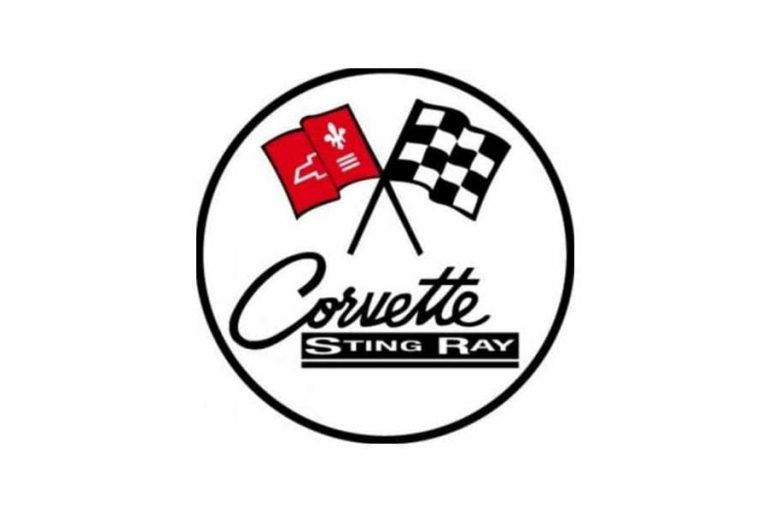
By the early 1960s, Corvette had established itself as a serious sports car. The logo was simplified by removing the wordmark entirely and enlarging the crossed flags. A prominent “V” element appeared, widely interpreted as a reference to the V8 engine that defined Corvette’s performance identity during this era.
1968–1982: Sharper Geometry and Modern Forms
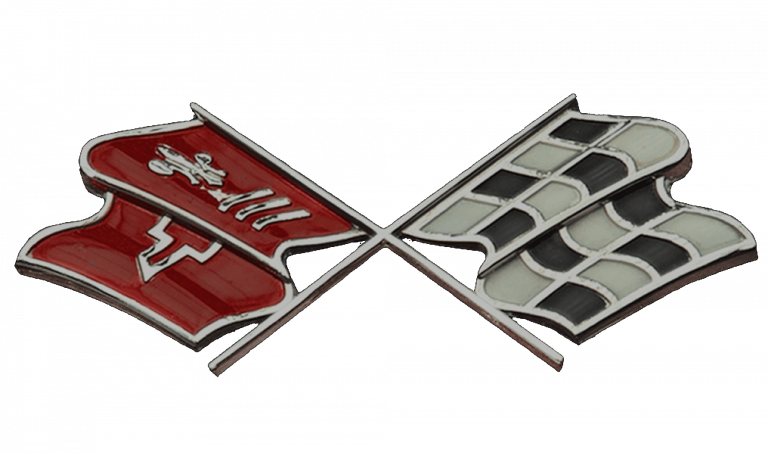
In 1967, the flags were flattened and stylized with more angular geometry. The emblem became stronger and more assertive, reflecting the aggressive design language of late-1960s and 1970s Corvettes. This period reinforced the logo as a performance badge rather than a decorative mark.
1982–1996: Radical Departure
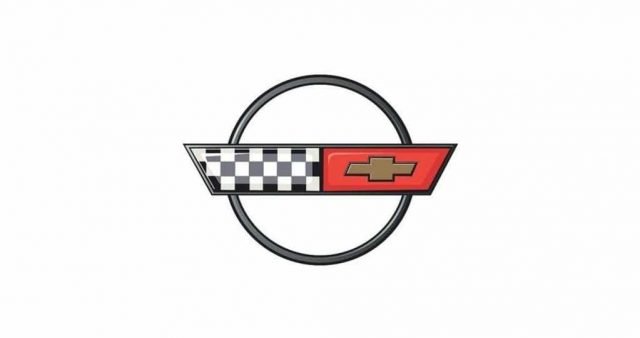
The 1980s brought the most dramatic departure in Corvette logo history. In 1984, the crossed flags were replaced with a circular emblem intersected by a long horizontal rectangle. One side retained the racing flag motif, while the other incorporated a Chevrolet symbol. Although bold, this design broke visual continuity and was later viewed as an experimental detour rather than a lasting evolution.
1997–2005: Return to Tradition
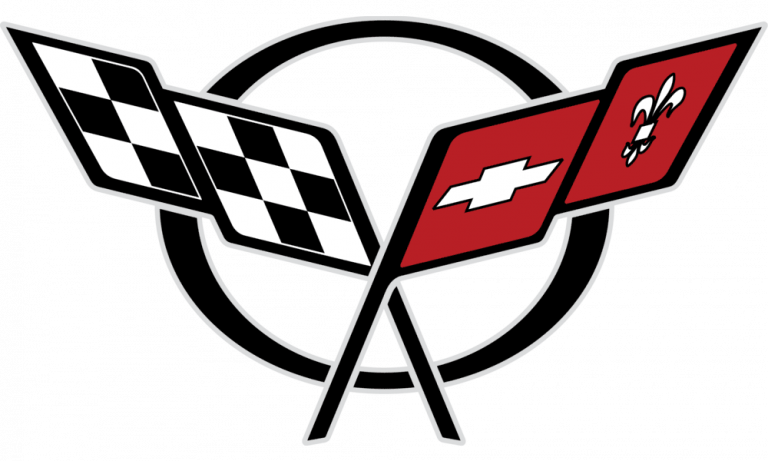
With the introduction of the C5 Corvette in 1997, the brand returned to its roots. The crossed flags reappeared, with their positions swapped. This redesign reestablished visual continuity and reaffirmed Corvette’s heritage-driven identity.
2005–2014: Compact and Dynamic
The 2004 redesign shortened the flag shapes and removed circular outlines. The emblem became more compact and angular, with subtle gradients adding depth. This version balanced tradition with modernity, aligning with early-2000s automotive design trends.
2014–2019: Futuristic Precision
In 2014, the logo adopted sharper lines and a more triangular composition. Thick silver outlines emphasized precision and technology, mirroring Corvette’s increasing focus on advanced engineering and aerodynamics.
2019–Today: The C8 Era and Aggressive Minimalism
The logo introduced for the C8 Corvette sharpened the crossed flags further, reinforcing the “V” shape formed by their intersection. The fleur-de-lis was modernized, and the overall design became more aggressive and angular.
2020–Today: Matte Performance Identity
A subsequent refinement replaced glossy chrome with matte black finishes and carbon-inspired textures. The Chevrolet bowtie within the emblem was flattened into yellow and black, with heavier outlines. This version reflects modern performance branding, emphasizing stealth, technology, and raw power.
Logo Symbolism: Racing, Victory, and Heritage
The Corvette logo symbolism is layered and deliberate. The crossed flags form a stylized “V,” often associated with victory and velocity. The checkered flag represents motorsport and competition, while the fleur-de-lis honors Louis Chevrolet’s European roots.
Together, these elements create a narrative that blends racing ambition with heritage. Unlike many automotive logos that rely on abstract shapes, Corvette’s emblem tells a story that is instantly readable to enthusiasts.
Typography and Color in the Corvette Logo
Typography has gradually receded from prominence in Corvette branding, with the emblem itself becoming the primary identifier. When present, lettering has favored clean, bold sans-serif forms, reinforcing performance and modernity.
Color usage evolved from bright reds and chrome finishes to darker, more restrained palettes. The modern use of matte black, silver, and subtle yellow accents reflects contemporary performance aesthetics and aligns with Corvette’s positioning as a supercar competitor.
Corvette Logo Heritage and Brand Identity
Corvette’s logo heritage stands out for its consistency. Despite occasional experimentation, the brand always returned to the crossed flags motif. This visual discipline helped Corvette maintain a strong identity across radically different automotive eras, from 1950s roadsters to mid-engine supercars.
The emblem functions as a badge of honor, signaling not just a model, but a philosophy of performance.
An Icon Forged in Motion
The Corvette logo history demonstrates how a powerful symbol can evolve without losing its soul. By refining rather than replacing its core elements, Corvette built a visual identity that feels timeless yet adaptable.
The crossed flags remain one of the most recognizable emblems in automotive history, embodying speed, victory, and heritage. As Corvette continues to redefine American performance, its logo stands as a reminder that true brand identity is built over decades, not redesign cycles.
FAQ: Corvette Logo Meaning, Symbolism, and History
What does the Corvette logo represent?
The logo represents racing heritage, victory, and performance through crossed flags.
Who designed the original Corvette logo?
The original 1953 logo was designed by Robert Bartholomew.
Why does the Corvette logo include a fleur-de-lis?
The fleur-de-lis honors the French heritage of Louis Chevrolet.
Has the Corvette logo always used crossed flags?
Yes, except for a brief experimental period in the 1980s, the crossed flags have remained central.
What does the “V” shape in the logo symbolize?
It is often associated with victory, velocity, and the V8 engine.
Is the Corvette logo different from the Chevrolet logo?
Yes, Corvette uses its own emblem rather than the Chevrolet bowtie.