Chuck E. Cheese Logo History: Meaning, Symbolism & Brand Heritage

Chuck E. Cheese occupies a unique position in American pop culture, blending fast food with family entertainment in a way few brands have managed to replicate. Founded in 1977 in Texas, the chain grew into an international network of more than 500 locations across the Americas, India, and the Middle East. Unlike traditional fast-food brands, Chuck E. Cheese was conceived not only as a place to eat, but as an immersive entertainment environment built around games, performances, and a recognizable mascot.
The Chuck E. Cheese logo history reflects this hybrid identity. Across decades of redesigns, the brand’s visual language remained anchored in one core element: its mouse mascot. While styles, colors, and typography evolved, the logo meaning consistently emphasized fun, accessibility, and child-centered entertainment. This continuity has shaped one of the most distinctive examples of logo heritage in the fast-food and leisure industry.
Meaning and History: The Origin of the Chuck E. Cheese Logo
Chuck E. Cheese was founded by Nolan Bushnell, co-founder of Atari. The original concept was closely tied to arcade gaming, with the restaurant serving as a showcase for Atari-developed video games. Pizza was chosen as the food offering for its universal appeal and ease of service, but entertainment was always the primary focus.
The logo origin reflects this philosophy. From the beginning, Chuck E. Cheese relied on character-driven branding rather than abstract symbols or purely typographic marks. The mascot became the emotional anchor of the brand, signaling joy, playfulness, and inclusivity. Even as the company went through bankruptcy, acquisition, and multiple repositionings, the mascot-based logo ensured continuity and recognition.
Chuck E. Cheese Logo History Timeline
1977–1981: Neon Energy and Arcade Influence
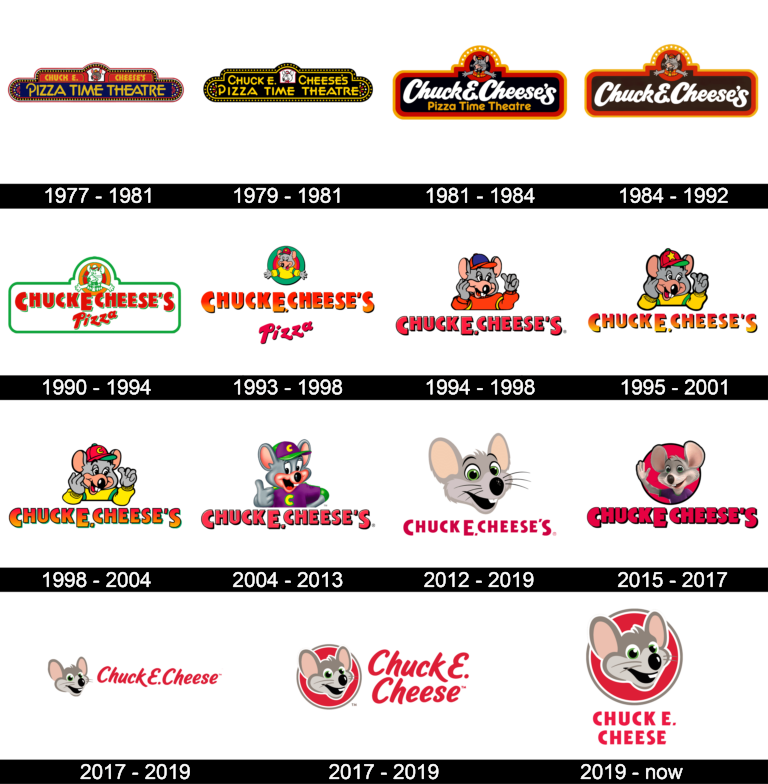
The original 1977 logo captured the spirit of late-1970s arcade culture. It featured a horizontally stretched banner in red and blue with bright yellow lettering. The central element was a gray rodent character placed against a white background, framed by an arched border decorated with lightbulb dots. This design echoed theater marquees and arcade signage, reinforcing the entertainment-first identity.
A darker signage variation appeared shortly after, replacing bright colors with black backgrounds and yellow outlines, improving visibility in low-light environments.
1981–1984: Stronger Geometry and Visual Weight
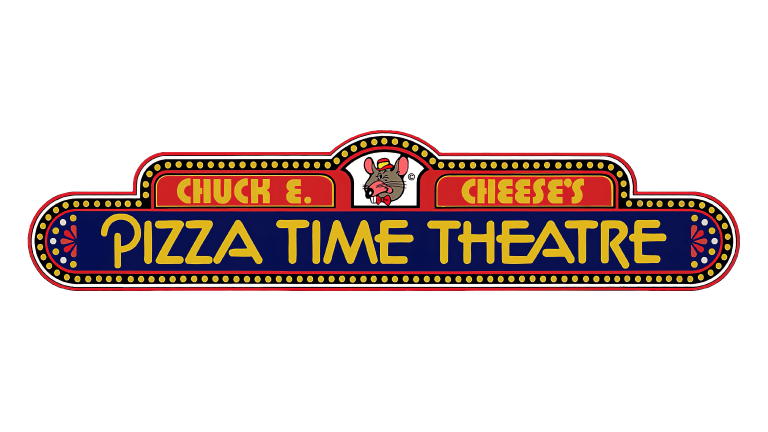
In the early 1980s, the logo adopted heavier shapes and darker tones. Blue elements were replaced with black, and the mascot was enclosed in a circular medallion with a dark red outline. The overall composition became more compact and structured, reflecting a maturing brand during a period of operational challenges.
1984–1992: Simplification After Acquisition
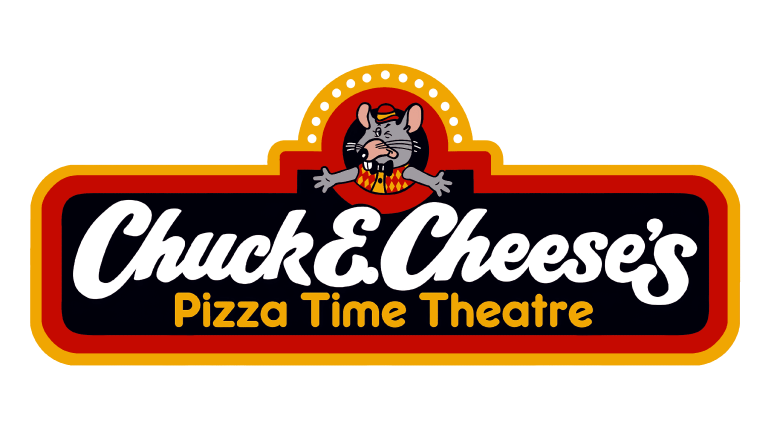
Following the acquisition by Brock Hotel Corporation, the logo was simplified. The “Pizza Time Theater” tagline was removed, signaling a shift toward a cleaner, more flexible identity. While the mascot and core structure remained intact, the emphasis moved toward clarity and scalability.
1990–1998: Color Experimentation and Mascot Evolution
Throughout the 1990s, Chuck E. Cheese experimented extensively with color and mascot styling. Green, red, orange, and yellow gradients were introduced, and the mouse character became more expressive and dynamic. During this period, the brand transitioned decisively from a rat to a mouse, a strategic move to make the mascot friendlier and more appealing to children.
Typography evolved into bold uppercase sans-serif lettering, improving legibility and reinforcing a more contemporary tone.
1998–2013: Consolidation and Brand Recognition
By the late 1990s and early 2000s, the logo settled into a more stable configuration. The mascot appeared above or alongside the wordmark, wearing branded clothing and a cap featuring the letter “C.” The color palette remained vivid, but more controlled, supporting strong brand recognition across signage, packaging, and marketing materials.
2012–2019: Minimalism and Icon Focus
A major simplification arrived in 2012, reducing the mascot to a head-only emblem. The mouse’s large green eyes became a defining feature, and the wordmark was rendered in solid red sans-serif lettering. This version reflected broader branding trends toward minimalism while retaining the brand’s playful essence.

2019–Today: Emblem-Centered Identity
The 2019 redesign reinforced the emblem as the primary visual element. The mouse head was enlarged and placed on a red circular medallion above a two-line wordmark. Typography became heavier and cleaner, with flat red lettering and no outlines or shadows. This version emphasizes clarity, digital adaptability, and mascot recognition.
Logo Symbolism: Entertainment First
The symbolism of the Chuck E. Cheese logo revolves around entertainment and emotional connection. The mascot embodies friendliness, safety, and fun, acting as a host rather than a corporate symbol. The red color conveys warmth, excitement, and energy, while gray and white soften the visual tone, making the logo approachable rather than aggressive.
The recurring use of circular frames suggests inclusivity and continuity, reinforcing the idea of Chuck E. Cheese as a welcoming space for families.
Typography and Color in the Chuck E. Cheese Logo
Typography evolved from decorative scripts and marquee-inspired lettering into bold, geometric sans-serif forms. The modern wordmark uses heavy uppercase characters with sharp cuts and straight edges, projecting confidence and clarity. Fonts similar to Kabel Pro Black or Italiano Fusion Extra Bold approximate this visual style.
Color remains central to the logo meaning. Red dominates as the primary brand color, symbolizing joy, celebration, and energy. Green accents—especially in the mascot’s eyes—add vitality, while gray and white maintain balance and neutrality.
Chuck E. Cheese Logo Heritage and Brand Identity
Chuck E. Cheese’s logo heritage is defined by adaptability without abandonment. Despite numerous redesigns, the brand never discarded its mascot, understanding its importance as a trust-building element for children and parents alike. This long-term consistency allowed the brand to survive ownership changes, market shifts, and evolving consumer expectations.
The logo functions as both a brand identifier and a character introduction, setting Chuck E. Cheese apart from traditional fast-food chains.
Conclusion: A Mascot That Carries the Brand
The Chuck E. Cheese logo history demonstrates the power of character-driven branding. By centering its identity on a friendly mascot and refining its visual language over time, the brand created a logo heritage that remains instantly recognizable across generations.
Rather than chasing trends, Chuck E. Cheese evolved its logo in response to cultural shifts while preserving its core promise: fun, entertainment, and family-friendly experiences. In doing so, it built one of the most enduring visual identities in the entertainment dining sector.
FAQ: Chuck E. Cheese Logo Meaning, Symbolism, and History
What does the Chuck E. Cheese logo represent?
The logo represents fun, entertainment, and family-friendly experiences through its mouse mascot.
Who founded Chuck E. Cheese?
Chuck E. Cheese was founded in 1977 by Nolan Bushnell.
Why is the mascot a mouse and not a rat?
The brand transitioned from a rat to a mouse to create a friendlier and more positive image.
When was the Chuck E. Cheese logo last redesigned?
The most recent major redesign took place in 2019.
What does the “E” in Chuck E. Cheese stand for?
The “E” stands for “Entertainment,” reflecting the brand’s core focus.
What colors define the Chuck E. Cheese logo?
Red and gray dominate the palette, with green and white used as accents.