Minecraft Logo History: Meaning, Symbolism & Brand Heritage
Few video game logos are as immediately recognizable as Minecraft’s. Built from blocky geometry and textured to resemble stone, the logo mirrors the very logic of the game itself. Since its earliest public versions, Minecraft has relied on a single visual metaphor: construction. The logo is not a decorative sign, but a material object, designed to look as though it could exist inside the game world.
The Minecraft logo history is a clear example of form following concept. While the logo has been refined several times since 2009, its core idea has never changed. Cobblestone, pixels, and modular structure remain central to its identity. This consistency has allowed the logo meaning and logo symbolism to grow stronger over time, turning the wordmark into a foundational element of the game’s broader visual culture.
Meaning and History: The Origin of the Minecraft Logo
Minecraft originated as an independent project developed by Markus Persson, later known as Notch. From the beginning, the game was conceived as a sandbox experience where players could build, destroy, and reshape the world freely. This philosophy directly influenced the logo origin.
Rather than adopting illustrative characters or abstract symbols, Minecraft’s identity was constructed from typography alone. The logo had to feel like part of the environment, not a label placed on top of it. This approach made the wordmark itself a “block,” reinforcing the idea that everything in Minecraft is made from simple elements combined creatively.
As the game evolved from an experimental project into a global phenomenon later acquired by Mojang Studios and ultimately Microsoft, the logo retained its original conceptual foundation. Each redesign focused on refinement, not reinvention.
Minecraft Logo History Timeline
2009: The Unused Prototype Logo
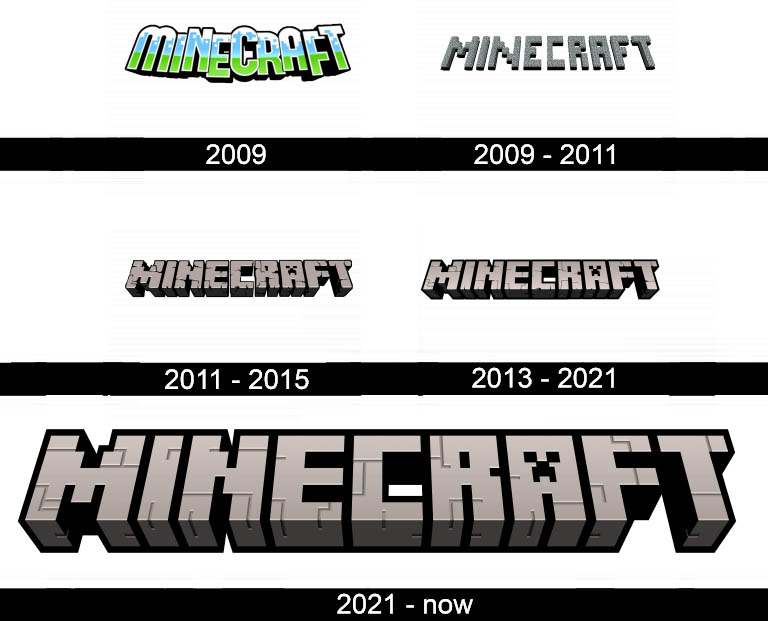
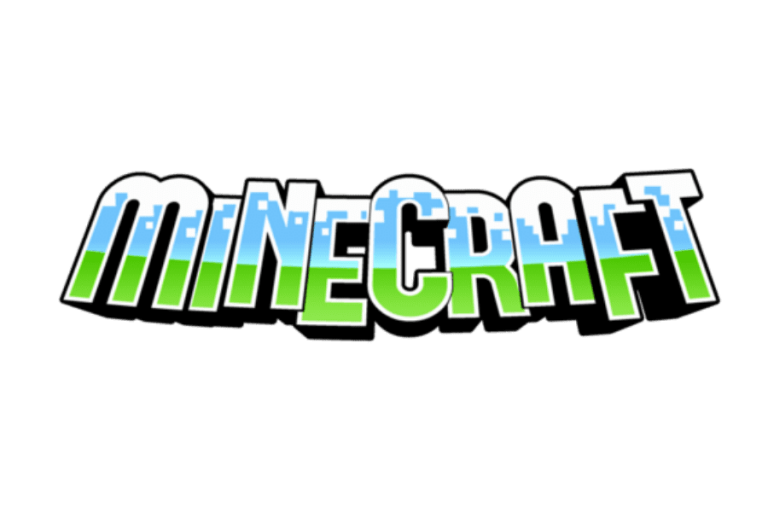
The earliest known Minecraft logo was created in 2009 by Hayden Scott-Baron. This version was never officially adopted. It featured a bold sans-serif wordmark with uneven, jumping letters, filled with a bright blue-and-green texture symbolizing sky and grass. While playful, this design lacked the structural clarity that would later define Minecraft’s visual identity.
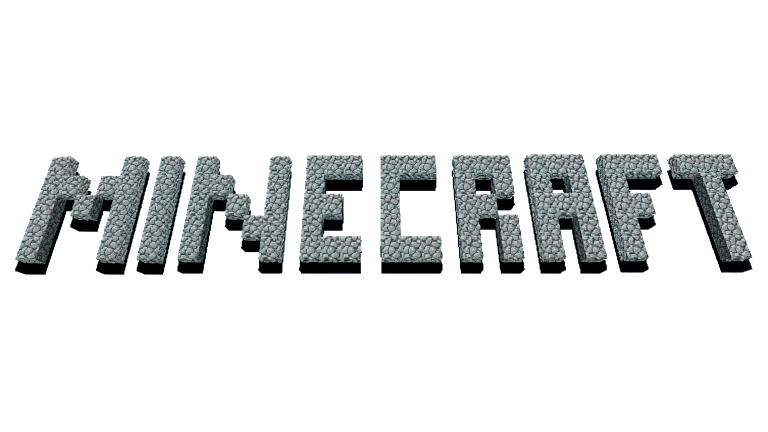
2009–2011: The First Official Cobblestone Logo
The first official Minecraft logo introduced later in 2009 marked a decisive shift. The letters became blocky and geometric, constructed from square pixels. Diagonal strokes were rendered as stepped pixel lines, reinforcing the digital, modular aesthetic. The surface texture resembled cobblestone, a fundamental in-game material, immediately tying the logo to gameplay mechanics.
2011–2015: Refinement and Weight
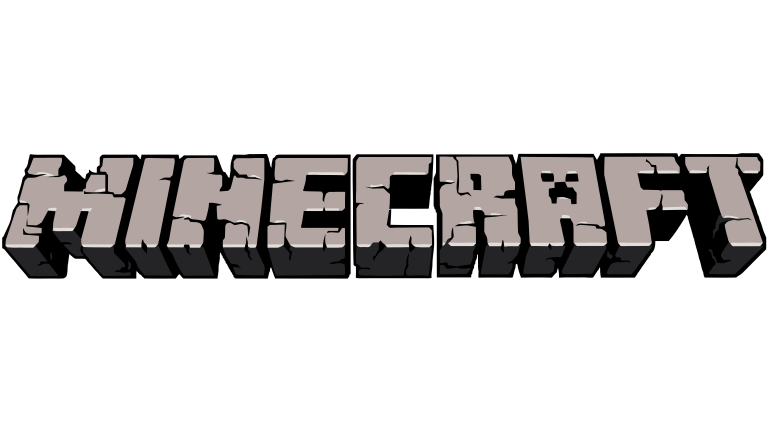
In 2011, the logo was redesigned to appear heavier and more stable. Letterforms were thickened, proportions tightened, and the stone texture refined. The gray surface became more uniform, accented with subtle black cracks that enhanced the illusion of carved stone. This version conveyed maturity and permanence, aligning with Minecraft’s transition from indie experiment to mainstream success.
2013–2021: Depth and Professional Finish
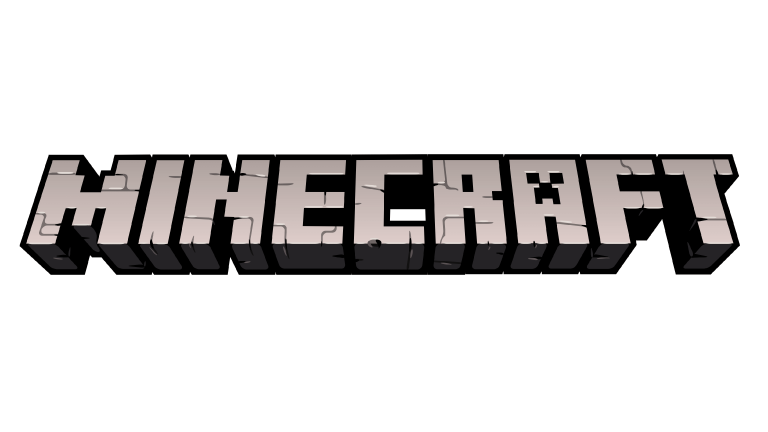
A further refinement introduced subtle gradients to the gray palette. These changes gave the logo more depth and dimensionality without altering its structure. Edges were cleaned, contours sharpened, and letter spacing optimized. The “A” gained a clearer internal cutout, improving legibility while maintaining the block-based design language.
Special variants were also introduced for Java Edition and Bedrock Edition, maintaining the same core structure with minor contextual distinctions.
2021–Today: Modern Shading, Same Structure
The 2021 update adjusted lighting and shading rather than form. Lighter tones were added to the lower portions of the letters, while the main surfaces became more matte. These changes modernized the appearance, especially for digital interfaces, while preserving the iconic geometry. The logo remains unmistakably Minecraft, proving the strength of its original concept.
Logo Symbolism: Building as Identity
The symbolism of the Minecraft logo is literal and conceptual at the same time. The cobblestone texture references one of the most basic building blocks in the game. It symbolizes effort, survival, and progression, as players must mine and shape the environment to advance.
The blocky typography mirrors the voxel-based world, where everything is constructed from cubes. Even the imperfections in the stone texture suggest a handmade, player-driven universe rather than a polished, pre-defined one. This symbolism reinforces Minecraft’s core promise: creativity through simplicity.
Typography and Color in the Minecraft Logo
Minecraft does not use a traditional font. The wordmark was custom-designed specifically for the brand, with each letter constructed as a modular object. While inspired by pixel aesthetics, the logo’s typography is more sculptural than digital, designed to feel solid and physical.
Color plays a restrained but essential role. Various shades of gray combined with black dominate the logo, reinforcing the stone metaphor. Unlike many game logos that rely on vibrant palettes, Minecraft’s neutral tones emphasize universality and adaptability, allowing the logo to exist comfortably across platforms, merchandise, and media.
Iconography and System Consistency
Beyond the wordmark, Minecraft’s icon system follows the same logic. The grass block cube, rendered in green and brown pixel textures, functions as an instantly recognizable symbol. Whether in three-dimensional form or flat app icon versions, it reinforces the same visual language as the logo.
This cohesion between logo, icon, and in-game assets strengthens Minecraft’s logo heritage, making the brand feel internally consistent rather than externally branded.
Minecraft Logo Heritage and Brand Identity
Minecraft’s logo heritage is defined by conceptual discipline. Instead of chasing trends or dramatic redesigns, the brand focused on perfecting a single idea. Each update improved clarity, depth, or adaptability while respecting the original structure.
This approach mirrors the game itself. Just as players refine their builds block by block, the logo evolved through incremental improvement. The result is a visual identity that feels timeless, functional, and deeply connected to the product it represents.
Conclusion: A Logo Built Like the Game It Represents
The Minecraft logo history demonstrates how a strong concept can sustain a brand for more than a decade. By treating typography as material and design as construction, Minecraft created a logo that feels intrinsic rather than applied.
Its cobblestone wordmark is not merely a name, but a symbol of creativity, effort, and imagination. As a piece of logo heritage, Minecraft stands as one of the clearest examples of identity design that grows organically from the product itself.
FAQ: Minecraft Logo Meaning, Symbolism, and History
What does the Minecraft logo represent?
The logo represents construction, creativity, and survival, symbolized through blocky typography and cobblestone texture.
Who designed the first Minecraft logo?
The earliest prototype logo was created by Hayden Scott-Baron in 2009.
Why is the Minecraft logo made of stone?
The stone texture references cobblestone, a core in-game material central to building and progression.
Has the Minecraft logo changed much over time?
The logo has been refined several times, but its structure and concept have remained consistent.
What font is used in the Minecraft logo?
The logo uses a custom-designed wordmark rather than a standard font.
Who owns Minecraft today?
Minecraft is owned by Microsoft through Mojang Studios.