The History of Fast Food Logos: How Color, Speed and Psychology Shaped Global Brands
Fast food logos belong to a rare category of visual symbols that almost no one consciously studies, yet nearly everyone recognizes instantly. They are embedded in daily life with a familiarity that borders on invisibility. Seen from highways, city intersections, smartphone screens, delivery apps, packaging, uniforms, and illuminated signage, fast food logos operate in environments of extreme visual competition. Their success is not accidental. It is the result of a century-long refinement process in which design, psychology, architecture, and mass behavior converged.
Unlike luxury branding, which invites contemplation, or industrial branding, which signals authority and stability, fast food branding was designed to function under pressure. These logos were built for speed. They needed to be legible in motion, memorable at a glance, and emotionally persuasive without explanation. The history of fast food logos is therefore not simply a design story. It is a cultural history of modern consumption, urban growth, and the transformation of branding into a behavioral tool.
Fast Food and the Birth of Visual Urgency
The origins of fast food branding are inseparable from post-war America. After World War II, suburbanization, automobile ownership, and changing work patterns created a new type of consumer: mobile, time-constrained, and visually overloaded. Restaurants designed for quick service began to appear along highways and arterial roads, competing for attention in seconds rather than minutes.
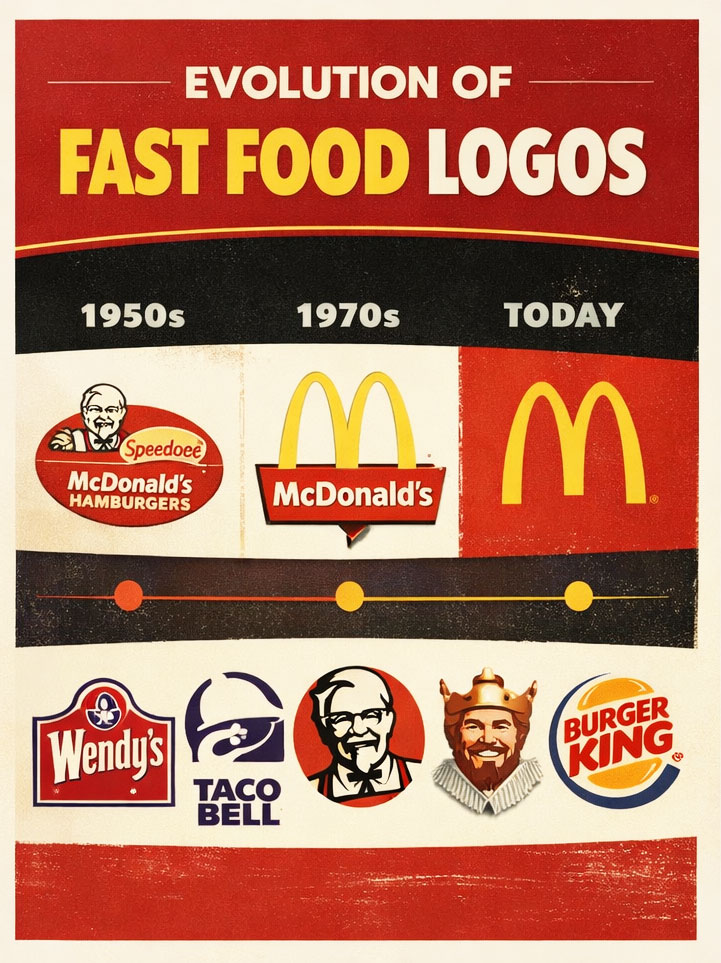
In this environment, the earliest fast food logos were not conceived as abstract graphic identities. They were extensions of architecture. Buildings themselves became logos. The most famous example remains McDonald’s, whose original Golden Arches were physical structures designed to make the restaurant visible from a distance. Only later were those arches abstracted into a graphic mark, transforming architecture into symbol.
This shift marked the birth of fast food logo design as a discipline. Recognition became more important than detail. Visibility mattered more than refinement. The logo’s primary task was to interrupt movement and anchor memory.
Color as Appetite, Speed, and Signal
No element of fast food branding has been studied more extensively than color, yet its effectiveness remains remarkably consistent. Red and yellow dominate fast food logos across decades and continents. This is not coincidence, nor mere tradition.
Red triggers physiological responses associated with urgency and stimulation. It increases heart rate and draws attention. Yellow enhances visibility, particularly in peripheral vision, and conveys warmth and accessibility. Together, these colors create a visual command: notice me, act quickly, feel comfortable.
Brands such as McDonald’s, KFC, Burger King, and Wendy’s refined this palette over decades, embedding color psychology directly into brand identity. Even when trends shifted toward minimalism, these core colors rarely disappeared entirely. Instead, they were softened, flattened, or rebalanced to suit digital environments.
Color in fast food logos is not decorative. It is functional design, optimized for behavioral response.
Typography and the Language of Speed
Typography in fast food logos evolved alongside the need for immediacy. Early wordmarks favored bold, rounded letterforms that could be read at high speed and from long distances. Sharp serifs and delicate details were avoided. Instead, designers favored custom lettering that conveyed friendliness, motion, and informality.
The Burger King logo history illustrates this evolution clearly. Its typography oscillated between playful and restrained, reflecting shifts in brand positioning. Domino’s adopted geometric simplicity, aligning its visual language with efficiency and delivery-focused service. Taco Bell embraced expressive lettering that communicated cultural fusion and casual dining rather than strict speed.
As digital platforms became central to fast food operations, typography adapted again. Logos needed to function as app icons, interface elements, and delivery thumbnails. This shift pushed brands toward cleaner, more neutral type systems that could scale across screens without losing identity.
Typography became less expressive, but more versatile.
Mascots, Founders, and the Human Face of Corporations
Fast food branding relied heavily on mascots during its formative years. Characters served as emotional intermediaries between corporations and consumers. They transformed abstract brands into familiar figures that could be trusted, especially by families and children.
The most enduring example remains Colonel Sanders, whose likeness anchors the KFC logo history. Unlike fictional mascots, Sanders represents a founder figure, blending authenticity with branding. Wendy’s followed a similar strategy with its red-haired mascot, creating a sense of warmth and approachability.
Other mascots, such as Ronald McDonald or the Burger King King, reflected the theatrical side of fast food branding. They were designed to entertain, to be remembered, and to occupy cultural space beyond the restaurant itself.
In recent decades, many brands have reduced or retired mascots. This shift reflects changing cultural sensibilities and a move toward more abstract, globally neutral branding. Yet the legacy of mascot-driven identity remains deeply embedded in fast food visual culture.
Architecture as Logo: When Buildings Were Branding
Before digital screens and mobile apps, fast food logos lived primarily in physical space. Architecture was branding. Rooflines, signage, and color schemes were as important as the logo itself.
Early McDonald’s restaurants were instantly recognizable not because of a printed logo, but because of their structural silhouette. Similar strategies were used by other chains, where standardized building designs reinforced brand recognition long before consumers read a sign.
This architectural approach explains why fast food logos often feel oversized or simplified. They were designed to coexist with large-scale structures, neon lighting, and roadside environments. Even today, many logo proportions and color choices can be traced back to architectural constraints rather than purely graphic considerations.
Global Expansion and Visual Neutrality
As fast food brands expanded internationally, logos had to transcend language, culture, and local aesthetics. This necessity pushed brands toward abstraction and universality. Symbols became more important than words. Shapes replaced slogans.
The McDonald’s Golden Arches, Starbucks siren, and simplified KFC logo exemplify this transition. These identities can function without text, allowing them to operate globally with minimal adaptation.
Globalization also forced brands to balance consistency with local sensitivity. While core logos remained stable, secondary elements were adjusted to align with cultural expectations. This adaptability helped fast food logos achieve global saturation without losing coherence.
The Digital Turn and the Death of Ornament
The late twentieth and early twenty-first centuries brought a fundamental shift in how fast food logos were used. Websites, mobile apps, self-order kiosks, and delivery platforms became primary points of interaction. Logos needed to work at small sizes, in flat formats, and across a wide range of digital contexts.
This shift accelerated the move toward minimalism. Three-dimensional effects, gradients, and detailed illustrations were removed. Brands such as Burger King and McDonald’s simplified their logos, often returning to earlier, more iconic forms.
Starbucks made one of the most decisive moves by removing its wordmark entirely, trusting that its symbol alone could carry the brand. This decision reflected confidence built through decades of visual consistency and cultural presence.
Minimalism in fast food logos is not an aesthetic trend alone. It is a response to technological demands and changing consumption habits.
Fast Food Logos as Cultural Symbols
Beyond their commercial function, fast food logos have become cultural symbols. They appear in films, art, social commentary, and political critique. They represent globalization, consumerism, convenience, and sometimes controversy.
The omnipresence of these logos has made them visual shorthand for modern life. They are instantly understood across cultures, generations, and languages. This level of symbolic power is rare and reflects the success of fast food branding in embedding itself into collective memory.
Designed for Speed, Built for Permanence
The history of fast food logos reveals a design philosophy shaped by urgency, psychology, and scale. These symbols were engineered to perform under extreme conditions of competition and distraction. Their evolution mirrors broader changes in society, technology, and consumer behavior.
Despite shifts in style and medium, fast food logos have retained their core purpose: immediate recognition. In a world of constant visual noise, their ability to remain legible, memorable, and culturally relevant stands as a testament to the power of strategic design.
FAQ
Why do fast food logos rely so heavily on red and yellow?
These colors stimulate appetite, increase visibility, and encourage quick decision-making, making them ideal for fast-paced dining environments.
Have fast food logos become too simple?
Simplicity reflects the need for digital scalability. Modern logos prioritize functionality across screens rather than ornamental detail.
Do mascots still play a role in fast food branding?
Their role has diminished, but mascots remain powerful cultural assets when aligned with brand heritage.
Which fast food logo is the most globally recognized?
The Golden Arches of McDonald’s are widely considered the most recognizable fast food symbol worldwide.