
MLB Logo History: Meaning, Symbolism & Brand Heritage

Few sports logos in the world have achieved the level of recognition and permanence enjoyed by the emblem of Major League Baseball. Instantly identifiable even without text, the MLB logo has transcended branding to become a cultural artifact—one that represents not a team, a city, or a single era, but the game of baseball itself.
Introduced at the end of the 1960s, during a period of profound social and cultural change in the United States, the MLB logo was designed with a rare ambition: neutrality. In a league defined by rivalries, legends, and regional loyalties, the logo would stand above all of them. Its success lies precisely in this restraint.
Meaning and History: The Origin of the MLB (Major League Baseball) Logo
The MLB logo origin dates back to 1968, when graphic designer Jerry Dior was commissioned to create a new visual identity for the league. Dior’s task was deceptively simple: design a symbol that could unify baseball’s past, present, and future without favoring any team, player, or demographic.
According to Dior himself, the logo was created in a single afternoon. Yet the speed of execution did not diminish the conceptual depth of the result. Using photographic references of several players, Dior deliberately avoided modeling the silhouette after any identifiable individual. His goal was abstraction—not anonymity, but universality.
At a time when professional sports branding was becoming increasingly commercialized, the MLB logo stood out as restrained, balanced, and timeless. It was not designed to follow trends, but to outlast them.
MLB (Major League Baseball) Logo History Timeline: Minimal Change, Maximum Longevity
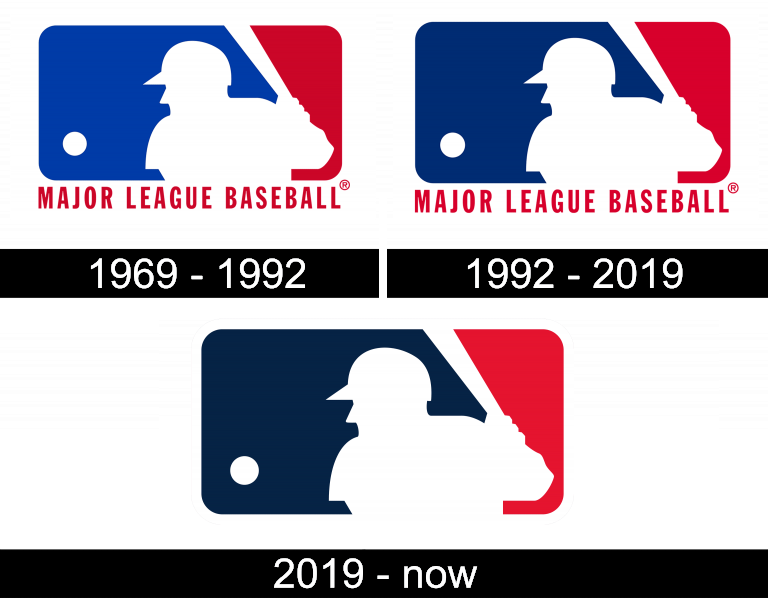
1969–1992: The Original Identity
The MLB logo officially debuted in the 1969 season. Its composition was strikingly simple: a horizontal rectangle with rounded corners, divided into two color fields—blue on the left, red on the right. At the center stood a white silhouette of a batter mid-swing, with a small white circle representing a baseball suspended in motion.
Beneath the emblem, the league’s name appeared in tall, uppercase red letters. This version established all the essential elements that would define the MLB logo heritage for decades.
1992–2019: Subtle Refinement
In 1992, the logo underwent a minor update. The structure remained unchanged, but the shades of red and blue were deepened, giving the emblem more visual weight and contrast. These refinements aligned the logo with contemporary broadcast standards and digital reproduction, while preserving its identity.
Crucially, the silhouette itself remained untouched—an acknowledgment that the core concept was already complete.
2019–Today: Pure Symbolism
The most recent evolution came in 2019, when MLB removed the wordmark entirely. The emblem was reduced to its purest form: color fields, silhouette, and ball. The colors were darkened once more, enhancing clarity across screens of all sizes.
This change signaled confidence. The league no longer needed its name attached to the symbol. The image alone was enough.
Logo Symbolism: Abstraction as Strength
The symbolism of the MLB logo is rooted in what it deliberately avoids. The batter is neither right-handed nor left-handed in an obvious way. There are no facial features, no uniform details, no hints of ethnicity or era. The figure exists outside time.
This abstraction allows fans of every team—from the New York Yankees to the Los Angeles Dodgers, from the Chicago Cubs to the Boston Red Sox—to see their own version of baseball reflected in the symbol.
The red, white, and blue color palette adds another layer of meaning. While undeniably patriotic, it also communicates authority, professionalism, and tradition. Unlike overt national symbolism, the colors here feel restrained and institutional rather than celebratory.
The Model Debate: Myth and Reality
Over the years, speculation emerged that the silhouette was modeled after Hall of Famer Harmon Killebrew. The resemblance, particularly in stance and proportions, fueled the myth. Killebrew himself became part of the narrative, reinforcing the logo’s legendary aura.
However, Jerry Dior consistently denied this interpretation. He maintained that multiple photographic references were used precisely to avoid any single identifiable model. The silhouette was designed to belong to everyone—and no one.
This ambiguity ultimately strengthened the logo. By resisting specificity, it achieved universality.
Emblem Controversy: Authorship Clarified
Another chapter in the MLB logo history involves a dispute over authorship. Illustrator James Sherman claimed the logo resembled a design he had created. Years later, however, Sherman acknowledged that his work dated to the early 1980s—more than a decade after MLB introduced its emblem.
This clarification put the controversy to rest and reaffirmed Jerry Dior’s role as the logo’s original creator. The episode serves as a reminder of how influential the design became, inspiring imitations precisely because of its clarity and strength.
MLB Logo Heritage and Timeless Design
The MLB logo heritage stands as a rare example of graphic design done so well that it no longer feels designed at all. It feels inevitable. In more than fifty years, the emblem has required no reinvention—only careful stewardship.
In a world where sports branding often chases novelty, the MLB logo proves that true longevity comes from clarity, balance, and respect for the game itself. It is not a logo about baseball stars. It is a logo about baseball.
FAQ: MLB Logo Meaning and History
Who designed the MLB logo?
The MLB logo was designed by Jerry Dior in 1968.
Is a real player depicted in the MLB logo?
No. Although often linked to Harmon Killebrew, the silhouette is an abstract figure created from multiple references.
Why hasn’t the MLB logo changed much?
Because its abstract, neutral design remains effective across generations and media formats.
What do the colors in the MLB logo represent?
The red, white, and blue palette reflects tradition, authority, and professionalism, with subtle patriotic undertones.