Coca-Cola Logo History: Meaning, Symbolism & Brand Heritage
Few brand marks on the planet are as instantly recognizable as the Coca-Cola logo. Those flowing white letters on a bold red background don’t just stand for a drink – they’ve become shorthand for joy, togetherness, and the very idea of pop culture itself.
What’s fascinating is that this legendary symbol was born in a small pharmacy office in Atlanta in the 1880s, and yet its core design has barely changed in more than a century. If you’re passionate about logo history and logo heritage, Coca-Cola is one of the purest examples of how a simple, well-crafted wordmark can outlive trends, fads, and complete shifts in media.
In this article, we’ll walk through the evolution of the Coca-Cola logo, from its first rough wordmark to the polished Spencerian script we know today. We’ll look at how color, shape, and typography turned a handwritten name into one of the most powerful visual identities in the world.
Origins: Naming the Drink and Creating the First Wordmark
Coca-Cola’s story begins in 1886, when Atlanta pharmacist John Stith Pemberton created a syrup he originally intended as a medicine. To turn that formula into a brand, he needed a name and a look – and that’s where his bookkeeper, Frank Mason Robinson, changed history.
Robinson suggested the name “Coca-Cola,” combining two of the original ingredients and cleverly giving the brand a rhythmic, memorable sound. Just as important, he believed that two capital “C” letters would look great together in advertising. He sat down and wrote the name in an elegant, flowing script that would become the foundation of Coca-Cola’s logo heritage.
At first, the logo was nothing more than a neat, handcrafted wordmark used in newspaper ads and on signs. But even then, the idea was clear: the brand would be built around a distinctive, consistent signature rather than a typical emblem or shield.
Early Coca-Cola Logos (1886–1893): Finding the Signature Style
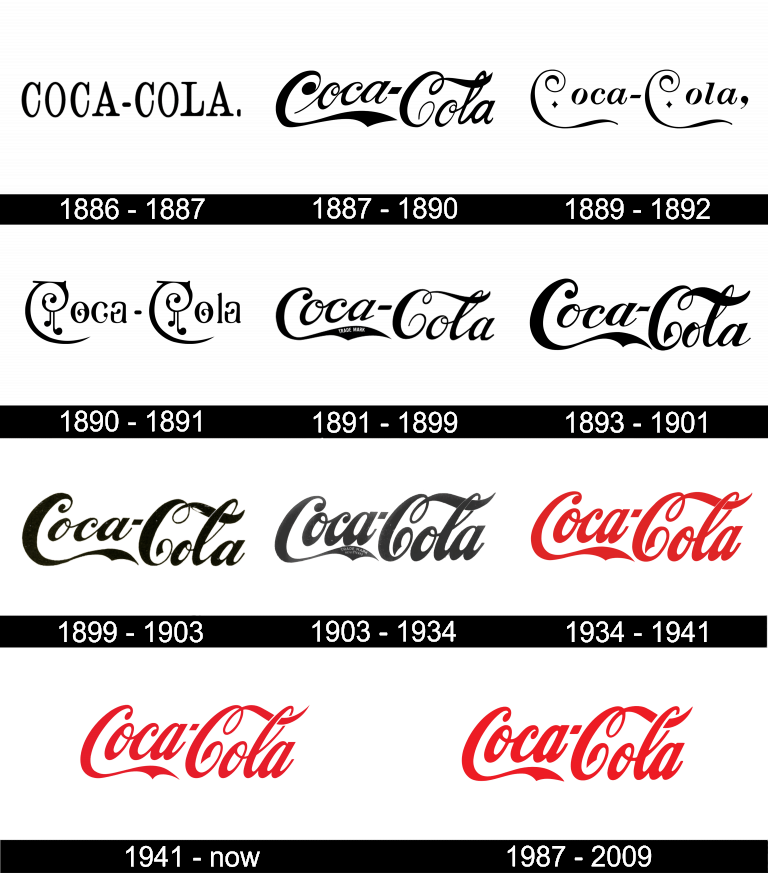
1886–1887: The Pre-Script Prototype
The earliest logo wasn’t yet the famous script. It was a simple wordmark set in a serif typeface, functional and undramatic. Looking back, it feels more like a placeholder than a fully formed identity – a quick label for a new beverage rather than a lasting symbol.
1887–1890: Spencerian Script Appears
Very soon, Coca-Cola leaned into the power of handwriting. Frank Mason Robinson introduced the Spencerian script – a style widely used in formal documents in the late 19th century.
The new wordmark featured fluid strokes, graceful capital Cs, and lively connections between letters. Although the lines were still relatively light and the logo was usually printed in black, the core character of the Coca-Cola logo was already there.
1889–1892: Refinement and Decorative Touches
In the next iteration, the brand refined the script. The loops of both capital “C” letters became more pronounced and dramatic, and small decorative diamond shapes were added inside the negative spaces, giving the logo more flair and personality. Even punctuation, like the comma, was enlarged and stylized to suit the overall look.
These small adjustments didn’t radically change the logo but helped it stand out more on signage and packaging, reinforcing its early logo heritage.
The Swirly Emblem Phase (1890–1891): A Brief Experiment
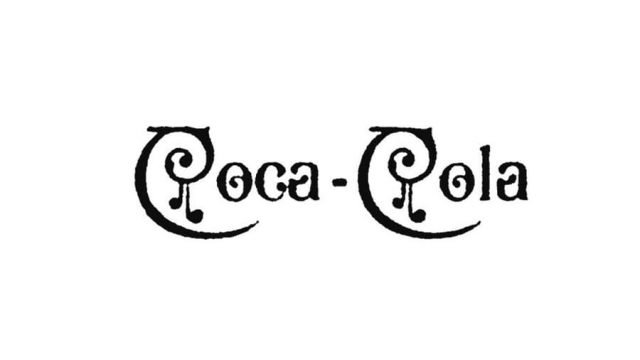
In 1890, Coca-Cola tried something far more ornate. The wordmark suddenly gained extra flourishes, extended swirls, and decorative curls around the letters.
This “fairy-tale” version of the logo felt almost like a piece of calligraphic art rather than a simple brand stamp. It looked beautiful on paper, but it wasn’t as legible or practical as the cleaner script. That’s why the company used this version only for about a year before returning to a more restrained design.
Even today, this short-lived logo is an interesting chapter in Coca-Cola’s logo history – proof that the brand tested more flamboyant options but ultimately chose clarity and consistency over ornament.
Back to Basics and the Birth of the Red Wordmark (1891–1934)
1891–1899: Subtle Tweaks, Stronger Identity
In the early 1890s, Coca-Cola quietly returned to a cleaner Spencerian script. The forms were nearly identical to the late-1880s version, but details were corrected and balanced. In some executions, a rectangular border and red color were introduced, adding structure and visual focus, especially for packaging and outdoor signs.
By 1899, another refinement gave the logo a more harmonious look. The two words “Coca” and “Cola” became better balanced in size and rhythm, and the script lines were smoothed. This version feels very close to what we would recognize as “classic” Coca-Cola today.
1903–1934: The Classic Script Takes Shape
In 1903, the logo was redrawn again with slightly taller, more confident letterforms. The script grew bolder and narrower, which made it more legible from a distance and easier to reproduce consistently.
Crucially, the fundamental silhouette of the logo stopped changing. From this point on, every update would be about tiny adjustments, not reinvention. The Coca-Cola logo had found its voice – and it was determined to keep it.
The Power of Red: Coca-Cola’s Color Identity (1934–Today)
1934–1941: The Red Revolution
In 1934, Coca-Cola committed fully to the color that would define its brand forever: red. The familiar script wordmark was now paired with a bold red background, making it brighter, more energetic, and more emotional.
Red didn’t just make the logo stand out; it also helped differentiate Coca-Cola containers in distribution. Crates and barrels painted red ensured the drink wouldn’t be confused with other products when delivered to pharmacies and shops. Over time, that functional choice turned into a core symbol of the brand’s identity.
1941–Today: Timeless Script, Minimal Changes
In 1941, the wordmark was slightly tilted and made more italic, giving it a livelier, forward-moving feel. The border was removed in many applications, letting the script stand on its own against the red field.
Since then, the core logo has remained virtually unchanged. Despite thousands of campaign slogans, bottle variations, and special editions, the Coca-Cola logo heritage rests firmly on that same elegant Spencerian script in white on red.
1987–2009: Slightly Bolder, Same Spirit
In the late 1980s, the logo was subtly thickened and straightened in some applications, making it read better on modern packaging, cans, and digital reproductions. These changes were so delicate that most people never noticed – and that’s exactly the point. Coca-Cola modernized its logo without sacrificing any of its historic character.
Who Designed the Coca-Cola Logo?
While John Pemberton invented the drink, the brand’s visual personality is largely the work of Frank Mason Robinson, his bookkeeper. Robinson named the drink, wrote out the wordmark, and chose the Spencerian script that became the backbone of all future logo versions.
He wasn’t a famous designer in the modern sense, but his instinct for rhythm, legibility, and style produced one of the most enduring logos in history. In terms of logo heritage, Robinson’s handwritten mark is as important as the recipe itself.
Symbolism: What the Coca-Cola Logo Represents
Today’s Coca-Cola logo is incredibly simple: a white script wordmark on a red field. That simplicity is exactly why it works.
• The script conveys friendliness and human touch, as if the brand is signing its name personally.
• The flowing lines and loops add a sense of joy and motion, echoing bubbles and the idea of refreshment.
• The red background suggests energy, excitement, and warmth.
Together, these elements communicate youth, optimism, and a classic, comforting experience – without needing any extra icons or illustrations.
The “Swirly” Version: A Curious Side Note
Among logo enthusiasts, the 1890 version with exaggerated swirls has become a cult favorite. It is the most decorative entry in Coca-Cola’s logo history and shows what might have happened if the brand had leaned into pure ornament.
Even though it disappeared quickly, this emblem illustrates an important lesson: beautiful design is not always practical design. Coca-Cola’s long-term success came from choosing a more disciplined script that worked on small bottle labels, huge billboards, and everything in between.
Shape and Structure: Why the Wordmark Works
Unlike many global brands, Coca-Cola doesn’t rely on a symbol or shield – its logo is built entirely around typography. The “shape” of the logo is the silhouette of the letters themselves.
Over time, this shape has become so familiar that even when the word is partially obscured or cropped, most people still recognize it instantly. The long horizontal curve of the name, the looping capital Cs, and the sweeping tail of the “L” in “Cola” all contribute to a unique visual rhythm.
This recognizable outline is a key part of Coca-Cola’s logo heritage. It proves that a wordmark, if carefully crafted, can be as strong as any icon or mascot.
Colors: Why Coca-Cola Chose Red and White
Coca-Cola’s color palette looks simple, but it’s packed with meaning:
• Red radiates energy, excitement, and appetite – perfect for a refreshing beverage.
• White balances the composition, keeping the logo clean, readable, and timeless.
Originally, the red also had a practical role: painted barrels and containers helped tax officials and shipping clerks distinguish Coca-Cola from alcohol and other products. Over time, “Coke red” became one of the most recognizable brand colors on Earth.
Today, that red-and-white combination signals youthfulness, optimism, and everyday pleasure – the exact emotional territory Coca-Cola has claimed for generations.
Font: The Magic of Spencerian Script
The Coca-Cola logo isn’t set in a digital typeface; it’s based on 19th-century Spencerian script, a style of formal handwriting used in business correspondence before the typewriter became widespread.
What makes it so special?
• The letters connect in a continuous flow, which reinforces the idea of smooth refreshment.
• The mix of thick and thin strokes adds elegance and personality.
• The capital Cs frame the logo like bookends, giving the whole wordmark a balanced, contained look.
While many companies have tried to imitate the feel of the Coca-Cola lettering, the exact curves and details are unique to the brand. This custom script is the heart of its visual identity – and the core of its logo heritage.
Why the Coca-Cola Logo Still Matters Today
In an age of constant rebrands and minimalist reductions, Coca-Cola stands out as a brand that trusts its own history. The logo you see on cans today has direct roots in the 1880s – and yet it still feels alive, modern, and relevant.
That’s the power of consistent logo history: small, thoughtful refinements over time instead of radical changes. Coca-Cola has proved that a strong idea, executed with care, doesn’t need to chase trends. It just needs to be protected, refreshed, and celebrated.
FAQ about the Coca-Cola Logo
1. Why has the Coca-Cola logo changed so little over the years?
Because the core design worked exceptionally well from the start. After Spencerian script was introduced, the brand focused on subtle refinements rather than redesigns. Consistency helped build trust and instant recognition across generations.
2. Is there an official font for the Coca-Cola logo that anyone can use?
No. The logo is based on custom handwriting in the Spencerian style, not on a standard font. While there are typefaces inspired by it, the exact curves and connections are proprietary to Coca-Cola.
3. What does the red color in the Coca-Cola logo stand for?
Red suggests energy, warmth, and excitement. Historically, it also had a practical purpose: red paint distinguished Coca-Cola containers from other goods during transport. Over time, it became an emotional and symbolic part of the brand’s identity.
4. Why doesn’t Coca-Cola use a symbol or icon along with the wordmark?
The wordmark itself became so iconic that no additional symbol was needed. The unique script and color combination function as both logo and symbol, making the brand instantly identifiable even without extra graphic elements.
5. Who is credited with creating the Coca-Cola name and logo?
Frank Mason Robinson, the company’s bookkeeper, coined the name “Coca-Cola” and wrote it in Spencerian script. His choices laid the foundation for one of the most enduring logos in branding history.