
Guinness Logo History: Meaning, Symbolism & Brand Heritage
Few brands in the world command the level of instant recognition and cultural reverence reserved for Guinness. Brewed for the first time in 1759 at St. James’s Gate Brewery in Dublin, the stout has become a defining element of Irish identity and one of the most widely known beer brands on the planet. Today Guinness is produced in nearly fifty countries and sold in more than 150 markets, yet its visual identity remains rooted in the symbolism and craftsmanship that shaped the brand centuries ago.
The Guinness logo is more than a trademark; it is a national emblem. The Golden Harp, the heart of the brand’s identity, represents legacy, artistry, national heritage, and the meticulous brewing tradition that has made Guinness an international cultural touchstone. Over time, the harp has been redrawn, refined, and reinterpreted, but its essence has remained unchanged: a promise of quality engraved into Ireland’s visual and historic fabric.
Guinness Meaning and Symbolism
At the core of the Guinness logo is a symbol older than the brand itself — the Gaelic harp, strongly tied to Irish culture, medieval craftsmanship, and national storytelling. When Benjamin Lee Guinness adopted the harp in 1862, he anchored the brand not only in national pride but also in a tradition of artistic excellence.
The harp symbolizes more than Ireland; it suggests harmony, refinement, and balance — qualities that mirror Guinness’s brewing philosophy. Its string arrangement, curvature, and engraved ornamentation evoke precision and heritage.
Guinness and the Republic of Ireland both use the harp, yet an intentional distinction exists. The government harp faces one direction; the Guinness harp faces the opposite. This subtle but essential difference preserves the identity of both institutions and prevents visual confusion in heraldic and commercial contexts.
Guinness Brand Heritage
Guinness’s heritage is not merely corporate history — it is part of Ireland’s cultural infrastructure. The brand shaped early advertising norms, influenced design trends across the twentieth century, and fostered a visual language around craftsmanship and authenticity.
Its packaging and iconography were among the first in the brewing world to foreground a single emblem as the comprehensive expression of brand value. Across wars, industrial innovations, and shifts in drinking culture, the logo remained a consistent visual anchor for consumers worldwide.
The harp — inspired by Brian Boru’s Harp, the oldest surviving Gaelic harp — serves as a link between medieval artistry and contemporary branding. This connection gives Guinness one of the richest lineages in global trademark history.
Guinness Logo History & Evolution Timeline
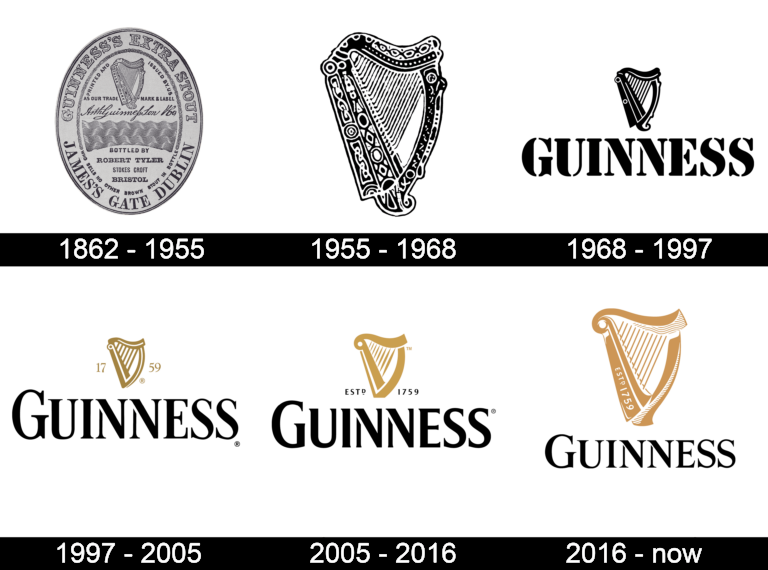
1862 – 1955: The Origin of the Harp
The earliest formal Guinness logo appeared as a double-outlined oval filled with dense text in varying scripts. At its top stood the harp — finely detailed, surrounded by ornate typography. Victorian in style, it embodied the era’s preference for elaborate craftsmanship. Though visually complex, it conveyed authority and heritage.
1955 – 1968: A Symbol Stands Alone
Mid-century modernism led Guinness to simplify dramatically. The harp was retained as the sole element, rendered in monochrome with meticulous detailing. This reduction signaled confidence — the brand no longer needed explanatory text; the harp alone was enough to identify it.
1968 – 1997: Modern Minimalism with a Strong Wordmark
The logo evolved into a clean black-and-white harp paired with a bold, stencil-like “GUINNESS” wordmark. The design was contemporary, minimal, and distinctly structured, bridging historic symbolism with modern visual expectations.
1997 – 2005: Gold Returns to the Harp
A renewed emphasis on heritage brought back a golden harp, now above the uppercase wordmark placed between the “1759” date markers. The palette conveyed warmth and craftsmanship while restoring historical depth to the emblem.
2005 – 2016: A Luxurious Black-and-Gold Identity
The redesign introduced a polished black backdrop with a detailed gold harp. Enhanced contours, balanced proportions, and a refined serif wordmark reflected premium positioning. The date “ESTD 1759” further reinforced the brand’s legacy.
2016 – Today: Sculptural Heritage for a Global Icon
The latest version transforms the harp into a three-dimensional, metallic form. Created with the expertise of Design Bridge in partnership with New North Press, the emblem was crafted as a physical object first — the embossed textures and engraved details enhance the perception of artisanal quality. The wordmark gained sharper serifs and elongated proportions, elevating the brand to a place where heritage and modern luxury converge.
Typography and Color
The Guinness typeface has shifted frequently but always shares characteristics: boldness, authority, and a subtle historic sensibility. Serif styles dominate the brand’s history, reinforcing a connection to Irish printing traditions and old-world craftsmanship.
The modern typeface features elongated, chiseled serifs and generous spacing, complementing the harp’s sculptural presence.
Color is equally central to Guinness’s identity.
The palette predominantly features:
Black — representing the stout’s deep color, seriousness, and heritage.
Gold — symbolizing quality, tradition, and the premium character of the brand.
White — used for clarity and contrast, enhancing legibility against dark backgrounds.
This trio has defined the brand for decades and remains one of the most recognizable combinations in beverage history.
The Enduring Power of a National Symbol
The Guinness logo stands among the most enduring and culturally significant trademarks in the world. Over more than 160 years, it has retained the same emblem while refining its form to reflect changing design landscapes and evolving consumer expectations.
Rooted in Irish history yet globally recognized, the Guinness harp continues to signal premium craftsmanship, authenticity, and the timeless artistry of one of the world’s most iconic beers. It is a masterclass in how heritage, meaning, and symbolism can sustain a brand’s identity across centuries.
FAQ Guinness
Why does Guinness use a harp as its logo?
Because Benjamin Lee Guinness chose the Gaelic harp in 1862 as a tribute to Irish heritage and craftsmanship. It became the brand’s defining symbol.
Why does the Guinness harp face the opposite direction of the Irish government harp?
To distinguish the commercial trademark from the national emblem and avoid legal and visual conflict.
Has the Guinness logo changed significantly over time?
Structurally, no. The harp has remained constant. However, its style, detailing, and pairing with typography have evolved dramatically.
Who designed the current Guinness harp?
The modern harp was developed in 2005 by Design Bridge and later refined into the contemporary three-dimensional version introduced in 2016.
What does the gold color in the Guinness logo represent?
Gold conveys quality, prestige, and the artisanal heritage of Guinness brewing.