Häagen-Dazs Logo History: Meaning, Symbolism & Brand Heritage
Häagen-Dazs began not as an Old-World European confectioner, but as an audacious idea born in the American boroughs of New York. In the early 1960s, when industrial ice creams filled supermarket shelves and mass-market flavors dominated the landscape, Reuben and Rose Mattus created a brand that defied every industry convention. They embraced a meticulous approach to craftsmanship, insisted on superior ingredients, and adopted a name designed to evoke Old-World mastery and exotic authenticity. This calculated act of storytelling—paired with uncompromising quality—transformed Häagen-Dazs into a global luxury icon.
Today, Häagen-Dazs has become synonymous with ultra-premium ice cream. Its logotype, a blend of European-inspired elegance and American innovation, reflects the brand’s fusion of mythology and craft. The visual identity has evolved subtly over decades, retaining the ornate qualities of its origins while enhancing clarity and luxury for modern audiences. The Häagen-Dazs logo stands as one of the most recognizable symbols in the premium dessert world, signaling indulgence, sophistication, and heritage.
Häagen-Dazs Brand heritage
The Häagen-Dazs story begins in 1961 when Reuben Mattus introduced his three original flavors—vanilla, chocolate, and coffee—each formulated to exceed traditional standards of ice cream composition. The founding philosophy was simple and radical: use fewer, better ingredients, more cream, and more flavor. As supermarkets expanded and industrial ice cream became standardized, Häagen-Dazs carved out an identity rooted in exclusivity, craftsmanship, and a pseudo-European mystique.
The brand expanded internationally throughout the 1970s and 1980s, gaining prestige well beyond the U.S. market. Ownership transitioned in 1983 when Pillsbury acquired Häagen-Dazs, accelerating global distribution. In 2001, the acquisition of Pillsbury by General Mills positioned Häagen-Dazs under a new corporate steward. For the U.S., distribution shifted once more through a joint venture between General Mills and Nestlé, integrating the brand into the Dreyer’s Ice Cream Company infrastructure.
Despite changes in ownership, production locations, and evolving sustainability commitments, the original ethos—craft, indulgence, purity—remains intact. Häagen-Dazs has preserved its aura of luxury by maintaining strict ingredient standards, focusing on rich textures, and continually elevating its brand storytelling through sophisticated design.
Häagen-Dazs Meaning and symbolism
Although the name Häagen-Dazs sounds Scandinavian or Dutch, it has no linguistic origin in any European language. It was intentionally crafted by Reuben Mattus as an homage to Old-World craftsmanship and European dairy traditions. The umlauts and complex consonant patterns were meant to convey authenticity, exclusivity, and artisanal heritage—qualities that would distinguish the brand in a crowded marketplace.
The visual identity embraces this mythology. Ornate frames, scalloped borders, and refined scripts echo nineteenth-century European patisserie aesthetics. Burgundy and gold—colors historically associated with royalty and celebration—reinforce the brand’s positioning as a premium indulgence. The logo is a symbol not only of high-quality ingredients but of a carefully built narrative that transformed simple ice cream into a luxury ritual.
Häagen-Dazs Logo history & evolution timeline
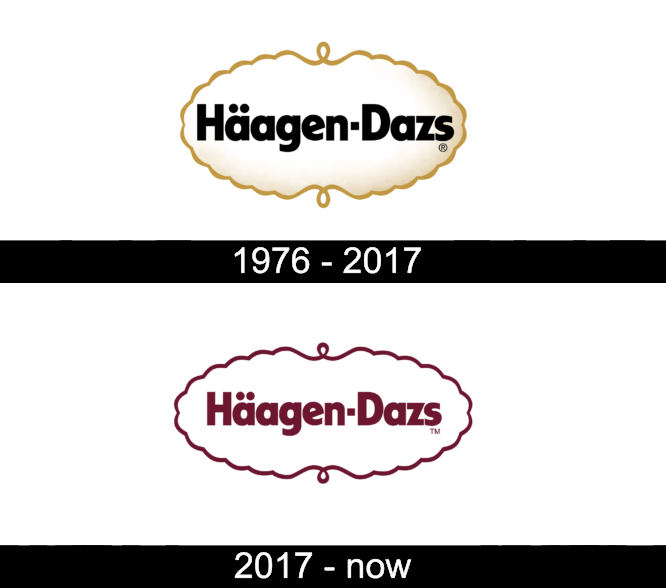
1976–2017: the ornate oval and bespoke “Dazs” typography
The long-standing Häagen-Dazs logo introduced in the mid-1970s established nearly all the brand’s enduring visual cues. The mark presented the name set in a custom typeface known as “Dazs,” developed by the original design firm specifically for the brand. The lettering was elegant yet substantial, its curves and slanted details evoking both nostalgia and a sense of refined indulgence.
The logotype sat within an embellished oval frame with scalloped edges, recalling vintage European confectionery packaging. Subtle filigree elements and gold ornamentation amplified the brand’s luxury posture. The result was an identity that communicated heritage, artistry, and sophistication—qualities that helped distinguish Häagen-Dazs from an otherwise utilitarian ice-cream market.
2017–today: modern refinement, preserved heritage
In 2017, Häagen-Dazs unveiled its contemporary evolution. While retaining the essential oval frame and its characteristic scalloping, designers refined the contours, reduced ornamental noise, and enhanced the logo’s clarity across digital and global packaging systems.
The wordmark now appears in a deep burgundy tone, a warm and sumptuous color that reinforces indulgence. Decorative swirls at the top and bottom offer subtle continuity with earlier versions but with a cleaner, more modern execution. This iteration reflects the brand’s transition into a new era—still luxurious, still rooted in heritage, but more minimal, global, and versatile.
Design analysis
Visual structure
The Häagen-Dazs logo is defined by balance: an ornate frame paired with a disciplined wordmark. The oval communicates tradition, enclosure, and craftsmanship, while the scalloped edges evoke pastry labels and classical confectioners’ seals. The minimal modern detailing allows the brand to maintain its heritage without appearing dated.
Typography
The original “Dazs” typeface was custom-designed to embody both European refinement and contemporary presence. While letterforms have been lightly modernized, the typography still carries the distinctive Häagen-Dazs personality: soft curves, carefully weighted strokes, and a refined silhouette that suggests indulgence and artistry.
Color palette
Burgundy is the signature tone of the brand’s current identity. It evokes richness, warmth, and sensory pleasure, drawing from visual traditions of vintage patisserie and luxury chocolatiers. Historically, gold was used extensively to heighten the brand’s opulent identity. Today, the restrained integration of gold accents supports a sophisticated, modernized luxury aesthetic.
Symbolism and consumer perception
The ornate oval remains the brand’s strongest symbolic asset. It frames the name like a seal of quality, communicating authenticity and tradition. Its elegance situates Häagen-Dazs firmly within the luxury dessert market, signaling to consumers that this is not an everyday product but a crafted indulgence.
The enduring seal of crafted indulgence
The Häagen-Dazs logo is more than a wordmark—it is a seal of origin, a passport to a mythical European past, and a visual promise of uncompromising quality. Across nearly half a century, the brand has preserved the core elements of its identity while refining them to meet modern expectations. It remains a masterclass in luxury brand storytelling: an invented heritage elevated into an authentic-feeling narrative through impeccable design, consistency, and craft.
FAQ — Häagen-Dazs logo & brand identity
Why does Häagen-Dazs have a Scandinavian-sounding name?
The name was artificially created to evoke Old-World craftsmanship and European dairy traditions, despite having no actual linguistic origin.
What does the Häagen-Dazs logo symbolize?
The ornate oval and stylized typography evoke luxury, heritage, and artisanal quality, reflecting the brand’s identity as a premium indulgence.
Why was the logo updated in 2017?
The update refined the original design for modern packaging and digital use while preserving its historic structure and elegance.
What colors define the Häagen-Dazs brand?
Deep burgundy and warm gold are core to the brand’s luxury aesthetic, symbolizing richness, warmth, and premium craftsmanship.
Who owns Häagen-Dazs today?
Globally, Häagen-Dazs is owned by General Mills. In the U.S. market, distribution is managed by a joint venture with Nestlé through Dreyer’s Ice Cream Company.