
Coach Logo History: Meaning, Symbolism & Brand Heritage

Few American brands embody the spirit of accessible luxury as convincingly as Coach. Established in 1941 as a small family workshop in New York City, the company built its early reputation on traditional leatherworking techniques and a meticulous dedication to craftsmanship. What began as Manhattan Leather Bags—a modest business that crafted wallets and hand-stitched accessories—eventually evolved into one of the world’s most recognizable lifestyle brands, known for a distinctive blend of heritage, modernity, and understated elegance.
Throughout its history, Coach has cultivated a visual identity rooted in tradition. Unlike many fashion houses that frequently reinvent their emblems, Coach has remained loyal to a single symbol: a horse-drawn carriage, an icon of refinement and timeless sophistication. This image, paired with a confident uppercase wordmark, has become synonymous with American luxury and the brand’s unwavering respect for artisanal craft.
The Coach logo tells a story not only of a company but of an era, a culture, and a design philosophy that values longevity over trends. Its evolution is subtle yet meaningful, mirroring the transformation of the brand itself while retaining its soul.
Coach Brand Heritage
Coach’s heritage is inseparable from the evolution of American leather craftsmanship. Inspired by baseball gloves and traditional saddle stitch methods, the brand embraced a functional yet elegant aesthetic that distinguished its products from European luxury maisons of the time. By the mid-twentieth century, Coach developed a reputation for durability and authenticity—values embedded into its identity long before the rise of lifestyle branding.
The horse-and-carriage emblem, introduced in the brand’s earliest years, was more than a decorative mark. It symbolized a commitment to excellence rooted in old-world craftsmanship and transported into a modern retail landscape. This blend of heritage and innovation allowed Coach to shape a unique cultural position: a luxury brand accessible to a wider audience while preserving the prestige of its origins.
Meaning and Symbolism
The Coach emblem centers on the image of a driver guiding a horse-drawn carriage. It is a deliberate visual reference to refinement, leisurely pace, and the artisanal culture of a pre-industrial era. The brand’s founders saw the carriage as a metaphor for craftsmanship that values precision over speed and quality over mass production.
As Coach expanded globally, the emblem came to symbolize a uniquely American form of luxury—an aesthetic that merges uptown elegance with downtown pragmatism. Paired with the bold serif wordmark, the logo encapsulates both the romantic legacy of handcrafted leather goods and the contemporary confidence of a modern fashion house.
Coach Logo History & Evolution Timeline
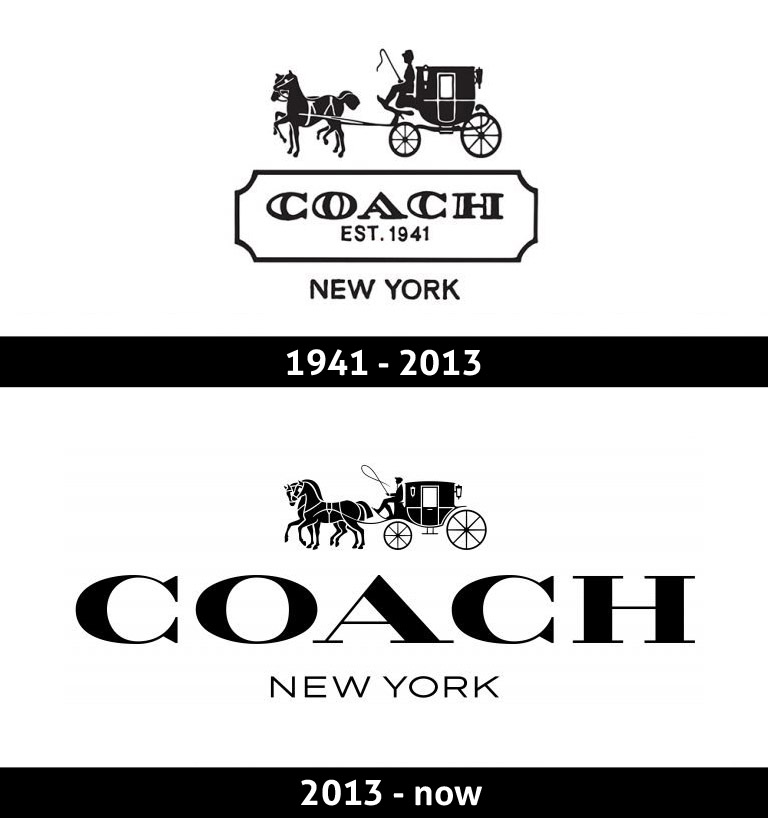
1941–2013: The Establishment of an Icon
The original Coach logo was introduced at the founding of the brand. It consisted of a detailed illustration of a horse and carriage set above an arched rectangular frame containing the COACH wordmark. The typography was executed in elongated, confident serif letters in full capitals, accompanied by the founding date “EST. 1941” below, with “NEW YORK” placed at the bottom of the composition.
The elaborate emblem emphasized craftsmanship and legacy, qualities central to the brand’s identity. Despite its ornate nature, the logo achieved a timeless presence, becoming recognizable across handbags, leather tags, and store signage worldwide.
2013–Today: Refinement for the Modern Era
The first and only significant redesign occurred in 2013. The core symbolism remained untouched, but the visual structure was simplified for contemporary use. The carriage illustration was redrawn with more streamlined contours, reducing ornamental details without compromising recognizability.
The framing around the wordmark was removed, and the typography was modernized into a thicker, more geometric serif with pronounced edges and a strong visual rhythm.
This new version preserved the soul of the original while aligning with modern minimalism and digital readability.
Today, Coach alternates between two visual formats:
The primary emblem featuring the refined carriage above the COACH wordmark, and a secondary framed wordmark paying homage to the 1941 version. Both reflect a coherent visual lineage and continue to reinforce the brand’s long-standing identity.
Design Analysis
Coach’s visual identity thrives on the tension between heritage and modernity. The horse-and-carriage motif—traditionally associated with old-world craftsmanship—gains new energy when paired with the bold contemporary typography introduced in 2013. This contrast has allowed the brand to remain relevant in an increasingly digital marketplace while maintaining its original character.
The emblem’s linear precision, balanced proportions, and sharp silhouettes reflect a commitment to quality and structure, traits echoed in the brand’s leather goods. Whether embossed in leather, printed on coated canvas, or rendered in metal hardware, the logo maintains clarity and distinction.
Font & Color
The Coach wordmark uses a custom serif typeface reminiscent of Speakeasy Modern but refined to create a stronger balanced presence. The elongated serifs and thick vertical strokes convey stability and sophistication, reflecting the brand’s commitment to traditional craftsmanship.

Black remains the standard color in Coach’s logo palette. This monochrome approach underscores timeless luxury, discretion, and authority. On products, the emblem may appear in metallic tones such as gold, brass, or silver, allowing it to adapt to different materials and design contexts without losing its identity.
A Legacy of Craft and Symbolic Strength
The Coach logo stands as one of the most enduring symbols in American fashion history. Its elegant carriage, preserved across decades, remains a testament to the brand’s roots in craftsmanship and tradition. While the 2013 refinement introduced a more contemporary visual language, the fundamental symbolism endures unchanged, anchoring the brand in its founding values even as its product lines evolve.
In a world where logos come and go with shifting trends, Coach has demonstrated that authenticity, heritage, and thoughtful design can sustain a brand’s identity for generations.
FAQ — Coach Logo & Brand Identity
Is every authentic Coach bag required to have a logo inside?
Yes. Authentic Coach handbags contain an interior brand label, often accompanied by a unique serial number that identifies the style and production details.
Did Coach ever change its logo?
Coach has conducted only one major redesign, in 2013. The update refined the carriage drawing, modernized the typography, and removed the frame, but preserved the emblem’s original spirit.
What does the horse-and-carriage symbol mean?
It represents craftsmanship, luxury, and the brand’s longstanding respect for tradition. The imagery evokes an era of artisanal production and timeless elegance.
Why is the Coach logo typically black?
Black represents luxury, strength, and refinement, while also offering high versatility across materials such as leather, fabric, metal, and digital formats.
Is the Coach emblem used on all products?
The symbol appears on most products, though some designs feature the wordmark only or integrate the monogram pattern, depending on the collection.