ABC Logo History: Meaning, Symbolism & Brand Heritage

Among the giants of American media, few identities carry the historical weight and cultural continuity of the ABC emblem. Founded in 1943, the American Broadcasting Company emerged during a transformative era in radio and television, soon becoming one of the most influential networks in the United States. As the broadcasting landscape evolved, ABC expanded globally, carried across continents through news, entertainment, sports, and storytelling that helped define modern American culture.
Alongside this rise in prominence, ABC cultivated a visual identity that would become a landmark in corporate design. Unlike many networks that embraced elaborate symbolism or intricate marks, ABC moved steadily toward reduction, simplicity, and clarity. This journey culminated in 1962 with one of the most celebrated modernist corporate symbols ever created: Paul Rand’s circular ABC logo, a masterclass in visual economy and enduring brand architecture.
Across more than seven decades, ABC experimented with ornate crests, typographic constructions, pictorial emblems, three-dimensional forms, and late-modern graphic refinements. Yet time and again, the company returned to Rand’s minimalist 1962 solution — a reminder of the power of design rooted in pure form, legibility, and timeless restraint.
Meaning and Symbolism
The ABC logo derives its symbolic strength from simplicity. Paul Rand’s 1962 design discarded ornamentation in favor of essential forms: a black circle and three rounded lowercase letters. The emblem embodies the fundamental principles of modernist design — clarity, neutrality, and functional elegance.
The circle acts as a universal container, a shape without hierarchy or direction, suggesting inclusivity and cohesion. It serves equally well on television screens, print materials, digital surfaces, and signage. Against the circle’s solid black field, the white lowercase “abc” creates a visual contrast that enhances legibility at any scale, from broadcast lower thirds to network idents.
Rand chose lowercase letters deliberately. Their soft geometry and balanced proportions evoke approachability rather than corporate severity. The counters of the “a”, “b”, and “c” visually mirror one another, creating internal rhythm and harmony. This subtle repetition of rounded shapes ensures that the mark feels unified rather than assembled.
Symbolically, the ABC mark conveys a brand that values clarity in storytelling, directness in communication, and a democratic spirit — a network for everyone, not a select few. Its longevity is proof that a minimal symbol can carry extraordinary cultural weight when crafted with precision and intention.
ABC Logo History & Evolution Timeline

1945–1952: The Founding Wordmark
The earliest ABC identity featured a three-line serif wordmark reading “American Broadcasting Company.” Rendered in black on white, it reflected the conventions of mid-century corporate typography. Straightforward and dignified, the design emphasized professionalism rather than graphic innovation, appropriate for a young broadcaster establishing trust with its national audience.

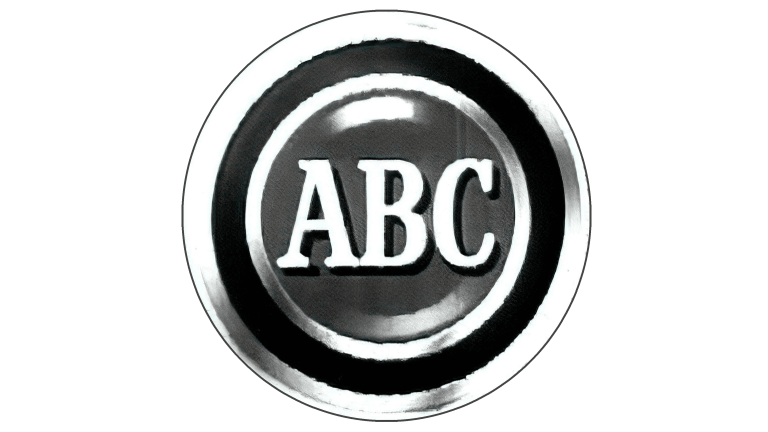
1952–1953: The Radiating Button
ABC’s first move toward symbolic imagery came with a circular emblem resembling a broadcast button made of concentric rings of black, white, and gray. At the center, the serif “abc” lettering appeared in white. The design introduced the circle motif that would eventually define the network’s identity.
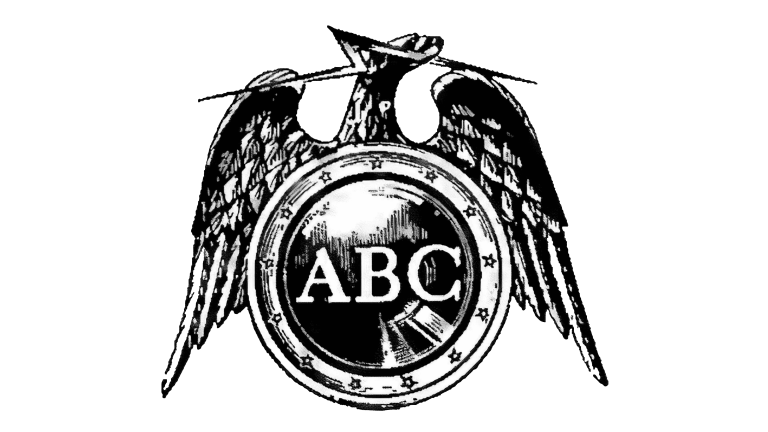
1953–1956: The Ornate Crest with Eagle
In 1953, ABC adopted its most elaborate emblem: a circular badge featuring an eagle with outstretched wings perched above the network’s initials. The central area displayed a metallic gradient, reinforcing themes of authority and strength. This emblem aligned with the patriotic aesthetics of the era but lacked the timeless adaptability later designs would achieve.
1956–1962: The Modernist Lowercase “A”
A dramatic stylistic shift arrived in 1956 with a bold, lowercase “a” enclosing the smaller “abc” lettering within its bowl. Executed in a heavy sans-serif, this design embraced mid-century modernism and signaled ABC’s transition into the television age. It was clean, forward-looking, and conceptually inventive.

1958–1962: The Typographic Rectangle
In parallel, ABC introduced a rectangular wordmark divided into two halves. The left displayed the lowercase “abc,” while the right presented the network’s full name in uppercase. The modular layout functioned well across print and promotional materials, demonstrating the network’s experimentation with more systematic design solutions.

1962–Today: Paul Rand’s Definitive Circle
Paul Rand’s historic redesign in 1962 introduced the identity that remains the foundation of ABC’s branding today. The white lowercase letters, set in a custom geometric sans-serif, rest within a perfect black circle. The composition achieved clarity, balance, and instant recognizability. Rand’s solution reflected the Bauhaus principle of “less, but better,” creating a corporate symbol that transcended time and trend.

1988–2007: A Lighter, Airier Interpretation
In 1988, ABC refined the Rand emblem by thinning the letterforms. The change created a lighter, more contemporary impression without altering the core structure. The badge preserved the 1962 visual logic while introducing a subtle sense of modernity appropriate for late-20th-century broadcast graphics.

2007–2013: The Glossy Dimensional Era
With the rise of digital interfaces and HD broadcasting, ABC modernized its mark with a three-dimensional glossy finish. The gradient sphere and embossed letters introduced a tactile quality reflecting contemporary design trends of the early 2000s. While visually dynamic, this version deviated significantly from Rand’s minimalist intent.

2013–2021: The Matte Refinement
In 2013, ABC softened the 3D approach, introducing a muted gradient that preserved depth while restoring some of the simplicity of earlier versions. The letterforms returned to Rand’s proportions, reaffirming the network’s commitment to design heritage.

2021–Today: The Flat Modern Revival
The 2021 redesign fully restored the flat aesthetic of the 1962 original while refining its contours for digital precision. The circle returned to a pure black field, and the white letters regained their clean, confident geometry. The updated mark sits comfortably at the intersection of mid-century modernism and contemporary minimalism, honoring history while meeting today’s visual standards.
Design Analysis
The ABC emblem is a study in reductive power. Its strength lies in its restraint — a perfectly balanced circle, three letters, and the interplay of black and white. Paul Rand’s mastery is evident in every detail. The proportions of the letters correspond geometrically to the circle, ensuring harmony regardless of scale. The consistent thickness of strokes, curved terminals, and generous counters create a rhythm that feels almost musical.
Color plays a fundamental supporting role. Black and white, chosen not for aesthetics alone but for their usability across broadcast mediums, guarantee maximum legibility and sharpness. Even in the analog television era, the logo read clearly under all lighting conditions and signal variations.
The versatility of the mark enabled decades of evolution without losing identity. It could absorb gloss, gradients, dimensional effects, and typographic variations — yet its core remained unmistakable. This adaptability is one reason design historians regard it as one of the most successful corporate marks of the 20th century.
ABC Studios, ABC News, and ABC Family (now Freeform) extend this heritage. Each adopts the circular emblem paired with distinct typography, proving the modular strength of the system. Whether in a newsroom, on a streaming interface, or in cinematic branding, the ABC circle retains its authority and simplicity.

The Enduring Minimalism of an American Icon
Across the evolving landscape of American broadcasting, the ABC logo remains a benchmark in modernist identity design. From its early typographic experiments to its ornate crests and later geometric innovations, ABC explored numerous pathways before arriving at Paul Rand’s masterpiece of restraint in 1962. That circular emblem created a legacy that endures because it is both universal and unmistakably specific, both rooted in design theory and deeply embedded in cultural memory.
The longevity of the ABC logo is not accidental. It is the result of clarity, form, and purpose distilled to their purest expression. Its black circle and white letters transcend the trends of each era, enabling ABC to move confidently into new technological and cultural frontiers while maintaining a consistent visual heartbeat. As one of the most significant emblems in American corporate history, the ABC logo stands as proof that timeless design emerges not from complexity, but from precision, intention, and simplicity executed flawlessly.
FAQ: ABC Logo & Brand Identity
What does the ABC logo represent?
The ABC logo symbolizes clarity, simplicity, and modernist design excellence. Its black circle and white lowercase letters express neutrality, accessibility, and visual authority.
Why is the ABC logo inside a circle?
The circle provides a perfect container for the rounded lowercase letters, creating balance and unity. It also enhances visibility across television screens and digital interfaces.
Who designed the iconic ABC logo?
The legendary 1962 ABC logo was created by Paul Rand, one of the most influential graphic designers of the 20th century, also known for the IBM, UPS, and NeXT logos.
Why does ABC keep returning to the 1962 design?
Rand’s design is timeless, highly legible, and universally adaptable. Each redesign that deviated from it eventually returned because the original remains the strongest expression of the brand.
What is the difference between ABC, ABC News, ABC Studios, and ABC Family logos?
Each division retains the circular ABC emblem but pairs it with its own accompanying typography, creating a consistent yet flexible visual system across the network’s branches.