Barbie Logo History: Meaning, Symbolism & Brand Heritage
Across more than six decades, Barbie has grown from a single fashion doll into one of the most influential and recognizable cultural icons of the modern era. She has mirrored evolving ideas of femininity, aspiration, creativity, and identity, shaping the childhoods of millions and leaving a lasting imprint on fashion, entertainment, and global culture. From the moment she debuted in 1959, Barbie represented something entirely new: a doll that embodied the life girls imagined for themselves, not the limitations of their present.
The Barbie logo, with its expressive curves and unmistakable pink palette, has traveled alongside her through every reinvention and cultural shift. It is a visual thread connecting generations of play, storytelling, and transformation. The emblem is at once youthful and sophisticated, playful yet iconic, embodying the fluid identity that has allowed Barbie to remain relevant across eras.
Meaning and Symbolism
The Barbie logo carries a symbolic weight rooted in its original creation. Designed by Ruth Handler, the logo’s handwritten style was meant to convey freedom, personality, and a distinctly modern femininity. Unlike rigid corporate marks, Barbie’s wordmark resembles a personal signature, an identity expressed rather than imposed. Each curve appears spontaneous, almost improvised, reinforcing the idea that imagination—not conformity—is at the heart of the brand.
Pink, the color inseparable from Barbie’s identity, deepens the symbolism. It is not merely decorative; it is expressive. Over the years, its hue shifted from rich fuchsia to soft pastel to the bright, contemporary tone seen today. Across every iteration, pink signaled optimism, energy, confidence, and individuality. Rather than reinforcing stereotypes, it became a symbol of self-defined femininity, a chromatic statement that celebrated creativity and possibility.
These intertwined elements—the handcrafted script and the vibrant pink—give the Barbie logo a personality that feels human, not manufactured. Its warmth, familiarity, and expressive motion helped transform Barbie from a product into a character, a presence, and ultimately a global symbol.
Barbie Logo History & Evolution Timeline
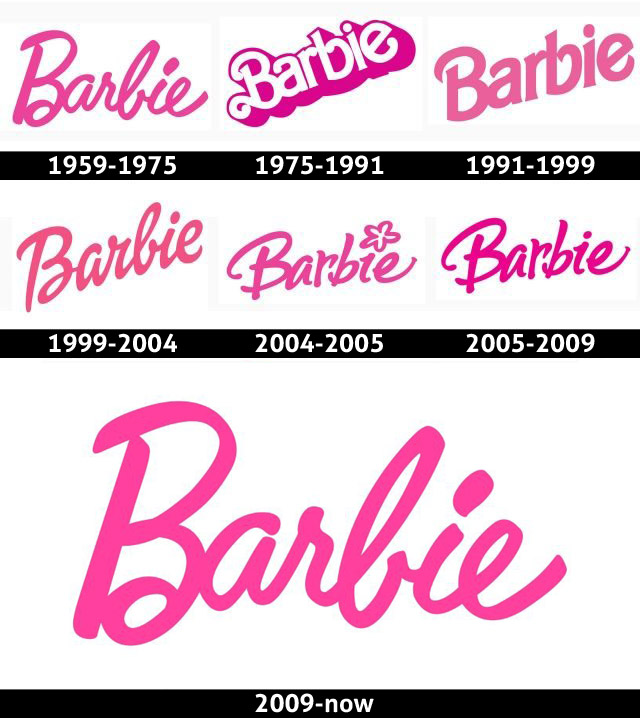
1959–1975: The Birth of a Feminine Script Identity
Barbie’s original logo introduced the flowing cursive wordmark that still defines the brand today. Created by Ruth Handler, the design appeared in bright pink on white, evoking style, modernity, and youthful charm. Its handwritten quality reflected Barbie’s role as a doll that embodied imagination rather than tradition.
1975–1991: A Bold Era of Graphic Energy
In the 1970s, Barbie adopted a strong, diagonal wordmark rendered in thick white letters with a vivid pink outline and shadow. The design responded to the bold visual language of the era and Barbie’s rapid rise in international popularity. Its rounded terminals and exaggerated forms projected energy and visibility.
1991–1999: A Sleeker, Contemporary Identity
With the arrival of the 1990s, Barbie embraced a lighter, more refined aesthetic. The diagonal placement remained, but the typography shifted to a slimmer sans-serif style. The softened pink and smoother contours reflected contemporary graphic trends and mirrored Barbie’s growing professional diversity across dolls, books, and animated media.
1999–2004: A Return to Signature Cursive
As the millennium approached, Barbie returned to a script inspired by the original 1959 wordmark. Updated with modern proportions and brighter pink, the logo reclaimed the expressive, feminine character that defined Barbie’s earliest identity. This iteration strengthened the emotional connection with long-time fans while appealing to a new generation.
2004–2005: A Playful Flower Accent
In a short-lived but charming adaptation, Barbie replaced the dot over the “i” with a stylized flower. This whimsical detail spoke to the playful spirit of early-2000s design and reinforced Barbie’s associations with fashion, creativity, and youth culture.
2005–2009: Refinement Before the Return
The flower disappeared after one year, marking a return to a more streamlined cursive signature. The logo remained lively yet polished, preparing the brand visually for its eventual return to its foundational identity.
2009–Today: Restoration of the Classic Signature
In 2009, Barbie completed a full visual circle by returning to her original 1959 wordmark. The restored logo maintained the beloved handwritten form but featured a brighter, more contemporary shade of pink. This choice reaffirmed the timeless strength of the original design and its deep emotional resonance across generations.
Cultural Impact
Few brands in history have achieved the level of cultural penetration and intergenerational recognition that Barbie enjoys, and her logo has played a defining role in that influence. The signature pink script has become inseparable from global conversations about fashion, identity, empowerment, and representation. It appears not only on packaging but in haute couture, Hollywood productions, museum exhibitions, luxury collaborations, and digital media.
The Barbie logo became a symbol of aspiration for millions of children who imagined futures shaped by possibility. It also became a cultural reference point in music, television, advertising, and social commentary. Designers, artists, and filmmakers frequently reinterpret the wordmark, proving its versatility and cultural staying power.
As Barbie expanded to include diverse body types, careers, ethnicities, abilities, and storylines, the logo remained stable—a symbol of continuity amid evolution. The bright pink script became a unifying banner across decades of transformation, emphasizing one core message: identity is expansive, imagination is limitless, and reinvention is always possible.
The Timeless Signature of a Global Icon
The Barbie logo stands today as one of the most enduring and influential visual identities in the modern world. Its evolution reflects the delicate balance between continuity and reinvention, an equilibrium that allowed Barbie to remain relevant across changing cultural landscapes. Each iteration preserved the essence of the original script—expressive, feminine, and unmistakably alive—while adapting to new eras of design and social meaning.

As both a branding symbol and a cultural artifact, the Barbie logo holds a unique place in global consciousness. It bridges childhood memories, artistic interpretations, fashion sensibilities, and cultural debate. More than a signature, it is a visual testament to the lasting power of imagination and the profound influence of thoughtful design. Barbie’s emblem is not simply recognized—it is remembered, cherished, and celebrated, generation after generation.
FAQ Barbie Logo & Brand Identity
What does the Barbie logo symbolize?
The Barbie logo symbolizes expressive femininity, creativity, and individuality through its handwritten script and iconic pink color.
Why is the Barbie logo pink?
Pink has defined Barbie’s identity since 1959, embodying vibrancy, optimism, confidence, and modern femininity across eras.
Who designed the original Barbie logo?
Ruth Handler, the creator of Barbie and co-founder of Mattel, designed the original 1959 script logo to express the doll’s modern, independent spirit.
Why did Barbie return to its original logo in 2009?
Barbie reinstated the 1959 script because it remains the strongest, most authentic expression of the brand’s visual identity and emotional legacy.
How many times has the Barbie logo changed?
The Barbie logo has undergone multiple redesigns, reflecting aesthetic trends and cultural shifts, before returning to its original 1959 form, which continues to define the brand today.