Walmart Logo History: Meaning, Symbolism & Brand Heritage
For more than six decades, Walmart has shaped the global retail landscape with a visual identity that mirrors its journey from a modest discount store in Arkansas to one of the largest corporations in modern history. The evolution of the Walmart logo is more than a series of design updates—it is a chronicle of ambition, reinvention, and the company’s unwavering commitment to accessibility, affordability, and innovation.
Understanding the Walmart logo means understanding Sam Walton’s vision: to democratize retail, serve communities, and make quality goods accessible to everyone. From early typographic experiments to the iconic spark symbol, each chapter in the brand’s visual identity has reflected a shift in corporate philosophy and consumer culture.
This is the complete logo heritage of Walmart.
Logo History and Evolution Timeline
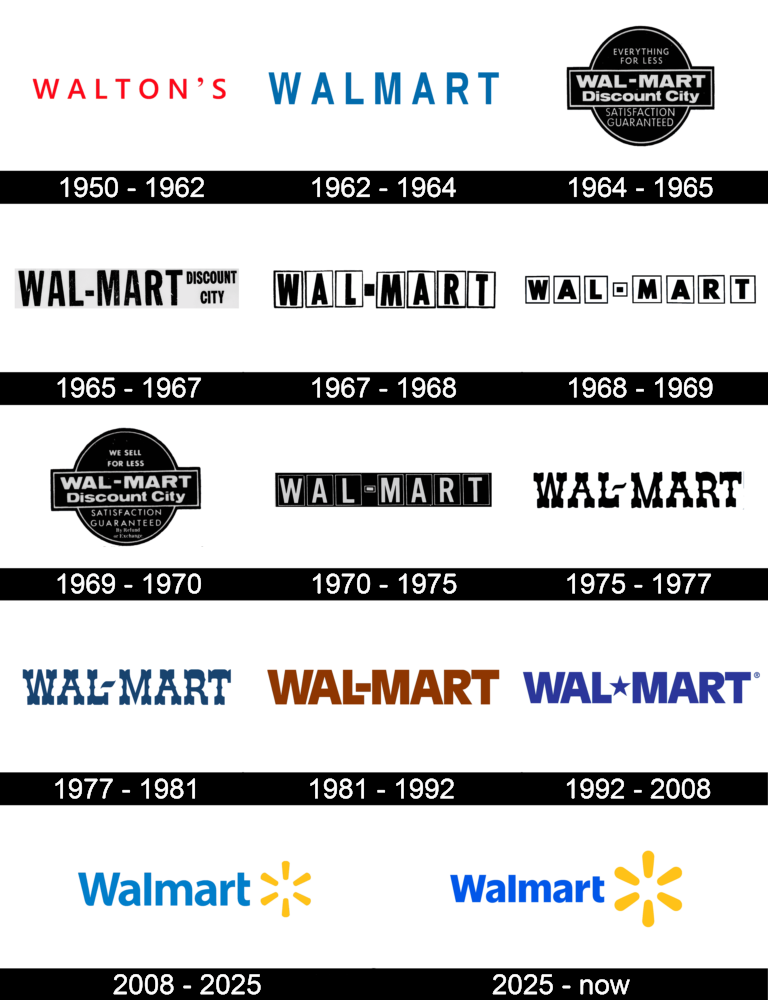
1950–1962: Walton’s — The Humble Beginning
Before Walmart existed, Sam Walton operated under the name “Walton’s,” a straightforward red logotype set in a clean sans-serif. It was modest, unembellished, and businesslike—a fitting introduction to the young entrepreneur who was learning the intricacies of retail with remarkable speed. The scarlet color conveyed energy and ambition, hinting at the drive that would soon reshape American shopping.
1962–1964: The First Walmart Wordmark
With the opening of the first Wal-Mart Discount City in 1962, the company adopted a new identity: a softened blue wordmark in a slightly condensed sans-serif. It was simple and accessible—an identity built for friendly, affordable shopping. The shift to blue signaled trust and responsibility, aligning with Walton’s promise of low prices and honest service.

1964–1965: The Roundel Debut
A black circular badge briefly became the emblem of the young retailer. Inside the monochrome ring sat the hyphenated “Wal-Mart,” rendered with firmness and clarity. While it appeared more austere than later versions, it offered visual authority during a period when the company was carving its place among regional competitors.

1965–1967: Discount City Identity
A return to simplicity marked this era. “Wal-Mart Discount City” appeared in a heavy geometric sans-serif, its confident, wide lettering emphasizing modernity and momentum. It captured the spirit of the American retail boom, when discount stores flourished and price accessibility shaped the culture of shopping.
1967–1968: Framed Typography
Each letter of “WAL-MART” was enclosed within tall rectangular boxes, creating a structured, modular feel. This brief experiment reflected the brand’s need for organizational clarity as it rapidly expanded its locations.
1968–1969: Refined Geometry
The brand returned to solid black typography but with more proportional, compact letterforms. The update introduced stability and balance, reflecting a company transitioning from regional chain to national contender.

1969–1970: A Roundel Revisited
A new version of the 1964 circular badge appeared, now with lighter and more polished letterforms. The text changed to pre-white, improving clarity. This return to a structured emblem mirrored Walmart’s growing professionalism and organizational scale.

1970–1975: White Letters on Black Panels
Walmart inverted its earlier boxed-letter logo: white glyphs set inside solid black rectangles. The look was bold and authoritative—a visual anchor for the brand as it began its rapid national expansion.
1975–1977: Western Influence
The company embraced a typography style reminiscent of American frontier signage—a nod to Walton’s roots and the spirit of independent enterprise. The decorative dots, playful serifs, and saloon-era influence created a distinctly American flavor.

1977–1981: The Western Style Refined
The 1975 identity returned in a more balanced and legible version, with subtle refinements for clarity in print and signage. The hyphen grew bolder, adding emphasis to the brand name’s recognizable break.
1981–1992: A Modern Business Identity
A dramatic shift arrived with a clean, brown sans-serif wordmark. It was restrained, contemporary, and corporate—reflecting Walmart’s shift from a local discounter to a national retail force. The tight spacing between the “L” and “M” made the wordmark visually compact and distinctive.
1992–2008: The Blue Star Era
Replacing the hyphen with a star introduced symbolism into the Walmart identity. The star suggested guidance, aspiration, and optimism, aligning with the company’s new slogan: “Always Low Prices.” Executed in dark blue, this logo became a symbol of American retail during the company’s most explosive growth period.
2008–2025: The Spark of Innovation
A major rebrand brought a brighter, friendlier identity. The wordmark shifted to a softer, rounded sans-serif in light blue, all lowercase except for the initial “W.” To its right, a yellow six-rayed symbol—often called the “spark”—represented innovation, warmth, and human energy. It was a visual celebration of Sam Walton’s philosophy and a nod to sustainability and optimism.
2025–Today: Strengthened Form
The 2025 refresh did not replace the previous identity but strengthened it. The blue and yellow hues became richer and more assertive, while the wordmark grew slightly narrower and more stable. The “W” now features straight bottom peaks, emphasizing structure and authority. It is a modern refinement of a well-known global brand.
Meaning & Symbolism
The Walmart logo carries several layers of meaning shaped by the company’s heritage and values. The wordmark embodies approachability and fairness through its clean, rounded typography. The spark symbol—six tapered rays arranged like a burst—represents inspiration, creativity, and the founding spirit of Sam Walton, who constantly pursued better, more accessible retail solutions.

The spark can also be interpreted as a sun, a flower, or a bright idea—each metaphor reinforcing optimism and growth. It echoes Walmart’s commitment to sustainability and its mission to improve lives through affordable products. The pairing of blue and yellow further strengthens this narrative: blue evokes trust and reliability, while yellow conveys energy, friendliness, and human warmth. Together they reflect Walmart’s promise of quality, service, and affordability.
Font, Typography & Color Palette
Walmart uses a clean, geometric sans-serif that aligns closely with Myriad Pro Bold, LCT Picón Semi Bold, and similar contemporary typefaces. The softened edges and approachable curves underline the company’s modern customer-forward strategy. The font’s clarity ensures readability across signage, packaging, digital platforms, and storefronts, which is essential for a global retailer.

The color palette is equally important. Walmart blue is bright, stable, and friendly—an evolution from earlier darker blues that felt more corporate. The yellow spark uses a vivid, warm tone that suggests joy, accessibility, and a positive shopping experience. The combination of blue and yellow has become instantly associated with the Walmart brand, ranking among the most recognizable retail identities in the world.
The Enduring Legacy of the Walmart Logo
The story of the Walmart logo is a story of evolution: from strong, utilitarian typefaces to the warm, modern identity that defines the brand today. Each version reflects a chapter in Walmart’s journey—its expansion, its transformation, its cultural impact, and its ongoing mission to make essential goods accessible worldwide.
Sam Walton built Walmart on values of honesty, affordability, and service to community. The modern logo—with its iconic spark—serves as a visual synonym for that legacy. It represents innovation, optimism, and progress. And like the company itself, the Walmart logo continues to evolve while remaining firmly rooted in the principles that shaped one of the most influential retailers in history.
FAQ – Walmart Logo, History & Brand Identity
Why did Walmart change its logo in 2008?
To reflect a friendlier, more modern brand image and highlight its shift toward sustainability, community engagement, and improved shopping experience.
What does the Walmart spark symbol represent?
The spark symbolizes innovation, inspiration, the energy of Sam Walton, and the company’s commitment to helping customers “save money and live better.”
Why is Walmart’s logo blue and yellow?
Blue symbolizes trust and reliability, while yellow conveys warmth and optimism—together reflecting Walmart’s promise of accessible quality.
What font does Walmart use?
A customized geometric sans-serif similar to Myriad Pro Bold, designed for clarity, friendliness, and global readability.
Is the Walmart logo trademarked?
Yes. The entire visual identity, including the spark symbol, typeface execution, and colors, is fully trademarked.