
Schneider Electric Logo History: Meaning, Symbolism & Brand Heritage
Few industrial brands have managed to modernize their identity as gracefully as Schneider Electric, a company whose origins stretch back to 1836 France and whose logo chronicles nearly two centuries of transformation. From ironworks and armaments to global leadership in energy management and automation, Schneider Electric’s visual identity reflects a remarkable journey of reinvention — one that blends heritage, engineering precision, and a forward-looking commitment to sustainability.
Today Schneider Electric operates in more than 100 countries, generates over €25 billion in annual revenue, and is universally associated with smart infrastructure, clean energy futures, and the recognizable green insignia that stands as a signature of its mission: “Life is On.”
This is the story of the Schneider Electric logo — its origins, its evolution, and the symbolism behind one of the world’s most enduring industrial marks.
Meaning & Brand Background
Before Schneider Electric became synonymous with digital energy solutions, it was a metallurgy and machinery company founded by brothers Adolphe and Joseph-Eugène Schneider in the small French commune of Le Creusot. The enterprise initially produced steel, locomotives, and armaments, gradually expanding into heavy engineering and infrastructure.
Its identity evolved dramatically throughout the next century. As Schneider adapted to post-war Europe, diversified into electrical equipment, and eventually pivoted toward automation and digital technology, the logo followed suit — each redesign marking a new chapter in the company’s ambition.
The modern Schneider Electric emblem no longer recalls cannons, anvils, or industrial machinery. Instead, it encapsulates sustainability, technological clarity, and the company’s long shift from heavy metal to green innovation.
Logo History and Evolution Timeline
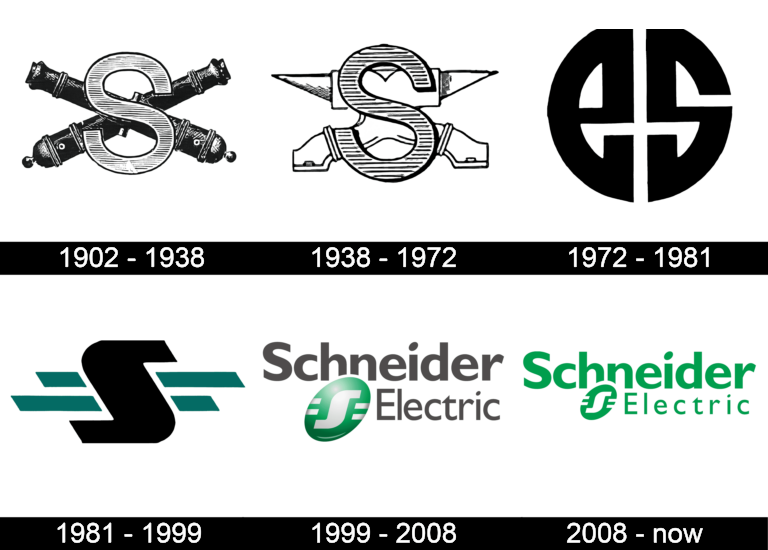
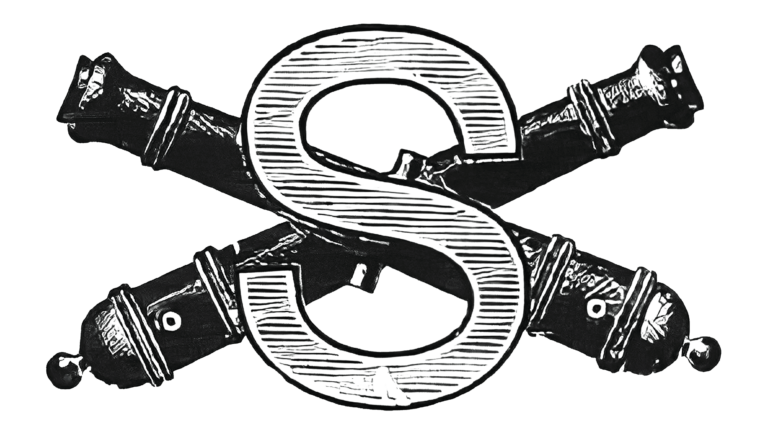
1902–1938 — The Industrial Monogram
The earliest known Schneider mark emerged in 1902, rooted firmly in the company’s industrial beginnings. The design featured two black crossed cannons — a nod to the company’s armaments production — overlaid by a large, vertically stretched capital S. The letter carried a refined sans-serif structure and a striped interior texture, giving it a sense of engineered precision. This emblem represented Schneider during its era of heavy steel, locomotives, and defense manufacturing.
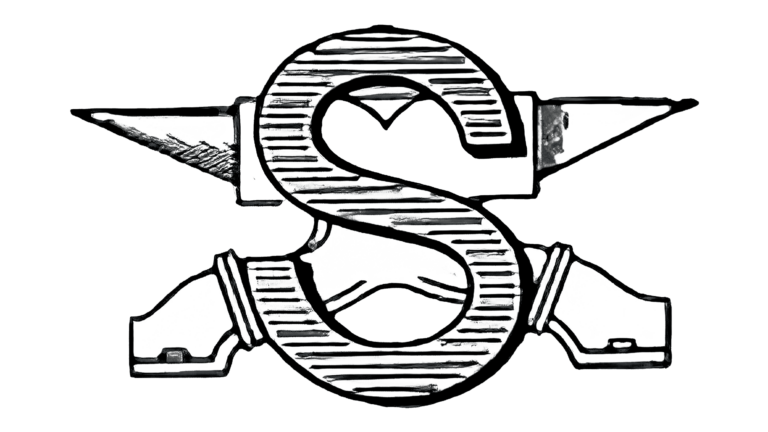
1938–1972 — The Anvil Era
As Schneider moved further away from weaponry and expanded its civil and industrial operations, the logo was redesigned in 1938. The crossed cannons disappeared, replaced by a white anvil outlined in black — a universal symbol of ironworking. The “S” remained central, now thicker and more imposing, still patterned with bold stripes. This mark reflected the company’s emphasis on metallurgy and large-scale industrial manufacturing throughout the mid-20th century.
1972–1981 — A Modernist Abstraction
The 1972 redesign marked a major stylistic departure. The anvil and striped monogram were abandoned in favor of an abstract, highly geometric symbol composed of stylized “E” and “S” forms interlocking inside a circular frame. Executed in solid black on white, the logo aligned with the modernist design language of the period — minimal, modular, and forward-looking.

1981–1999 — The First Green Identity
In 1981 Schneider embraced color for the first time, introducing a bright green palette that would later become its visual hallmark. The new logo featured a bold black S placed over two diagonally sliced green bars, creating a dynamic sense of movement and energy. Outlined in white, the “S” appeared illuminated, symbolizing the company’s entry into electrical power systems and its pivot toward energy technology.

1999–2008 — The Glossy Oval
By 1999, Schneider Electric was asserting its presence as a global electrical systems leader. Its logo was modernized into a glossy, three-dimensional green oval, inside which sat a smooth white “S.” Below it, the company name appeared in grey, with “Schneider” in a bold sans-serif and “Electric” in a lighter companion type. This version reflected late-90s digital aesthetics and the era’s fascination with glassy, dimensional branding.
2008–Today — The Contemporary Green Signature
The current Schneider Electric logo strips away gloss in favor of clarity and modernity. The wordmark appears in two lines:
Schneider in a confident, rounded sans-serif; Electric in a lighter, more technical companion type. To the left, a flat green oval holds the iconic white S, flanked by two horizontal stripes that evoke current flow, circuit paths, or streamlined electrical energy.
The bright green color now dominates the identity, symbolizing sustainability, innovation, and Schneider’s commitment to future-ready energy management. Clean, approachable, and unmistakably modern, the logo mirrors the company’s shift into smart grids, automation, and eco-efficient technology.
Meaning & Symbolism
The modern Schneider Electric logo is built around ideas of energy, continuity, balance, and environmental awareness.
The iconic green oval is the heart of the design. Its smooth contours suggest a circuit, a flow of power, or a closed-loop ecosystem — a visual metaphor for modern electrical networks and sustainable energy. Within it, the white “S” appears to sit in motion, channeling electricity and forming a path flanked by two white parallel lines. The shape reads almost like a stylized pulse, a quiet reference to energy transmission and to Schneider’s belief in “Life is On.”
The exclusive use of green and white conveys clarity, environmental harmony, and safety — values essential in energy management. It communicates trustworthiness without rigidity, technology without coldness, and progress without aggression.
This logo is not simply a symbol of a brand; it is a distillation of Schneider Electric’s mission to make energy safe, efficient, and sustainable.
Font & Typography + Color Palette
Schneider Electric’s typography is a carefully modulated sans-serif: rounded enough to feel human and accessible, yet structured enough to convey reliability. The heavier weight used for “Schneider” gives the name authority, while the lighter “Electric” introduces a technical, precise counterbalance. Together, the pairing echoes the company’s combination of engineering rigor and environmental sensitivity.
The palette revolves around a vivid, lively green, a tone that has become inseparable from Schneider’s brand identity. It reflects renewal, energy, sustainability, and the forward-thinking ethos at the core of the company. The green is anchored by clean white, which adds contrast, clarity, and a sense of transparency — vital qualities in the energy sector.
A Logo Evolving Toward a Greener Future
The Schneider Electric logo has traveled far from the industrial cannons of its origins. Its evolution mirrors the company’s own transformation: from metallurgy to machinery, from machinery to electrical systems, and ultimately to global leadership in sustainable energy and automation. Every redesign has shed old layers and embraced new technologies, yet the result remains consistent — a logo that stands for clarity, innovation, and the promise of a connected, efficient future.
Schneider Electric’s visual identity today is more than a corporate mark; it is a symbol of ecological responsibility and the belief that energy must empower life. In the world of modern branding, few logos so elegantly narrate the story of a company’s path from iron and steel to green intelligence.
Frequently Asked Questions About the Schneider Electric Logo
What does the Schneider Electric logo represent?
It symbolizes energy flow, sustainability, and the company’s commitment to efficient and intelligent power management. The green palette emphasizes environmental responsibility.
Why is the Schneider Electric logo green?
Green reflects sustainability, growth, and environmental harmony — key pillars of Schneider Electric’s brand philosophy and its modern work in eco-efficient solutions.
When was the current Schneider Electric logo introduced?
The current logo debuted in 2008, adopting a flat modern green and white design that aligns with digital interfaces and sustainable branding.
What was Schneider Electric’s original logo?
The first logo from 1902 featured crossed cannons and a striped “S,” referencing the company’s early work in armaments and iron production.
How has the Schneider Electric logo evolved?
It moved from industrial symbols to abstract modernist forms, and ultimately to a clean, green identity reflecting innovation and sustainability.