Hitachi Logo History: Meaning, Symbolism & Brand Heritage
Hitachi’s visual identity is one of the longest-running and most quietly influential in modern corporate history.
What began as a small electrical repair shop in 1910 has grown into a global conglomerate of more than 1,100 companies, spanning advanced engineering, infrastructure, information technology, industrial systems, and consumer appliances that have shaped everyday life across continents. Through this transformation, the Hitachi logo has carried forward a unique cultural signature rooted in Japan’s industrial dawn: a rising sun crafted by the company’s founder over a century ago.
While today the brand is associated internationally with refrigerators, washing machines, air conditioners, and a spectrum of home appliances, its visual identity tells a broader story of ambition, precision, technological optimism, and an unwavering dedication to craftsmanship.
Meaning & Symbolism: The Origin of the Hitachi Mark
The soul of Hitachi’s branding lies in a symbol created personally by its founder, Namihei Odaira, in 1912. In an era when Japan was accelerating toward industrial modernization, Odaira fused two kanji characters—“hi” (sun) and “tachi” (rise)—to express the spirit of progress and illumination. Together, they formed Hitachi, the “Rising Sun,” an idea that resonated deeply with the nation’s identity and with Odaira’s belief in engineering as a force for advancement.
He enclosed the two characters in a perfect circle, creating the original Hitachi Mark. This ancient-influenced seal remains the corporation’s most sacred emblem today, still used on flags, awards, and official signage.
The round form suggests unity and completion, while the rising sun characters evoke energy, invention, and a forward-looking philosophy. Unlike many global brands that introduced symbols decades after their founding, Hitachi’s emblem carries the direct imprint of its origin story.
Logo History and Evolution Timeline
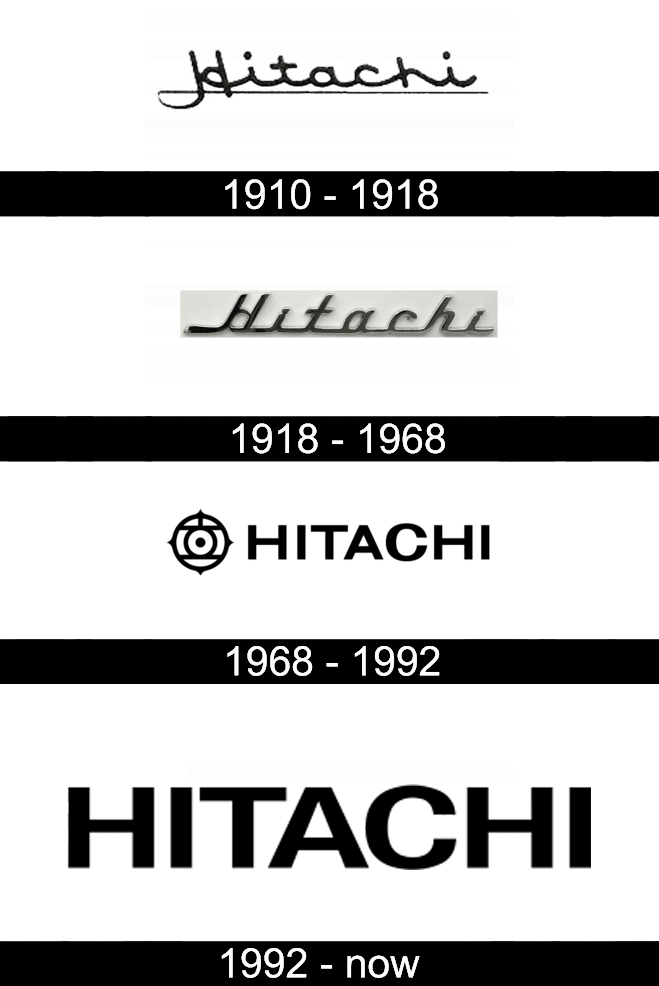
1910–1918: The Script of a New Beginning
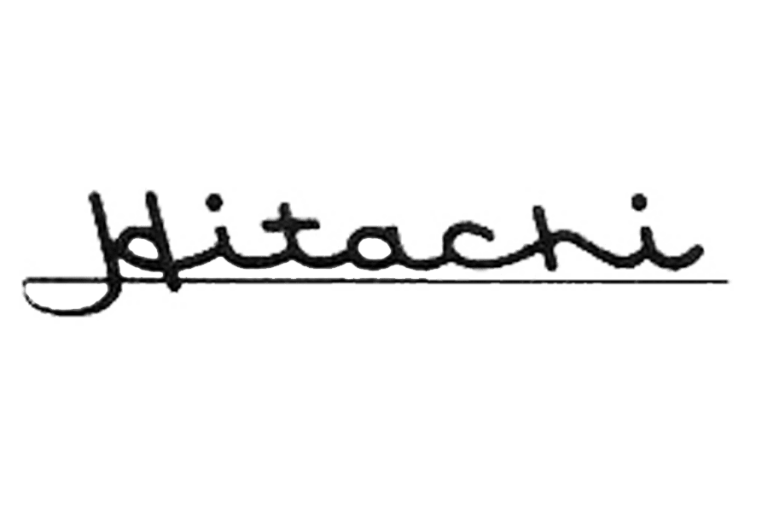
The earliest representation of the Hitachi name appeared in 1910 as an elegant handwritten script. Its black lettering leaned gently to the left, emphasizing motion and craftsmanship. All letters were connected in a single flowing stroke, and a thin underline supported the mark, recalling the graceful penmanship common in early Japanese industrial branding. This first signature expressed humility and careful workmanship, mirroring the small workshop that Odaira operated.
1918–1968: A Bolder Script for a Growing Industry
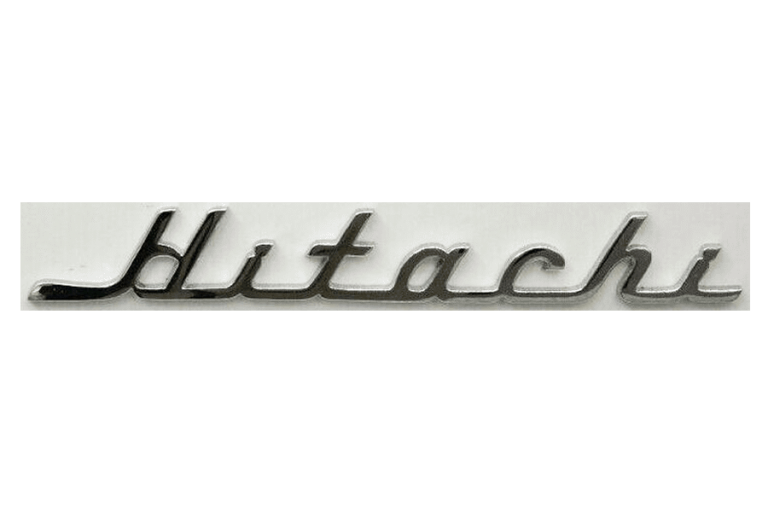
By 1918, the wordmark pivoted toward a more upright and stable form. The tilt was corrected, the letters were straightened, and the underline was removed. In its place, a single horizontal connecting stroke unified the base of the characters, giving the name a more architectural presence. This version marked Hitachi’s transition from a small electrical manufacturer into a rapidly industrializing company aligned with Japan’s expanding infrastructure needs.
1968–1992: The International Modernist Identity
Hitachi’s major leap onto the world stage came in 1968 with the development of a modern, international corporate logo. The handwritten script was replaced by a stark all-capital sans-serif wordmark, minimalist and geometric enough to be reproduced on machinery, electronics, and international exports. The emblem positioned beside the wordmark became its defining feature: a circular symbol resembling an abstract eye. Built from intersecting lines, the mark seemed to watch over the world—an early metaphor for the precision engineering and forward vision that defined Hitachi’s growing global presence. It balanced industrial clarity with subtle cultural character.

1992–Today: The Global Corporate Standard
The contemporary Hitachi logo retains the simplicity and authority of the 1968 version, refining it into a clean, bold, uppercase wordmark. Whether rendered in deep red or solid black, the letters sit firmly grounded against a white background. This visual restraint underscores Hitachi’s reputation for reliability and engineering excellence. Alongside the wordmark, the company introduced the corporate statement “Inspire the Next,” a quiet yet aspirational phrase rendered in gray, with a red accent over the “t” suggesting a spark of innovation. The overall composition merges discipline with creativity, a balance that has become synonymous with the brand’s philosophy.
Font & Typography
Typography has played a defining role in Hitachi’s identity. The geometric, all-capital letterforms used in the post-1968 logos resemble Helvetica 73 Bold Extended or Univers Bold, two typefaces known for precision, legibility, and industrial neutrality. Their clean forms give the name strength and clarity, while the extended proportions of the uppercase letters offer balance when paired with the iconic emblem. The typeface choice aligns with the brand’s engineering lineage: functional, dependable, and unembellished.
The “Inspire the Next” corporate statement introduces a softer tone with its rounded sans-serif design, creating a subtle contrast between historical strength and contemporary innovation.
Color Palette
Hitachi’s palette is rooted in classic corporate tones. Black is often used for its authority and neutrality, reinforcing the brand’s serious engineering heritage. Red appears frequently as a symbol of energy, dynamism, and Japanese identity. The combination of red and black on white surfaces conveys trust, precision, and technological confidence. Though minimal, this palette allows the Hitachi name to command presence across products ranging from industrial turbines to home appliances.
A Century of Rising Energy
Few global corporations maintain such deep continuity between their visual symbols and their founding philosophy. The Hitachi logo is more than a wordmark; it is a cultural artifact linking modern engineering with a symbol of Japan’s industrial awakening. From a hand-drawn signature in 1910 to the disciplined corporate identity of today, Hitachi has preserved the essence of its Rising Sun while continually adapting to global markets, new technologies, and evolving aesthetics.
As Hitachi moves further into digital infrastructure, renewable energy, and advanced electronics, its logo continues to embody the values that launched the company more than a century ago: innovation, integrity, and the quiet power of good engineering.
FAQ — Hitachi Logo: History, Meaning & Design
What does the Hitachi logo represent?
The Hitachi logo represents the Japanese concept of the “Rising Sun,” expressed through two kanji characters placed inside a circle by founder Namihei Odaira in 1912. It symbolizes energy, progress, and technological optimism.
Why is the Hitachi emblem circular?
Odaira chose the circle because it represents completeness, unity, and harmony. The form also resembles a traditional Japanese seal, reinforcing craftsmanship and authenticity.
When did Hitachi adopt its modern wordmark?
The modern international wordmark was introduced in 1968, marking Hitachi’s expansion into global markets and its transition into a modern industrial giant.
What font does the Hitachi logo use?
The lettering resembles Helvetica 73 Bold Extended or Univers Bold, chosen for clarity, reliability, and adaptability across products and global markets.
Why are Hitachi’s colors red and black?
Black communicates precision and authority, while red symbolizes energy and Japanese cultural identity. Together, they form a timeless and highly recognizable palette.