3M Logo History: Meaning, Symbolism & Brand Heritage
Few corporate emblems have traveled such a long, complex, and transformative path as the logo of 3M. What began in 1902 as a small mining venture in Minnesota would—over the course of more than a century—become one of the most diversified and innovative conglomerates in the world. From health care to consumer goods, from engineering solutions to everyday stationery, the name “3M” has become synonymous with invention, reliability, and practical design.
The visual identity of the company mirrors that evolution. The 3M logo has shifted from highly ornate early symbols to extreme minimalism, eventually arriving at one of the most recognizable wordmarks of the modern era: the bold scarlet 3M, fused into a single block of industrial certainty. And yet, behind this simplicity lies a long heritage of experimentation, aesthetic refinement, and evolving corporate values.
Meaning & Symbolism: The Power Behind Three Characters
The company’s original name, Minnesota Mining and Manufacturing Company, generated the abbreviated form “3M” or “MMM”, which soon became far more iconic than the full title. Beyond its literal meaning, the symbol of 3M captures an identity built on ingenuity and transformation. It represents a brand that continuously shifts across industries, adapting to new technologies while maintaining a unified visual voice.
Over the decades, the logo has embodied different values. In the 1900s, ornate seals and heraldic frames conveyed tradition and craftsmanship. By the 1930s, minimalism and industrial clarity reflected efficiency and progress. Later, the use of red brought boldness, energy, and universal recognizability — the unmistakable stamp of a global innovation leader.
The modern 3M symbol is entirely typographic, yet its simplicity expresses the very heart of the brand: clarity, reliability, and technological purpose. A logo so minimal can only belong to a company confident enough to be understood instantly.
Logo History and Evolution Timeline
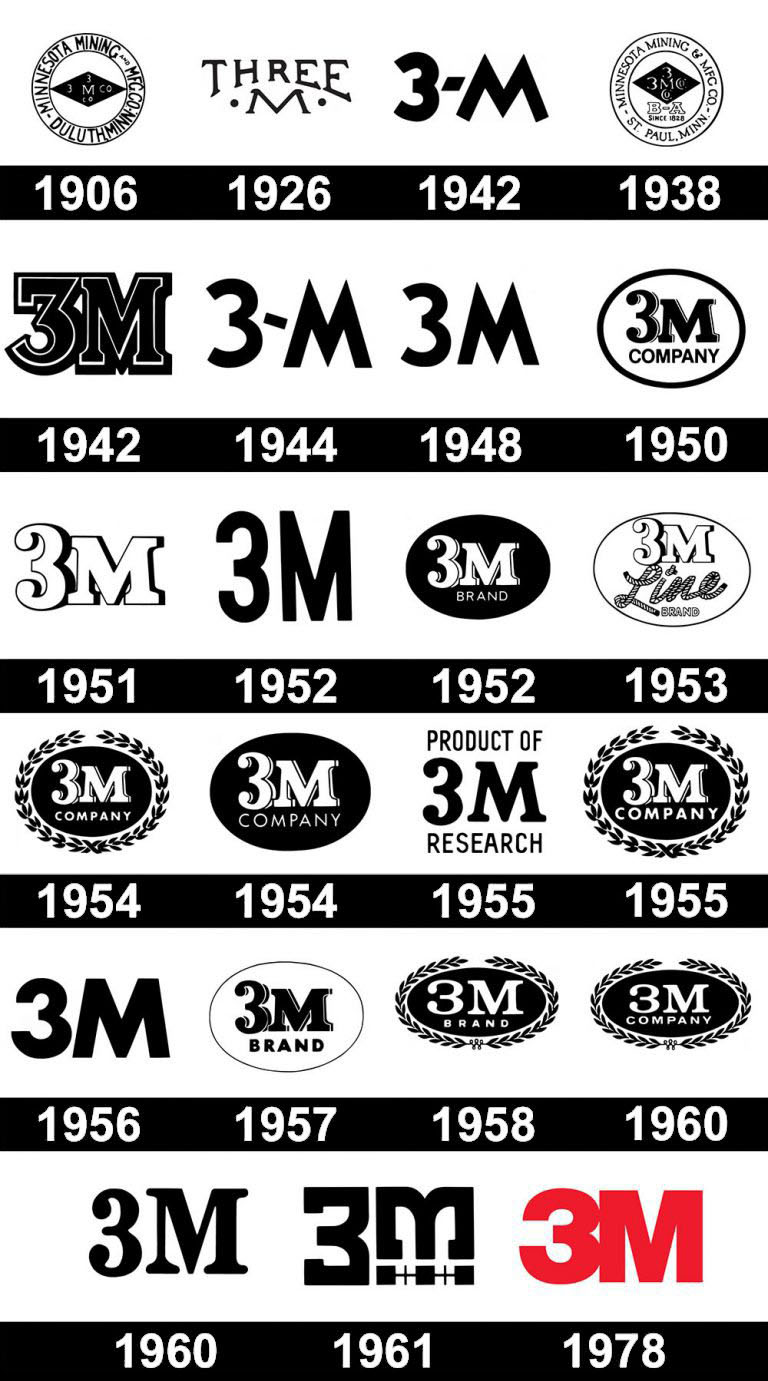
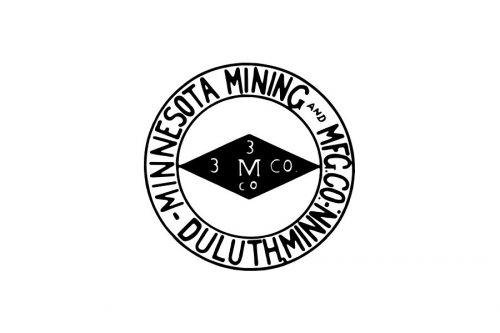
1906–1938: Ornamental Heritage and Industrial Refinement
The earliest recognizable emblem — a black rhombus with the inscription “3 M Co” — was enclosed in a decorative double circle bearing the company’s full name. This mark reflected the conventions of early-20th-century industrial labels, where ornamentation and formal framing conveyed authority and craftsmanship.
1926–1938: The Emergence of Simplicity
Two notable variations appeared during this period. One displayed the words “Three M” in a stylized inscription, while another reinterpreted the original rhombus in a lighter palette. Both versions attempted to modernize the brand while preserving familiarity, signaling the early desire to streamline the visual identity.
1937–1942: A Revolutionary Minimalist Break
The 1937 redesign marked a radical departure. The logo became simply “3-M”, presented in bold black with a minimal dash. In an era dominated by ornate trademarks, this stripped-down emblem looked shockingly modern — almost futuristic. It set the foundation for all future iterations.
1938–1942: Two Parallel Identities
While the minimalist wordmark gained traction, the company simultaneously kept a serif version of the earlier emblem. This dual branding showcased a company in transition: one foot in tradition, the other firmly stepping toward modern industrial aesthetics.
1942–1948: Serif Experimentation
The early 1940s brought refinement in the form of heavier serif lettering outlined in white. This bold, upright mark conveyed strength during wartime and aligned with the firm’s expanding production capabilities.
1944–1948: The Return of the Futuristic Dash
By 1944, the logotype returned to the sleek “3-M” of 1938, this time with a lighter diagonal dash. Clean, crisp, and instantly recognizable, it demonstrated the company’s preference for clarity above ornament.
1948–1950: Stripping Down the Elements
The dash disappeared completely in 1948. What remained was a purer, more self-contained logotype, with refined proportions and improved legibility.
1950–1951: The Framed Identity
The company began using an oval badge containing the inscription “3M Company.” The serif typography of “3M” contrasted against the simpler sans-serif “Company” beneath it. This marked a brief return to framing devices and more elaborate layouts.
1951–1954: Competing Design Philosophies
During these years, 3M used multiple logos simultaneously — some serif, some sans-serif, some placed in ovals. It was a transitional era marked by experimentation and brand exploration, reflecting a company growing so rapidly that its visual identity struggled to keep pace.
1952–1954: A Battle Between Complexity and Simplicity
From stark minimalist versions to cluttered iterations with shadows, decorative scripts, and even rope flourishes, these years saw dramatic oscillation in design. Laurel wreaths appeared and disappeared, as did ornate typography. This turbulent period highlights how difficult it was for 3M to settle on a definitive identity.
1956–1957: A Return to Rational Minimalism
For a short period, the company revived the simple “3M” logotype, executed with heavier strokes for better visual balance. This was one of the clearest stepping stones toward the modern mark.
1958–1960: Ornamental Persistence
Despite pushes toward minimalism, management continued experimenting with laurel wreaths and oval badges — traditional motifs that emphasized prestige but clashed with 3M’s increasingly modern spirit.
1960–1961: Nearing the Modern Era
A sophisticated serif “3M” appeared briefly, signaling another attempt to refine the brand with restraint and typographic intelligence.
1961–1978: The Gerald Stahl Masterpiece
Designed by Gerald Stahl Associates, this custom “3M” was a breakthrough. With mirrored geometry between the “3” and “M,” flat tops and bottoms, and a robust industrial presence, this wordmark finally harmonized minimalism with brand personality. For the first time, the logo felt truly timeless.
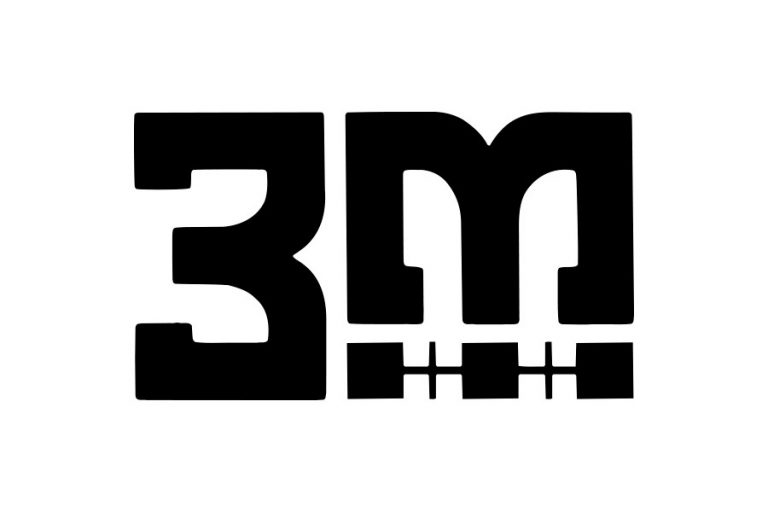
1978–Today: The Siegel+Gale Scarlet Wordmark
The definitive 3M logo was introduced in 1978 by Siegel+Gale. Using the extra-bold forms of Helvetica, the characters were “glued” together into a compact red block — powerful, confident, unmistakable.
Its shift to scarlet red marked a final step into modern corporate identity. This color, energetic yet authoritative, aligned perfectly with 3M’s ethos of innovation and global reach. For more than four decades, this version has remained untouched — a testament to its enduring strength.
Font & Typography: Industrial Precision in Letterform
The current 3M logo uses an extra-bold adaptation of Helvetica, one of the most influential sans-serif typefaces of the 20th century. The compact spacing and fused forms create a sense of solidity and cohesion, while the geometric consistency of the “3” and “M” gives the emblem a near-monolithic presence.
Earlier logos experimented with everything from ornamental serif fonts to mid-century grotesques and custom industrial designs. But Helvetica’s neutrality and strength ultimately captured the brand’s essence: clarity, innovation, and universal applicability.
Color Palette: Red as an Expression of Energy
The dominant color of the modern logo is scarlet red — a strategic, expressive choice. Red communicates:
• energy and innovation
• confidence and reliability
• strength and industrial power
It also ensures immediate recognition across packaging, signage, and digital media. Historically, the brand worked in black and white, but red injected modernity and boldness at a turning point in 3M’s evolution.
How 3M Built One of the Strongest Wordmarks in Corporate History
The evolution of the 3M logo is not simply a timeline of graphic redesigns — it is a visual biography of a corporation that constantly reinvents itself while staying true to its core principles. From ornate industrial seals to ultra-minimalist modernism, the brand refined its identity until only the essential remained. Today, the scarlet 3M stands as one of the most efficient and powerful wordmarks in global industry — a symbol of innovation, trust, and unrelenting progress.
3M Logo FAQ
What does the 3M logo stand for?
It represents the abbreviation of the original company name, Minnesota Mining and Manufacturing Company, while symbolizing innovation, industrial excellence, and modern minimalism.
Why is the 3M logo red?
Red conveys strength, energy, and confidence. It also ensures high visibility in global markets, supporting 3M’s identity as an innovation-driven leader.
When was the current 3M logo created?
The iconic scarlet Helvetica logotype was introduced in 1978 by Siegel+Gale and has remained unchanged ever since.
What font is used in the 3M logo?
A customized, ultra-bold version of Helvetica, modified for compact spacing and fused letterforms.
How has the 3M logo changed over time?
It evolved from ornate industrial seals in the early 1900s to streamlined geometric wordmarks, finally settling on its modern minimalist form.